The U.S. airline industry has seen significant consolidation in recent decades, culminating this year with Spirit Airlines joining a long list of carriers that have ceased operations, including former household names like Continental Airlines, Northwest Airlines, and US Airways. Today, the four largest airlines collectively command approximately three-quarters of the U.S. market, prompting a contentious debate over whether this consolidation benefits the flying public.
Industry advocates, such as Chris Sununu, the former governor of New Hampshire and current head of the trade group Airlines for America, assert that competition is thriving. Speaking at a Capitol Hill hearing last month, Sununu claimed, “We have more competition per route than ever before.” He cited the example of “four or five or six carriers going from Wichita to Dallas,” all competing on the same route.
However, this example from Wichita, Kansas, has drawn skepticism. Rachel Mayberry, the air service and marketing manager for Wichita Dwight D. Eisenhower National Airport, clarified that while six airlines serve the airport, only American Airlines offers a nonstop flight to Dallas. “If you want a direct flight from Wichita to Dallas, it’s only American Airlines,” Mayberry stated. She added that most people, including herself, would likely opt to drive the 360 miles to Dallas rather than endure a connecting flight through cities like Denver, Houston, or Chicago. Mayberry noted that for smaller airports like Wichita, the majority of flights are typically from a single carrier to a single nonstop destination, making the industry’s claim of increased competition feel disconnected from local reality.
While airlines maintain that a healthy level of competition exists when considering connecting flights through their extensive hub networks, critics argue that the current level of consolidation is unprecedented and ultimately detrimental to consumers. Ganesh Sitaraman, a professor at Vanderbilt Law School and author of *Why Flying Is Miserable and How to Fix It*, explained the airlines’ perspective: “From the airlines’ perspective, it makes sense. Bigger is better, and it’ll be more efficient for them, even if there’s a lot of drawbacks for communities and passengers.”
Sitaraman traces many of the current issues in air travel, including the emergence of megahub airports, back to the industry’s deregulation in the late 1970s. He described the passenger experience at these crowded hubs as “disorienting and frustrating,” noting that connecting flights can often involve “running a half-marathon from one side of the airport to the other, just to see the door close before your flight.” Airlines have structured their businesses around hubs since at least the 1980s, citing their ability to reduce costs by centralizing operations and maintenance, while also providing access to a vast network of destinations.
The industry views deregulation positively, arguing that it has fostered competition, leading to a significant plunge in average fares since the 1970s when adjusted for inflation. Sununu highlighted this point to lawmakers, stating that in the late ’70s, flying was primarily for “rich white people,” whereas “today, almost any American, through a variety of different ways, can afford to fly from Point A to Point B.”
Conversely, critics contend that fares could be even lower if airlines competed more directly. Marc Remer, an economics professor at Swarthmore College and a former research economist in the antitrust division at the Department of Justice, where he analyzed airline mergers, pointed to data showing “not much competition between nonstop routes.” He described most routes as effectively a “monopoly or duopoly.” Remer also observed a shrinking number of hubs, with airlines increasingly routing flights through what are known as “fortress hubs,” where one airline controls over 70% of flights. “The hubs have become hubbier, in some sense,” Remer explained, adding that this creates “fewer overlap routes between the airlines,” which in turn reduces competition and grants airlines greater market power.
The current situation at Wichita’s Eisenhower National Airport reflects this trend, with only a few routes served by more than one airline and no nonstop flights to major cities like New York or Los Angeles. This stands in stark contrast to the airport’s peak in the 1940s, when, according to the Kansas Aviation Museum, dozens of planes regularly flew coast-to-coast.
When NPR inquired about the choice of Wichita and Dallas as a success story, John Heimlich, chief economist for Airlines for America, conceded in an interview that “It was probably not the best choice of examples for routes.” However, Heimlich disputes the notion that there is less competition in the airline industry overall. He argues that the largest markets now boast more competitors per route and more nonstop flights than they did 20 or 30 years ago. Heimlich also emphasized the strategic importance of megahubs in enabling airlines to serve a broader network of destinations. “You are never going to have a nonstop flight between Wichita and Tokyo,” Heimlich said, “But if you have nonstop flights to Dallas and Denver and Chicago, then guess what? You suddenly have one stop to a lot of places in the world.”
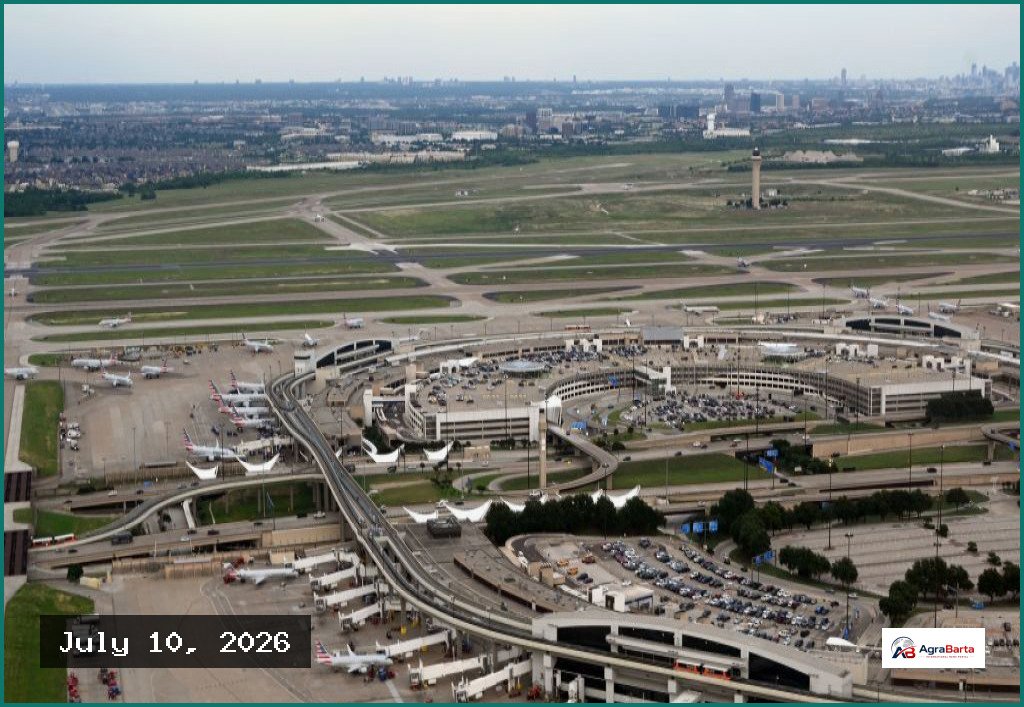
American Airlines is the dominant carrier at Dallas Fort Worth International Airport. Daniel Slim/AFP via Getty Images hide caption
American Airlines is currently the only carrier that flies nonstop between Wichita, Kan., and Dallas. Andrew Caballero-Reynolds/AFP via Getty Images hide caption