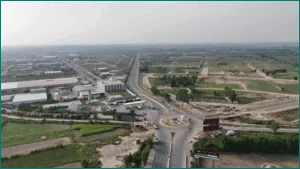
Allama Iqbal Industrial City (AIIC), the premier Special Economic Zone under the China-Pakistan Economic Corridor (CPEC), is facing significant operational hurdles. Despite attracting over 327 billion rupees ($1.2 billion) in committed investments and allocating 223 of its 424 planned plots, a recent field survey reveals that fundamental infrastructure remains severely underdeveloped. The 3,966-acre zone, located along the M-4 Motorway and administered by the Faisalabad Industrial Estate Development & Management Company (FIEDMC), currently lacks the basic utilities and logistics required to support its growing list of tenants.
The diagnostic survey, which included FIEDMC management and four operating firms, highlights a lack of a zone-wide piped water network, forcing companies to rely on self-bored wells. Furthermore, sewerage systems are still under construction, and there is no funded Combined Effluent Treatment Plant (CETP) to manage industrial waste. Senior officials at FIEDMC, including 1-5 managers for engineering, estate, and land, identified utility reliability and the establishment of a CETP as the most urgent reforms needed to sustain the zone.
Tenant firms expressed similar frustration regarding the current state of the facility. Ocean Ceramics, a wall-tile manufacturer that has operated in the zone since 2022 with 230 employees, reported that poor mobile signal and internet coverage hinder digital customs filings and coordination with international buyers. The firm also noted a lack of local public transport for its workforce. A China-Pakistan steel joint venture, which began operations in 2024 with 88 employees, echoed concerns regarding the quality of shared infrastructure, specifically rating the zone's effluent-treatment and testing facilities as only average. Of the 4 companies surveyed, 3 reported no supply or sourcing relationships with any other AIIC tenant, describing themselves as operating as stand-alone units rather than integrated partners.
Customs facilitation emerged as a primary barrier to export growth. The survey found that AIIC lacks on-site warehousing, logistics, and customs facilities, which officials acknowledge exacerbates delays for exporters. Since its 2020 notification, the zone has attracted 117 investors, drawing 147 billion rupees in foreign capital and 180.53 billion rupees in domestic investment—figures consistent with the more than $1 billion in commitments publicly reported by Pakistan’s Board of Investment. This lack of integration extends to the tenant base itself; only 1 firm, Matco Foods, a food-processing exporter, reported sourcing materials from another tenant within the zone.
While the zone has attracted 117 investors from countries including Switzerland, Germany, the Netherlands, Canada, and China, the lack of systematic data tracking remains a concern. FIEDMC’s records regarding firm-level export performance, including destination markets and export values, remain largely incomplete. With FIEDMC leadership now prioritizing streamlined customs, worker transport, and utility upgrades, the findings underscore an urgent need to transition from simply securing investment to creating a fully functional, export-ready manufacturing hub.
You have reached the limit of 2 free articles this month.
Among the zone officials surveyed, customs facilitation ranked as the most serious barrier to exports at the AIIC – ahead even of energy costs, which firms described as “costly” rather than simply scarce. The survey found that AIIC currently has no on-site warehousing, logistics, or customs facilities of any kind – all three were explicitly marked “not included” in the zone’s own infrastructure assessment.