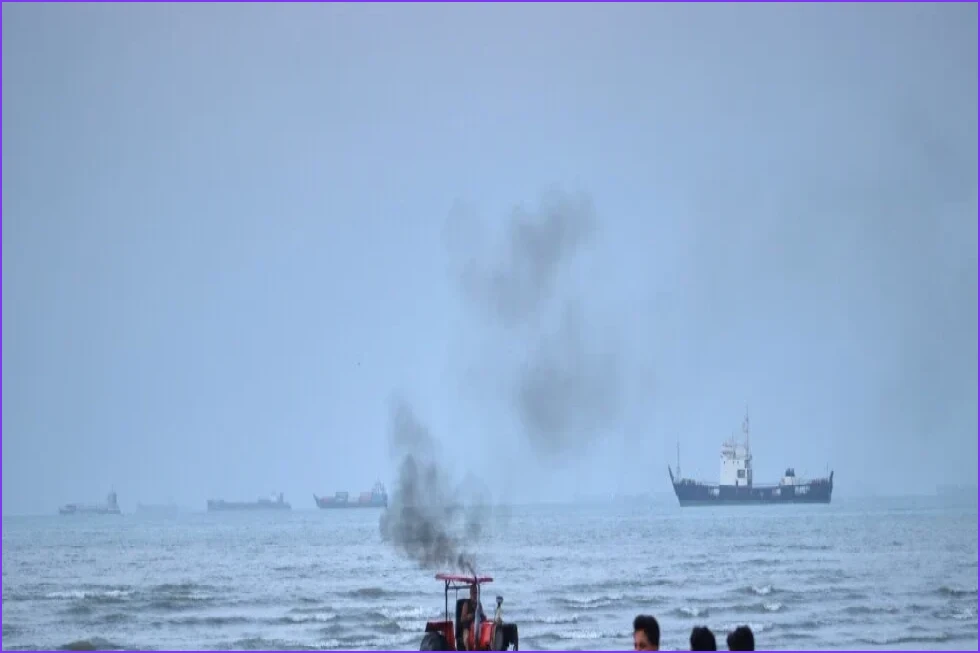
President Donald Trump on Monday publicly scoffed at demands from Iran seeking reparations for the destruction caused by U.S. and Israeli bombardment over the past five months. Trump stated that these demands had not been previously raised by Tehran’s negotiators. The President’s response, delivered via social media, followed comments from Iranian Foreign Ministry spokesperson Esmail Baghaei, who insisted that Iran would maintain its closure of the Strait of Hormuz until specific conditions are met. Tehran is calling for the U.S. to lift its blockade of Iranian ports, remove economic sanctions, and release Iran’s frozen assets. Baghaei emphasized that it remains the responsibility of the U.S. to cease what he described as illegal and destructive actions.
In his rebuttal, Trump countered by demanding compensation from Iran for the lives of Americans lost or wounded in various conflicts and roadside bombings involving Iran-backed militants over several decades. He specifically cited the 1983 bombing that killed 241 U.S. military personnel at a Marine compound in Beirut and the deaths of at least 603 U.S. troops in Iraq between 2003 and 2011. Trump further stated he expects Tehran to provide compensation to the families of Iranian protesters killed during domestic unrest, noting he has instructed his representatives to include these demands in all future negotiations.
The ongoing closure of the Strait of Hormuz, a critical maritime passage that previously handled roughly one-fifth of global oil supplies, remains a significant concern for U.S. politics ahead of the November midterm elections. Amid these pressures, Iranian President Masoud Pezeshkian reported on a seven-hour meeting with the new supreme leader, Ayatollah Mojtaba Khamenei. In an interview with Iranian state television, Pezeshkian stated that the discussions focused on people’s livelihoods, the state of the market, employment, housing, and the problems created by U.S. sanctions. He noted that the supreme leader placed a primary emphasis on national unity to counter division. This meeting marks only the second between the two leaders since Khamenei assumed his role in March following a U.S.-Israeli strike that killed his father. Khamenei, who is believed to have been wounded in that same attack, has not appeared in public since.
Changes in leadership have also occurred, with Iran appointing Mohsen Rezaei, a 71-year-old military adviser and former commander of the paramilitary Revolutionary Guard, to head the Supreme National Security Council. Rezaei, who commanded the Guard from 1981 to 1997, replaces Mohammad Bagher Zolghadr, who will transition to a political adviser role for Khamenei. Last week, Rezaei threatened U.S. forces with serious risks and casualties if the blockade of Iranian ports is not lifted. According to the U.S.-based Institute for the Study of War, while Rezaei appears willing to negotiate to secure Iran’s maximalist aims, including control of the Strait of Hormuz, he has shown an unwillingness to present any Iranian concessions.
Broader regional instability continues to unfold. In Yemen, Iranian-backed Houthi rebels attacked a government-held port on the Red Sea on Sunday, killing seven people—four military personnel and three civilians—and injuring 30 others. A Houthi spokesperson claimed the attack was a response to Saudi drones breaching Yemeni airspace. Clashes also persisted near the village of Taiz, where the Houthi group reported that a 13-year-old child was killed by artillery shelling and another child was injured. Meanwhile, Yemen’s military has launched attacks against the Houthi rebels in response to the strikes, threatening to reignite the civil war.
In the occupied West Bank, the Israeli military declared the Christian-majority town of Taybeh a closed military zone to prevent Israeli settlers and other non-residents from entering. The army stated this tactic is designed to stop arson, vandalism, and settlers from encroaching on private property. Palestinian residents and journalists will be allowed entry unless soldiers determine their presence poses a threat. This designation follows months of unrest in the territory, where at least 87 Palestinians have been killed by Israeli settlers or soldiers in 2026, according to the Ramallah-based Palestinian Health Ministry. In Gaza, the human cost of the conflict was highlighted by the return of displaced residents, such as beekeeper Niveen al-Ashkar, to Jabalia, where she found her home reduced to rubble and debris, yet discovered a swarm of bees emerging from a crack in the ruins.