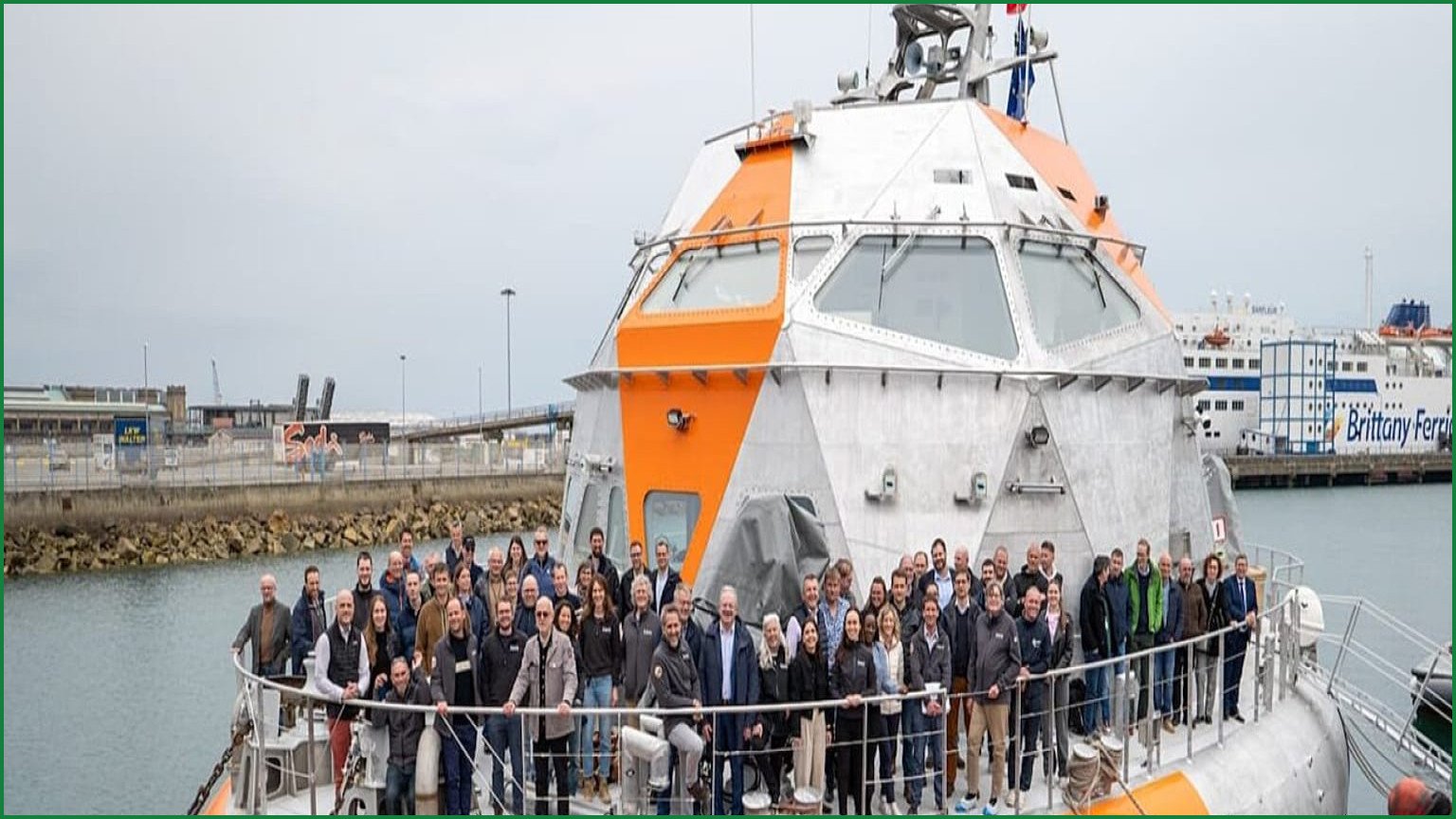
The Tara Polar Station, a unique scientific research vessel engineered to drift alongside sea ice, departed from the port of Lorient this past Sunday. The launch of its inaugural expedition to the North Pole drew a large crowd to the quays, with the Minister for the Sea, Catherine Chabaud, in attendance to witness the vessel's departure.
Designed as a floating saucer resembling an igloo mounted on a massive buoy, the station is built to endure extreme conditions, including temperatures as low as −52 °C and the immense pressure exerted by sea ice. The crew’s objective on board the floating saucer is to gain a better understanding of the biodiversity of the Arctic Ocean and the effects of global warming in this region, which is heating up three to four times faster than the rest of the planet and where the sea ice is retreating at a rapid pace. The mission, which carries an estimated cost of 6 million euros, represents the first of ten planned expeditions scheduled to take place every two years between 2026 and 2045.
The primary objective of the crew is to investigate Arctic biodiversity and the accelerating impacts of global warming in the region. Scientists note that the Arctic is currently heating up three to four times faster than the rest of the planet, leading to a rapid retreat of sea ice. International cooperation is central to the project, with participants from twelve countries, including the United States, Canada, Germany, Spain, Switzerland, and Japan.
The vessel's journey is carefully planned: from mid-August, it will navigate the Russian coast accompanied by an icebreaker. By early September, the station is expected to be captured by the pack ice, where it will drift for 350 to 500 days at an average speed of ten kilometres per day. The drift is intended to carry the station toward the Fram Strait, located between Greenland and Svalbard, with an anticipated arrival at the end of 2027.
Life on board will be managed by a rotating crew of twelve during the winter months and eighteen during the summer. To prepare for the harsh environment, which includes five months of polar night and average temperatures around −25 °C, all members underwent rigorous medical and psychological testing, as well as team-building exercises. Because of the risk posed by polar bears, the crew has been trained to use firearms, and a Lapponian herder dog will be present to detect approaching wildlife.
Scientific operations will utilize state-of-the-art instruments and a central well to collect over 10,000 samples from the atmosphere, sea ice cavities, and the water column at depths reaching 2,000 metres. Researchers aim to gather critical data on largely unknown Arctic biodiversity and improve climate models. Several programmes will also help to improve climate models, in particular by studying the role of bacteria in the reflectivity of clouds.
Shaped like an igloo set on an immense buoy, the Tara Polar Stationhas been designed to withstand the pressure of the sea ice and temperatures as low as −52 °C.
Thanks to a well built at the heart of the station and state-of-the-art scientific instruments, researchers will take more than 10,000 samples from the water column, down to a depth of 2,000 metres, as well as from the atmosphere and cavities within the sea ice.