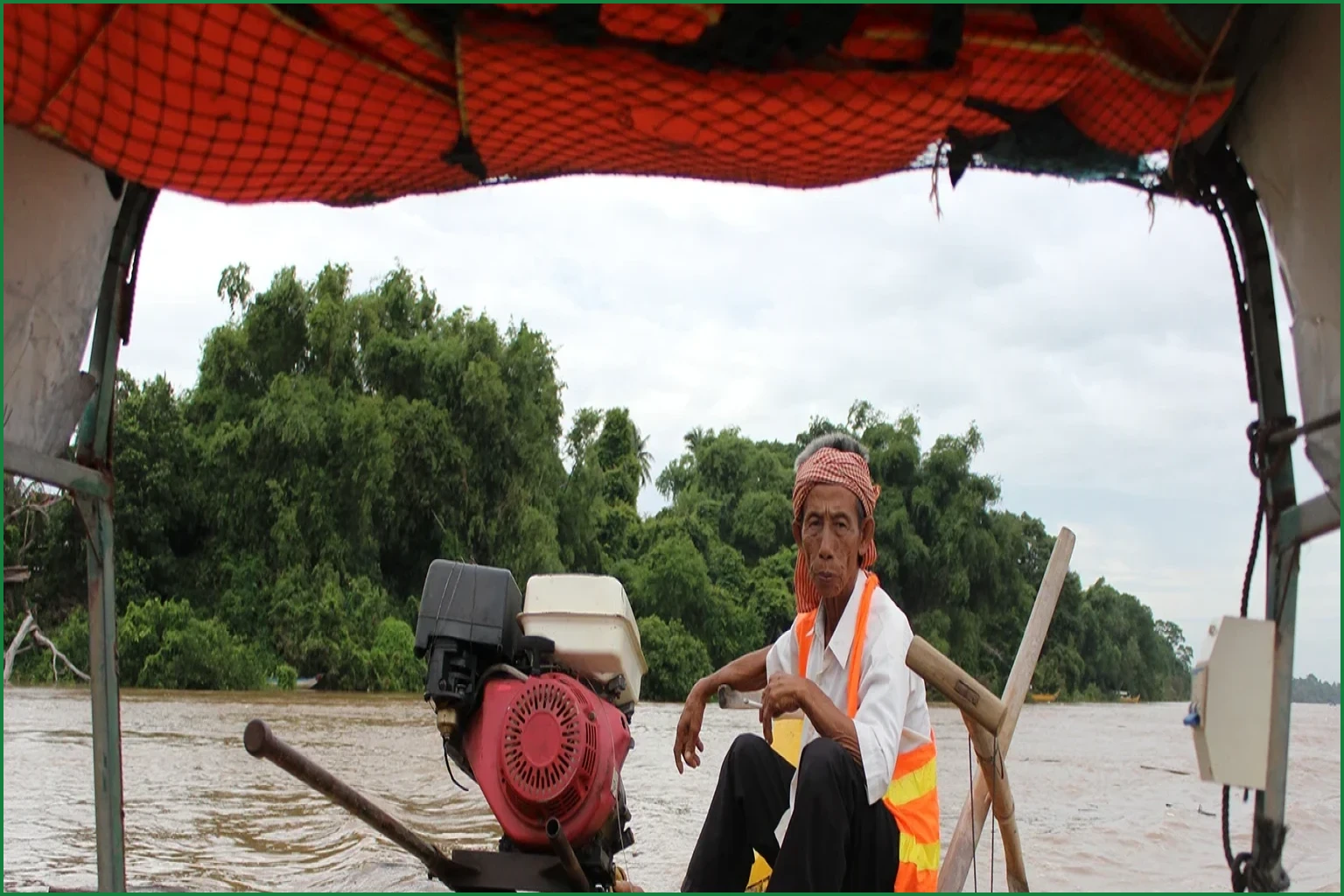
At nine in the morning, the sun beats down on the Mekong River as Heang Koeurn turns off the motor of his boat and bobs on the water. He has performed this routine every morning for 11 years, leaning forward with his elbows on his knees, eyes scanning the surface for the gray curve of an Irrawaddy dolphin. Finally, he spots the river’s sole cetaceans. Just meters away, a boat carries about half a dozen foreign tourists who squint and point at the dorsal fins of a group of Irrawaddy dolphins (Orcaella brevirostris) as they crest above the water. Around half a dozen tourists wait quietly aboard a boat, squinting and pointing at where they see a group of dolphins surface for breath above the reflected sunlight. Photo by Eung Sea for Mongabay.
“Irrawaddy dolphins are very important for our community,” Koeurn says, drifting his boat slowly. “People here can make more income from tourists by driving them to see the beauty of Irrawaddy dolphins.” However, the Mekong River, a lifeline for millions across Southeast Asia, is in an ecological crisis, threatening the survival of these dolphins and the livelihoods of communities along the river. The Kampi pool, a 60-meter-deep stretch of the river in Cambodia’s Kratie province, is one of three deep pools that are home to the Mekong’s last surviving population of Irrawaddy dolphins. The population has collapsed from an estimated 200 individuals in the late 1990s to a little over 100 today, with losses driven by hunting, bycatch in gillnets, and habitat degradation. The species has already been lost in most of its historic range, which once spanned the Mekong Delta, the Tonle Sap Lake, and the Mekong’s tributaries.
Ian Baird, a professor of geography at the University of Wisconsin-Madison, emphasizes the dolphins' value. “Dolphins are important for various reasons,” he says. “They have economic value related to tourism. They also have value in relation to cultural and environmental heritage. They are a source of Cambodian national and local pride. They may also inspire people to protect the river and its tributaries from the impacts of more dams in the future.” Irrawaddy dolphins are regarded as sacred in both Laos and Cambodia, with communities seeing them as representing the ancestral spirit of the river. Despite this, the species remains at risk. “The main threats are gillnets and electrofishing. Many people in our community are aware of the importance of conservation but people from other places tend to intrude into our community fishing grounds to commit these crimes,” Koeurn says.
The proliferation of dams has also changed the river’s ecology. There are more than 160 operational dams along the Mekong and its tributaries, including 13 on the mainstream. Baird notes that while upstream dams are not known to kill the dolphins directly, they alter the river’s hydrology, degrading seasonally flooded forests and changing the fish communities the dolphins depend on for food. Veang Tino, a patroller based at the Kampi Conservation Centre, attributes the decline in the dolphin population to electrofishing and accidental entanglement in gillnets set by illegal fishers in core habitat zones. Photo by Eung Sea for Mongabay. Tino explains that calves are particularly vulnerable, often dying when their mothers become trapped or when they stray into nets themselves.
Electrofishing is banned throughout Cambodia, but gillnets are only prohibited within protected core habitat zones along a 180-kilometer stretch of the river in Kratie and Stung Treng provinces, established in 2012. That same year, the fisheries department employed 72 river guards to patrol the area. By 2025, the Ministry of Land Management designated the habitat as state land. Officials say law enforcement has improved but remains uneven. In 2022 alone, about 36,000 meters of gillnets, 7,000 fishing hook nets, and 500 meters of mesh fishing nets were confiscated and destroyed in the protected zones. “We cannot leave Irrawaddy dolphins behind as they are the Mekong River’s ecological treasure. The use of gillnets is the main threat to them. That is why conservation efforts must be enforced to combat the illegal fishing methods,” Tino says. “We need everyone, from the local community themselves to the government, working in tandem with each other to conserve Irrawaddy dolphins. Law enforcement does not have full capacity to address these issues.”
Patrollers are generally concentrated around the Kampi pool, following the dolphins’ behavior, but illegal fishers observe and adapt to these patterns. At the Kampi river guard station, a sparse building adorned with faded maps and fish identification posters, patroller Kem Sophat says guards face physical risks when confronting illegal fishers, who sometimes carry weapons. Sophat also notes the low income, with guards earning $5-$7.50 per day while using their own boats and paying for their own meals. “It is quite far from where we are based to do patrolling. The income is small, but it is out of the goodness of our hearts we keep doing this job because we specialize in patrolling,” Sophat says.
Frances Gulland, chair of the U.S.-based Marine Mammal Commission, notes the intrinsic loss. “We lose them, we lose a species, another species lost from the earth, which is like losing a star from the sky,” she says. The cost of failure is evident at the Anlong Chheu Teal dolphin pool, which straddles the Laos-Cambodia border and lost its last Irrawaddy dolphin in 2022. “Before, we didn’t have enough boats to drive to see Irrawaddy dolphins and Mekong treasures like the flooded forest, when there were still Irrawaddy dolphins, and the ecotourism was well organized,” says Phoy Vanna, community leader of Anlong Chheu Teal. The last dolphin, a male named “the lonely dolphin,” died on Feb. 15, 2022, after entanglement in illegal gear. Vanna points to fluctuating water levels caused by dam construction and climate change as a major threat. The Don Sahong Dam, located less than 2 kilometers from the border in southern Laos, has been operating since 2020 and is a critical gateway for fish migration. “When all the dolphins died, only about 40 percent of tourists still came to see the tree roots, the waterfall, and other sites along the river,” one boat driver says. “Things are changing for the worse. It’s hard to make a living.”
However, by late June, conservationists confirmed at least six calves born this year along the 120-kilometer stretch of the Mekong in Kratie and Stung Treng provinces, lifting the estimated population to 118 individuals. I Sanaroth, Kampi fisheries chief, says this is a strong signal that the population is still reproducing. He notes that while gillnets are still used within protected zones, it is at a smaller scale. The work is supported by the Fisheries Administration and WWF-Cambodia. “The population of the Mekong Irrawaddy dolphins has increased due to joint conservation. Our work is not done. Authorities, with support from conservation groups, are stepping up patrols and prosecutions to hold illegal fishers accountable,” Sanaroth says. For now, in Kratie, the mornings still bring the same ritual: boats gliding out, engines cutting near feeding grounds, and the wait for a gray curve to break the surface.