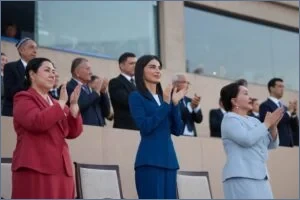
Saida Mirziyoyeva, the daughter of Uzbek President Shavkat Mirziyoyev, has added a significant new role to her portfolio. By presidential decree, she has been appointed as the manager of the Tashkent International Financial Center (TIFC). This appointment comes as she continues to serve as the head of the presidential administration.
The TIFC was initially proposed in a March 2026 decree as a strategic initiative to secure long-term foreign direct investment. The center is intended to host a diverse array of industries, including banking, insurance, investment services, digital assets, green technology, and Islamic finance, alongside professional fields like legal counsel and auditing. Following the signing of legislation in July 2026, the TIFC is set to operate under a distinct legal regime based on English law, featuring its own regulatory framework and an independent commercial court. This structure is designed to mitigate long-standing investor concerns by establishing a legal environment separate from standard Uzbek law.
To bolster its appeal, the TIFC offers substantial incentives to participants, including tax and customs breaks valid until 2076. Furthermore, entities within the center are permitted to utilize cryptocurrency or foreign currency for payments and can hire foreign personnel without the standard work permit requirements, while also benefiting from expedited visa options. Commenting on the legislative progress in July, Mirziyoyeva noted that the TIFC represents the result of nearly a decade of reform efforts, providing mechanisms that global investors and financial institutions expect.
As manager, Mirziyoyeva is tasked with coordinating the center’s launch, organizing its agenda, and presiding over meetings when the chairman—a role held by President Mirziyoyev—is absent. Her responsibilities include representing the TIFC to international partners and investors, establishing working groups, and engaging experts to conclude formal agreements.
This appointment occurs as Mirziyoyeva continues to consolidate significant authority. Since her appointment as head of the presidential administration in June 2025, she has functioned as the country's highest-ranking official after her father. A new law adopted in August 2026 granted her expanded powers over anti-corruption and judicial reforms, along with a seat on the Security Council and lifetime immunity. Observers have noted that this trend of family members holding high-level positions is also present in neighboring countries. Uzbekistan is not unique in turning to family to consolidate power. In neighboring Tajikistan, President Emomali Rahmon’s son, Rustam Emomali, holds a variety of important positions – he’s chairman of the National Assembly and also mayor of the capital, both posts he was appointed to by his father, in 2020 and 2017, respectively. As chairman of the National Assembly, Emomali is constitutionally next in line for the presidency, should his father resign or otherwise vacate the post. In Turkmenistan, Gurbanguly Berdimuhamedov passed the presidency on to his son Serdar in 2022 before government changed its structure to give the elder Berdimuhamedov a new position technically above that of the president. Nepotism may be politically comforting for those in power, but it is not necessarily comforting for investors.
You have reached the limit of 2 free articles this month.
Now she’s also in charge of Tashkent’s ambitious gambit to attract foreign investment.