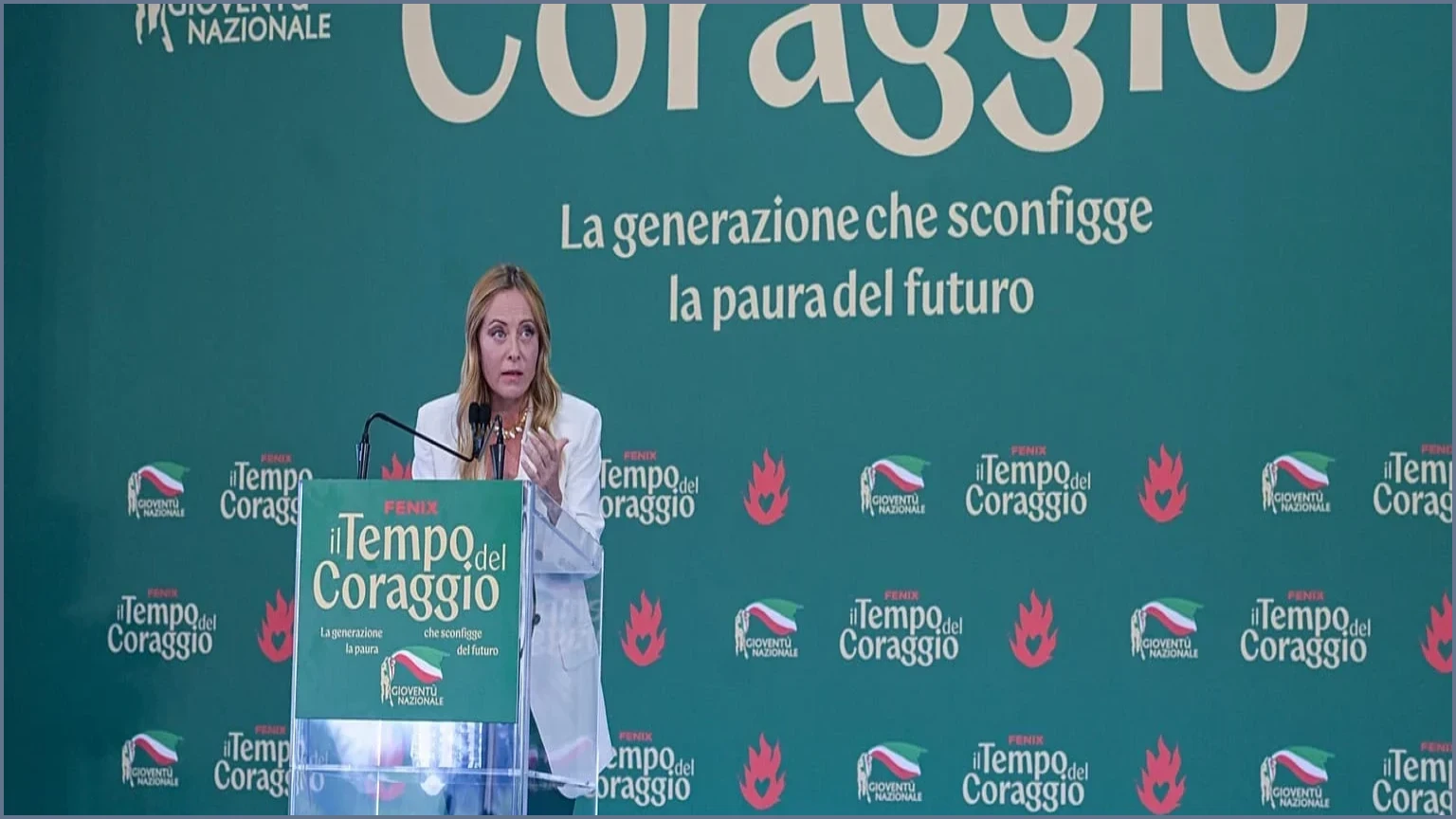
Italian Prime Minister Giorgia Meloni has announced that her government is drafting a bill to ban burqas and niqabs in schools and impose a statutory limit on the number of foreign pupils in each classroom. The proposed package of measures, which is expected to be presented to the Italian cabinet soon, also includes a requirement for the parents of students who face serious integration difficulties to learn the Italian language.
The announcement comes as Italy prepares for elections next year, amid intensifying political competition on the right. The entry of retired general Roberto Vannacci into the political arena, who has called for even stricter measures, has heightened the focus on migration, which remains a deeply divisive issue in the country.
Speaking at a rally organized by Gioventù Nazionale, the youth wing of her Brothers of Italy party, Meloni defended the proposals, stating that it is unacceptable for Italian children to feel pushed into a corner or become a minority in their own classrooms.
She dismissed current integration approaches as a convenient lie promoted by those who do not experience these issues firsthand.
If the proposed limit on foreign pupils becomes law, Italy would become the first European nation to establish a statutory maximum for foreign students per class. Currently, Italy has a non-binding 30% limit on non-Italian pupils, established in a 2010 ministerial circular by then-Education Minister Mariastella Gelmini. However, this guideline has frequently gone unenforced due to local demographic realities and a lack of flexibility, particularly in urban outskirts.
Other European nations handle classroom demographics differently. Denmark allows upper secondary schools to implement caps of up to 50% for students of "non-Western origin" or those from disadvantaged neighborhoods, and even permits class organization based on parental income to encourage social and ethnic mixing—a system the Italian government is reportedly studying.
In contrast, France deems origin-based quotas unconstitutional because the state does not collect data on ethnic or religious identity. Instead, French authorities use geographic zoning to link wealthier and working-class neighborhoods and reduce class sizes in areas with high concentrations of migrants.
Meloni's proposed ban specifically targets the burqa—which covers the entire body and uses a mesh over the eyes—and the niqab, which covers the face but leaves the eyes exposed. It does not apply to the hijab, which covers only the hair and neck. The announcement follows several legislative moves in Italy earlier this year. In August, Education and Merit Minister Giuseppe Valditara proposed targeting full-face veils through an amendment to a security bill.
In July, Futuro Nazionale, a party founded by far-right MEP Roberto Vannacci, tabled a resolution against full-face veils in the Chamber of Deputies' Culture Committee, which was approved with center-right votes after being redrafted at the government's request.
Additionally, the League party introduced a Senate bill in March to amend Article 5 of the 1975 Reale law, which originally banned face coverings in public during the Years of Lead. The League's amendment seeks to make forcing someone to conceal their face a crime punishable by one to two years in prison, fines of €10,000 to €30,000, and a ban on obtaining Italian citizenship.
Across Europe, policies on face coverings vary widely. France introduced a nationwide ban on face concealment in public in 2011, which was later upheld by the European Court of Human Rights. Belgium also enacted a nationwide ban in 2011, imposing fines and prison sentences. Bulgaria banned full-face veils in state, administrative, and educational institutions in 2016.
Austria passed an anti-mask law in 2017, and starting in September 2026, it will prohibit girls up to age 14 from wearing traditional Islamic head coverings at school. Denmark implemented a ban in 2018 with escalating fines, while the Netherlands introduced a partial ban in 2019 covering schools, hospitals, public transport, and government offices.
Switzerland enforced a federal ban in 2023 following a referendum, and Portugal completed legislation for a public ban in August 2026. Germany lacks a nationwide ban but restricts public employees, judges, soldiers, and drivers from covering their faces, with several states banning full-face veils in educational institutions. Conversely, countries like Spain and Poland protect freedom of conscience and religion through their constitutions.
The proposals have split Italian public opinion, drawing support from Meloni's governing coalition but facing sharp criticism from opposition politicians and legal scholars. Salvatore Curreri, a professor of constitutional law at the University of Enna, warned that the measure could violate Article 34 of the Italian Constitution, which guarantees that schools are open to everyone. Curreri argued that excessively restrictive measures that uproot families could conflict with the primary goal of integration and infringe upon constitutionally recognized rights.
Meanwhile, Angelo Bonelli, an MP for the Green and Left Alliance and co-spokesperson for Green Europe, accused Meloni of neglecting school functionality and chasing the far-right policies of Germany's AfD and Vannacci, who has previously proposed separate classes for disabled students. Bonelli noted that Italian teachers' salaries remain among the lowest in Europe.