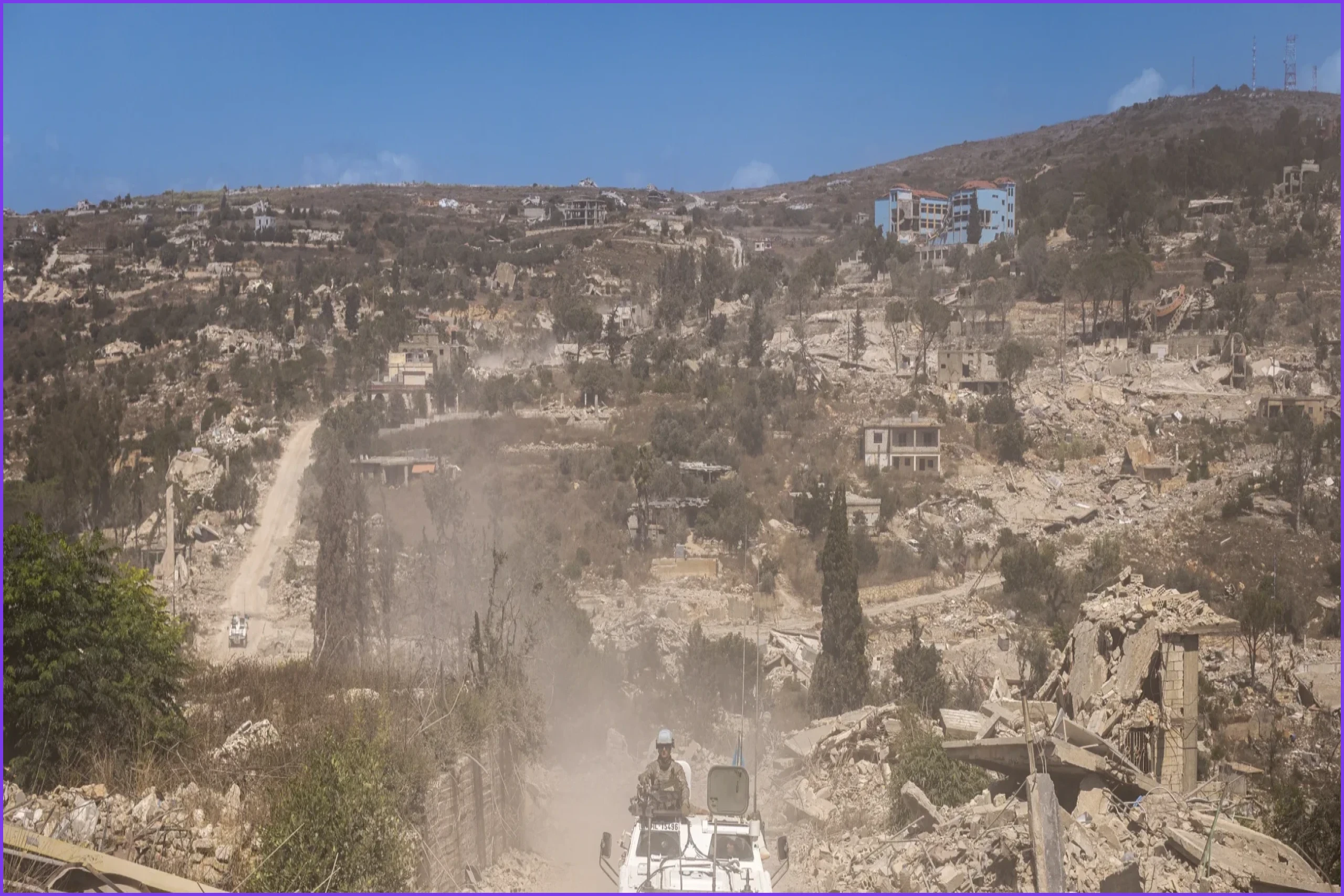
United Nations peacekeepers in southern Lebanon are navigating a profoundly transformed landscape, where a fragile, U.S.-brokered ceasefire has introduced new boundaries of military control even as the international peacekeeping mission prepares for an imminent departure. Armored vehicles belonging to the United Nations Interim Force in Lebanon (UNIFIL) move slowly along the de facto border, not because of difficult terrain or the immediate threat of shelling and drones, but because every mile requires peacekeepers to relearn a geography that has been completely reshaped by months of intense warfare.
UNIFIL has monitored this volatile border region since 1978, when the peacekeeping force was first established to verify the withdrawal of Israeli troops following Israel's first occupation of Lebanon. Over the decades, the mission's responsibilities grew. Twenty years ago, the United Nations expanded UNIFIL's mandate to include monitoring adherence to a ceasefire in the conflict between Israel and Hezbollah, the Iran-backed Lebanese militant group originally formed in 1982 to counter a second Israeli invasion. Now, nearly half a century after its inception, the peacekeeping force is nearing the end of its operations. Due to strong opposition from the United States and Israel at the U.N. Security Council, UNIFIL's mandate will expire at the end of the year, on December 31, 2026, and will not be renewed, leaving the region without a durable ceasefire or an international monitoring presence.
The June agreement between Israel and Lebanon has brought only a highly fragile pause to a devastating conflict. According to the Lebanese government, the hostilities have killed more than 4,300 people, displaced more than 1.2 million, and redrawn the physical and political geography of southern Lebanon since fighting intensified in March, when Hezbollah began firing rockets into Israel. The Lebanese Health Ministry places the total death toll across Lebanon at more than 4,354. On the Israeli side, officials state that 39 soldiers, one military contractor, and two civilians have been killed in Hezbollah attacks. The conflict has also taken a direct toll on the international peacekeeping mission, with UNIFIL reporting that seven U.N. peacekeepers have been killed since the war began this year.
For decades, the primary reference point on the border was the "blue line," a demarcation line marked by blue metal and plastic barriers that was drawn up by the United Nations to verify another Israeli withdrawal in 2000, which ended an 18-year occupation of southern Lebanon. The blue line has long served as the de facto border between two nations that have never formally agreed on their boundaries. While the blue line remains on official maps, it no longer describes the actual reality of control on the ground. Instead, a new boundary has emerged: the "yellow line."
Following the recent ceasefire, Israel established a restricted buffer zone beyond the yellow line, extending up to five miles wide in some areas of southern Lebanon where Israeli forces continue to maintain a military presence. The Israeli government states that the purpose of this buffer zone is to prevent Hezbollah from firing rockets into northern Israel. However, the zone covers approximately 6% of Lebanon's total territory and has revived painful memories of the 18-year Israeli occupation that ended in 2000. Within this restricted area, Lebanese civilians are strictly prohibited from entering their own land, and Israeli forces have demolished civilian homes and infrastructure in many of the border towns.
Despite the restrictions and the looming expiration of their mandate, UNIFIL peacekeepers have recently reopened access to parts of their eastern sector that had been placed entirely off-limits by the Israeli military presence. French UNIFIL peacekeepers have resumed patrols along the yellow line, passing through the flattened towns of Houla, Kfar Kila, and Odaisseh. "Today, for the first time in several months, we are heading into the eastern sector. It is an opportunity for us," said Sgt. Audric of the French UNIFIL battalion. Due to French military security regulations, soldiers are identified only by their first names. "Since the negotiations began, we have been able to reopen this sector and finally regain our freedom of movement following the ceasefire."
This resumption of patrols comes at a time when the implementation of U.N. Security Council Resolution 1701, which was adopted in 2006 to end the war between Israel and Hezbollah and establish a security framework for southern Lebanon, faces unprecedented challenges. UNIFIL's original 1978 mandate was to restore security, oversee Israel's withdrawal, and help re-establish Lebanese state authority in the south. Now, that mission is preparing for an orderly and phased withdrawal from Lebanon by the end of December.
The newly drawn yellow line is not recognized by the international community or the peacekeepers themselves, yet it dictates daily operations. "The yellow line does not exist for us, but we have to mark it on the map so that we can visualize it," explained Lt. Col. Sebastián Dorado Santos, UNIFIL's Spanish public information officer. "It has disrupted normal life. Many civilians are unable to go to work or carry out their daily activities. The harvest season is approaching, but they cannot access their fields."
The physical scars of the conflict are visible across the entire border region. Roads have been reduced to rough, unpaved tracks marked by the heavy tread of Israeli tanks. Houses that once sheltered families have been reduced to piles of concrete and twisted metal rubble, and in several places, Israeli flags fly directly above the ruins. The route between the sectors is marked by a succession of emptied and flattened villages, including Houla, Odaisseh, and Kfar Kila. Houla carries deep historical scars, having been the site of a massacre in 1948, shortly after the establishment of the state of Israel, in which Israeli forces killed dozens of Lebanese civilians. In Kfar Kila, the landmark Fatima Gate—a former border crossing between Lebanon and the Israeli town of Metula that was closed when Israeli forces withdrew in 2000—now features crossed-out graffiti, symbolizing the shifting boundaries of the region.
For local civilians, these lines are not abstract concepts. They physically separate families from their homes, communities from their workplaces, and farmers from their agricultural land. While some Christian villages, such as Ibel al-Saqi, remain inhabited just a few miles from the heaviest destruction, they are highly isolated and have extremely limited access to basic services. Spanish UNIFIL battalions continue to patrol the streets of Ibel al-Saqi, where local residents, including young children, watch the peacekeepers pass through their quiet streets.
Humanitarian convoys have become a lifeline, bringing food, medicine, and other essential supplies to these isolated communities. However, their presence also carries a heavy symbolic weight. "When they see us, they know they are not alone," said Father Hani Tawk, coordinator of a network of Catholic organizations. He added that many residents remain caught in a desperate limbo, trapped between a border they do not control, a minimal Lebanese state presence, and an occupation with no clear end in sight.
For local authorities, the loss of access to agricultural land is a pressing economic crisis. "Agriculture remains the main source of income and an essential driver of local development," said Salman Abou al-Ola, the mayor of the southern town of Mari. "Farmers need to reach their fields and harvest their crops."
In response to the severe lack of services, UNIFIL has resumed some of its non-military humanitarian activities. Spanish peacekeepers run a medical clinic in Mari as part of a Civil-Military Cooperation (CIMIC) initiative, while Indian peacekeepers operate a dental clinic in the same town. The Spanish Armed Forces have been deployed in Lebanon since September 2006, carrying out numerous civil-military activities to strengthen ties with local communities. Yet, the scale of the crisis remains overwhelming for those on the ground. "There are no doctors here, and humanitarian assistance is insufficient. We are living like in a prison," said Fayez Al Khaled, a Syrian resident of Ain al-Arab who was treated by a visiting Spanish doctor. Al Khaled noted that the main road to Nabatieh remains closed, which prevented his mother from receiving adequate medical care when she recently became ill.
Maj. Jesús Fernández Manchado of the Spanish UNIFIL contingent noted that the peacekeepers had suspended their humanitarian activities in March due to the escalation of hostilities and only recently resumed them. "This area is characterized by a lack of employment opportunities and, more recently, intense fires," Manchado said. The Lebanese government has accused Israel of deliberately setting wildfires in forested and agricultural areas to ensure that displaced villagers cannot return to their land. The Israeli military has refused to comment on these charges. "The yellow line affects all our activities because it represents a new reality on the ground," Manchado added. "For civilians, it means separating homes from their land. For us, it is neither recognized, marked, nor demarcated."
Beyond the yellow line, another development is reshaping the border region: a new system of "pilot zones" established under a U.S.-brokered trilateral framework involving Israel, Lebanon, and the United States. These pilot zones pinpoint specific areas where Israeli forces and Hezbollah fighters are meant to withdraw, allowing the Lebanese Armed Forces (LAF) to redeploy and restore state authority in areas long contested by militant groups.
The town of Zawtar al-Gharbieh is the first village to participate in this pilot project. Following reports that Israeli forces had withdrawn from the village at the end of July, displaced residents have begun cautiously returning to a devastated town that completely lacks electricity and running water. Ihsan Yaghi, a mother of six daughters whose husband is retired, was displaced to Beirut's southern suburbs but returned to Zawtar al-Gharbieh daily. She waited for a week on the outskirts of the village for official clearance from the Lebanese Armed Forces before finally being allowed to enter her heavily damaged home. At the entrance of the town, Lebanese Army soldiers stand beside armored vehicles at temporary checkpoints that separate civilian areas from active Israeli military positions.
Inside Zawtar al-Gharbieh, the physical evidence of the recent occupation remains stark. A line of Israeli tanks stands positioned directly behind residential houses. Just a few meters away, a home that had been used as a temporary shelter by Israeli soldiers lay in ruins. Inside a dirty room, discarded cans, water containers, mattresses, and Christian crosses—the belongings of the home's original Christian occupants—were scattered across the floor. The walls of the hallway were covered in drawings, including a Star of David, left behind by the occupying soldiers.
Mahasen Fakih, another resident of Zawtar al-Gharbieh, recently returned to the village after being displaced to the Chouf region, only to find her apartment completely destroyed. Despite the pilot project, the sounds of war remain constant. "The explosions don't stop throughout the night, especially from Ali al-Taher. I can barely sleep," Fakih said, referring to a nearby mountain landmark where Israeli forces have been fighting to dislodge Hezbollah fighters.
Across southern Lebanon, thousands of displaced people are attempting to return to homes that no longer exist. While the blue line remains where it was drawn more than two decades ago, the reality on the ground has been entirely redrawn. The landscape is now defined by the constant, high-pitched hum of surveillance drones, heavily restricted military zones, abandoned and flattened villages, destroyed roads, and agricultural fields that their owners can no longer reach. Daily airstrikes and ongoing clashes serve as a constant reminder to the residents of these border towns that, despite diplomatic agreements and shifting lines on a map, the war is far from over.