Samsung has introduced a novel variant to its foldable lineup with the Galaxy Z Fold 8, a squat, passport-shaped device that opens to reveal a large, iPad-like screen. Launched alongside the more conventional candy bar-shaped Z Fold 8 Ultra, both models come with a significant price tag, with the Fold 8 starting at £1,699 (€1,999/$1,899.99/A$2,699) and the Ultra at £1,899 (€2,199/$2,099.99/A$2,999).
While early foldables experimented with various shapes, most have converged on a narrower closed form for better phone-like functionality. The Z Fold 8, however, opts for a short and wide design, measuring 9.7mm thick when closed, which resembles a mini tablet or notepad. This form factor makes one-handed operation difficult, often requiring two hands, akin to large 'superphones'. The external screen is crisp and bright, but using the keyboard significantly reduces the available space for content, with apps like WhatsApp further shrinking the usable area.
Unfolding the Z Fold 8 reveals a 7.6-inch QXGA+ 120Hz AMOLED flexible display. This internal screen is described as crisp, smooth, and bright enough for direct sunlight, though its softer material is prone to fingerprints and requires gentle cleaning. The 4:3 aspect ratio is well-suited for video playback, resulting in smaller black bars compared to squarer foldables when held in landscape. In portrait mode, websites are more comfortably viewed, and the keyboard occupies a smaller portion of the screen, facilitating better multitasking. Most applications adapt to a dual-pane tablet interface in either orientation.
Despite the new shape, the internal screen's width is comparable to last year's Fold 7 and the Fold 8 Ultra, meaning landscape video content appears similar in size, with only the letterboxing differing. The stereo speakers function only when the device is held in portrait mode, which is a drawback for landscape video viewing.
Under the hood, the Fold 8 is powered by the Qualcomm Snapdragon 8 Elite Gen 5 for Galaxy chip, matching Samsung's top-tier S26 Ultra. This provides ample power for demanding tasks like multitasking and gaming, positioning it among the fastest Android phones available. The device boasts a solid battery life, lasting up to 40 hours with mixed usage of both screens, averaging eight hours of screen-on time across browsing, messaging, photography, and note-taking on a combination of 5G and Wi-Fi. Intensive activities like gaming will reduce this duration, but it's expected to last a full day for most users.
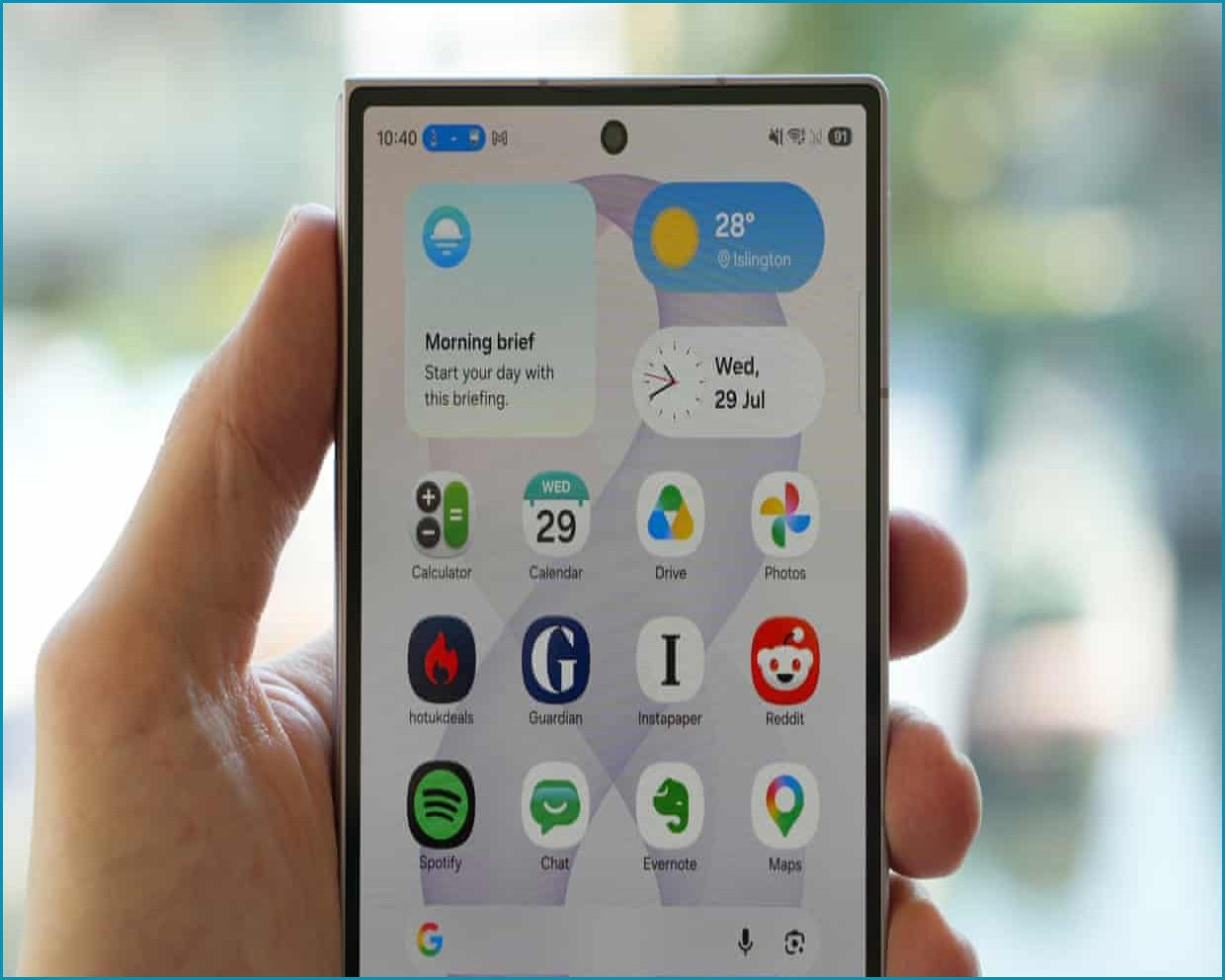
Samsung's One UI 9, based on Android 17, runs on the device, featuring the 'Now Bar' for live updates and the 'Now Nudge' AI suggestion tool, which pulls information from various sources. However, the 'Now Brief' AI feature is noted as a weak point, often providing only basic information like weather or calendar events. Google's Gemini AI is integrated, alongside other AI tools. An unusual aspect of the software is the creation of three separate home screen layouts if users opt for different configurations on the internal and external displays: one for the cover screen, and two for the internal screen (one for portrait, one for landscape).
The camera system includes two 10-megapixel selfie cameras and two 50-megapixel cameras on the rear, notably lacking a telephoto lens. The main 50MP camera performs comparably to the S26's main camera, capturing good photos in various conditions. The 50MP ultrawide camera is also solid, maintaining consistent color. While a 2x crop zoom from the main camera is functional, digital zoom beyond 4x or 10x quickly degrades image quality. The selfie cameras are adequate for video calls, but using the main camera with the cover screen as a viewfinder yields superior results, albeit with an awkward setup.
The camera app offers numerous modes and shoots decent video, with auto-tracking features that assist in keeping subjects in frame when the phone is partially folded. Compared to other high-end devices, the Z Fold 8 is priced at £1,699, while the S26 Ultra costs £1,279, the Honor Magic V6 is £1,999.99, and the Google Pixel 10 Pro Fold is £1,299.
While Samsung has pioneered narrower book-style foldables, the introduction of the squat Z Fold 8 feels like an unusual strategic shift. The internal screen's aspect ratio is better suited for media and web browsing, but its actual width doesn't offer a significant advantage over previous models or the Fold 8 Ultra, with video letterboxing being the primary difference. The closed form factor, however, compromises the phone experience, making it less comfortable for one-handed use and occupying too much screen space with the keyboard. It also did not prove easier to fit into a pocket than narrower competitors.
Despite these form factor criticisms, the Z Fold 8 is a technologically impressive device with strong software integration, ample processing power, and good battery life. However, the absence of a telephoto camera at its price point is a significant drawback. The Z Fold 8 represents an improvement on earlier 'passport' foldable attempts, but the evolution towards narrower, candy-bar-like foldables over the past eight years is seen as a valid design progression.
Key specifications include a 7.6-inch QXGA+ 120Hz AMOLED flexible main display and a 5.5-inch WUXGA+ 120Hz AMOLED cover screen. It is IP48 water-resistant. Dimensions when folded are 123.9 x 81.9 x 9.7mm, and unfolded, 123.9 x 161.4 x 4.5mm. Connectivity features include 5G, dual SIM, e-SIM, USB-C, Wi-Fi 7, NFC, Bluetooth 6, UWB, and GNSS.
Pros include its dual phone and tablet functionality, thin and light design, powerful multitasking, excellent tablet screen, top performance, solid battery life, and water resistance. Cons are its extreme expense, less-than-ideal 'passport' shape for phone duties, lack of dust resistance, fragility and high repair costs, and the absence of a telephoto camera.