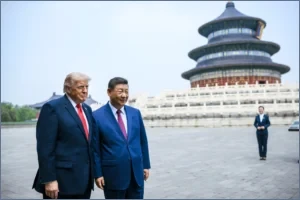
When U.S. President Donald Trump embarked on his second state visit to China in May 2026, his tour of Beijing’s Temple of Heaven with President Xi Jinping transcended its traditional cosmic significance, becoming instead a stage for the display of recognition between two leaders characterized by autocratic impulses and outsized egos [23, 25]. This dynamic, dubbed a “Temple of Thymos,” highlights a proposed analytical framework known as the “Thymos Trap,” which suggests that regimes built around strong personalities, despite outward magnificence, are inherently precarious.
The concept of thymos, popularized by political philosopher Francis Fukuyama, describes “the part of the soul that craves recognition of dignity.” While innate to all, it differentiates between isothymia (recognition as equal) and megalothymia (recognition as superior). Liberal democracies are designed to satisfy isothymia, but megalothymia, fueled by past humiliations, persists. This desire for superior status is evident in Xi Jinping’s emphasis on China’s “century of humiliation” and his “Chinese Dream of rejuvenation,” as well as in Donald Trump’s “Make America Great Again” slogan.
Political philosopher Ye Xue notes that in the United States, status is relative and defended through demands for honor, a trait Trump embodies with his individualistic and often antagonistic approach. Conversely, China’s culture prioritizes a stable hierarchy and relational status, seeking harmony. Xi’s leadership reflects a collective megalothymia, demanding deference to China as a whole. This contrast was highlighted in January 2026, when Canadian Prime Minister Mark Carney recalled Xi’s admonition, “don’t lecture me in public,” implying an aversion to being publicly criticized and losing face.
Historian Walter Russell Mead identifies Trump’s style as a continuation of populist, informal, and insult-responsive leaders like Andrew Jackson. Both Trump, who must visibly win, and Xi, who must not lose face, represent variations of the same underlying substance: a paradox of outward strength masking inward fragility. This perennial human temptation for megalothymia underscores the need for institutional safeguards, which James Madison famously articulated as making “ambition… counteract ambition” in liberal democracies.
Columnist Gideon Rachman, in “The Age of the Strongman,” outlines four common traits of strongman rule: a cult of personality, contempt for the rule of law, populism, and a politics of fear and nationalism. This style spans a continuum from unchallenged autocrats like Xi and North Korea’s Kim Jong Un to strongmen in hybrid regimes such as Russia’s Vladimir Putin, and those operating within democratic systems, like Trump.
Summits serve as crucial stages for strongmen, where protocol and positioning become significant displays of honor. During the May 2026 meeting, Trump’s effusive rhetoric, describing Xi as his “good friend” and “a man I admire greatly,” and his poetic mention of receiving “the most beautiful roses,” exemplified how affective ties can manipulate leaders, as political scientist Todd Hall’s research suggests. Chinese officials likely aimed to induce warm feelings, and they succeeded.
While Xi’s language was less rhapsodic, the Chinese readout of the meeting was extensive, detailing a new four-pillar framework of stability centered on Taiwan, a “tifa” for the Communist Party. The White House readout, in contrast, was a single paragraph. For the CCP, such summits are vital for legitimizing a narrative of China’s return to greatness, especially when a powerful foreign leader appears flattered by the pageantry.
Trump’s admiration for “strength” was evident long before his presidency; in a 1990 Playboy interview, he praised China’s leaders for crushing the Tiananmen Square protests the previous year while calling Soviet leader Mikhail Gorbachev “weak” for his restraint. Analysts Ursula and Dennis Wilder have noted Xi’s “iron Machiavellian detachment,” a ruthlessness required to ascend the Chinese Communist Party’s apex.
The “Thymos Trap” becomes a structural problem when a leader fuses himself with the state, and the regime’s legitimacy hinges on his recognition. Ironically, this institutionalization of megalothymia makes the regime vulnerable. Personalist leaders often isolate themselves, suppress bad news, overreach, and over-centralize decision-making, with the very ego that builds the regime ultimately hollowing it out. Political scientist Milan W. Svolik observes that most deposed dictators fall not to mass uprisings but to regime insiders sensing weakness, a vulnerability exacerbated by an ostensibly indestructible leader facing defeat abroad.
Xi Jinping’s ceaseless purges within China’s military, a struggle against what John Garnaut called the “calcification and putrefaction that inevitably corrodes and degrades every dictatorship,” illustrate the regime’s brittleness, not its strength. The absence of competent rivals makes a succession crisis far more serious.
The Thymos Trap is a tendency, not a forecast. While leaders like Trump, Xi, and Putin follow a similar script, each plays a unique part. Xi’s face-saving culture and lack of electoral cycles allow for greater patience for delayed gains compared to Trump, potentially explaining Beijing’s off-ramps in trade disputes. Despite the appeal of seemingly harmonious autocratic systems, historian Stephen Kotkin notes that strongman regimes “last far longer than generally anticipated” but “remain prone to sudden runs on their political banks.”
Trump operates within a country with a robust democratic tradition, constrained by the U.S. Constitution’s checks and balances, a vibrant civil society, and a powerful opposition party. Fiona Hill, a former National Security Council official, described Trump as having “autocrat envy,” praising dictators while insulting democratic leaders. This palpable desire for autocratic power, paradoxically, indicates he cannot truly be one. Xi, conversely, holds the near-absolute control Trump desires. As his former ambassador to Hungary noted, “Trump would love to have the situation that Viktor Orban has, but he doesn’t.”
The irony of Trump’s Temple of Heaven tour in May 2026 extends to Xi. Chinese cosmology posits that the Mandate of Heaven, which emperors invoked through rites, could be withdrawn, linking magnificence with precarity. As Gideon Rachman concludes, strongman rule is “an inherently flawed and unstable form of government” that “will ultimately collapse,” though not without significant turmoil and suffering.
The Communist Party leader projects confidence, but the Thymos Trap’s fragility is structural, not merely individual. The same impulses that build a one-man cult eventually bedevil it, as the performance of strength consumes the substance. The rare counter-model is a leader like Roman Emperor Marcus Aurelius, who, despite near-absolute power, interrogated his own status-hunger through Stoicism, a stark contrast to the likely ghost-written “Xi Jinping Thought.”
You have reached the limit of 2 free articles this month.
This desire for status, as the journalist Will Storr explained in “T he Status Game,” is pursued through dominance, virtue, or success. These differing tactics can depend on the cultures in which status-seeking individuals operate.