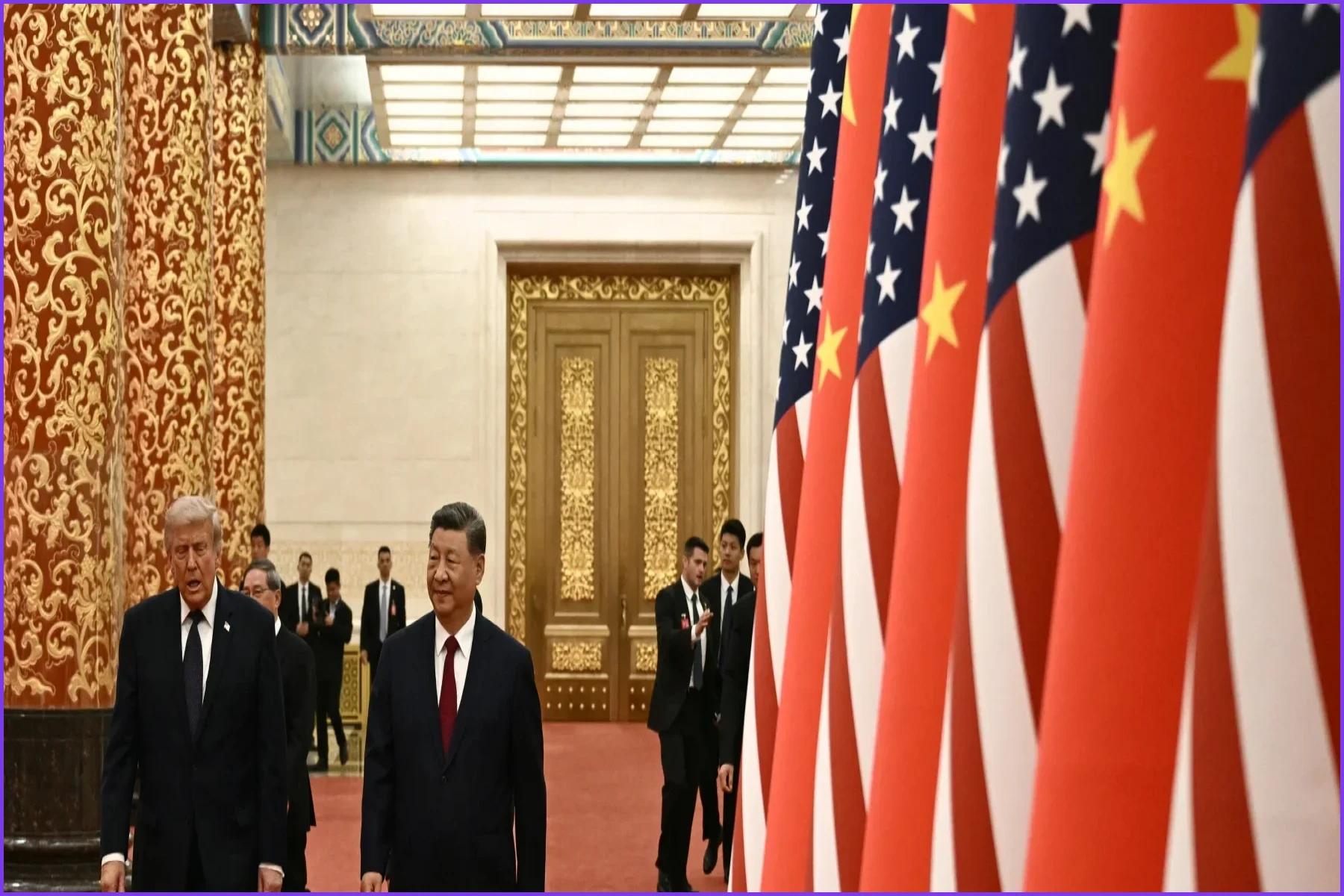
Chinese President Xi Jinping is scheduled to arrive in the United States on Wednesday evening, marking his first state visit to the U.S. in 11 years. He is set to engage in high-stakes discussions with President Trump, their second meeting this year following a summit in Beijing in May where they aimed to foster a more stable bilateral relationship.
The visit comes at a pivotal time for both leaders as they seek to consolidate power domestically. For President Trump, the talks precede the midterm elections by just over a month, while for President Xi, preparations for an all-important Party Congress will begin upon his return to Beijing.
Despite both nations publicly expressing a desire to build what China terms a relationship of "constructive strategic stability," intense negotiations are anticipated over critical subjects such as artificial intelligence (AI) and trade. U.S. Treasury Secretary Scott Bessent remarked in a July Fox News interview that "Under the water, the Chinese seem to have done a lot of kicking lately. And you know, if we have to, we'll kick back."
President Trump has frequently praised the hospitality he received during his recent trip to China, which included elaborate pageantry and a state banquet at Beijing's Great Hall of the People. Wu Xinbo, who directs the American Studies center at Shanghai's Fudan University and attended the banquet, described it as the warmest period in U.S.-China relations in years. However, Wu noted that relations have become more "fragile" since then, stating, "In the last several months, the U.S. has continued to contain and pressure China in economic, technological [and] people-to-people exchanges."
Examples of recent U.S. actions include the imposition of extra tariffs on Chinese exports over forced labor claims, the Pentagon adding Chinese tech giants to a military blacklist, and the Federal Communications Commission banning new imports of Chinese humanoid robots and robot dogs due to national security concerns.
Professor Zhang Yun of Nanjing University, an international studies expert, acknowledged that fluctuations are to be expected in a relationship as complex as that between the U.S. and China. Zhang indicated that Taiwan, technology, and trade are high on President Xi's agenda for this trip. Discussions are also expected to cover ongoing conflicts in Iran and Ukraine, as well as tensions on the Korean peninsula.
The U.S. is prepared to reciprocate the high level of pomp and circumstance for President Xi, irrespective of the tough negotiations expected. President Trump has consistently expressed high regard for his Chinese counterpart.
On the economic front, U.S. Trade Representative Jamieson Greer confirmed this week that the two countries are still negotiating a potential extension of a rare earths truce. This agreement is crucial for ensuring a continuous supply of Chinese rare earth products to the U.S., given China's dominance in refining these critical minerals essential for manufacturing everything from cellphones to weapons.
AI governance is another key area for discussion. Rose Gottemoeller, a former NATO official who participates in regular dialogues on nuclear proliferation with retired Chinese military officials, noted that China has "been trying to figure out, in talking to the United States, what kind of so-called guardrails or controls can be put on artificial intelligence." While China is interested in imposing safety measures, Zhang Yun pointed to significant "mistrust" between the two nations regarding proposed solutions.
Taiwan remains a highly sensitive issue. In previous meetings, President Xi has repeatedly emphasized to President Trump that Taiwan, a self-governing island claimed by Beijing, is a "red line" and that mishandling it could put U.S.-China relations in "jeopardy." President Trump later told reporters he was not interested in a war thousands of miles away. Zhang Yun urged, "Let's see if the United States can make [a] clearer statement opposing Taiwan independence." As President Xi departed for the U.S. on Wednesday, China's state news agency published a statement from the country's cabinet-like State Council, sharply criticizing Taiwan's president, Lai Ching-te, whom Beijing suspects of attempting to lead Taiwan toward formal independence. William Klein, who served as acting deputy chief of mission at the U.S. Embassy in Beijing until 2021, affirmed that Taiwan is "the most important issue that the Chinese always raise in preparation for these high-level visits."
Regarding trade and investment, Trump and Xi agreed in May to establish trade and investment boards. Discussions include a reciprocal tariff reduction framework on products valued at $30 billion or more. China is expected to announce purchases of American agricultural products, while the U.S. is anticipated to announce tariff reductions on "4A consumer goods," such as footwear and apparel, according to two anonymous sources in the U.S.-China business community. However, no details on the members of these trade or investment boards have been released yet. During President Trump's visit to China this spring, the U.S. announced that China had agreed to purchase American beef, soybeans, and 200 Boeing jets, though data indicates China is currently behind schedule on its agricultural purchase commitments.