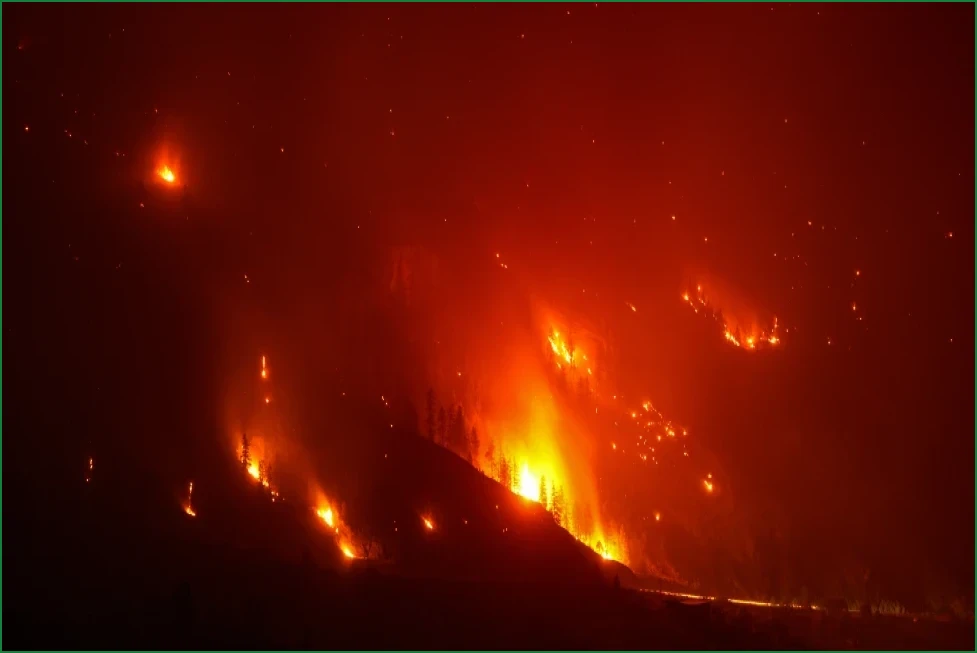
Wildfires burning across the western United States and Canada on Sunday left residents in a state of uncertainty, with many keeping a wary eye out for potential evacuation orders while others who had already fled waited to see what remained of their properties. In western Canada, the situation became dire over the weekend as a fast-moving wildfire forced more than 20,000 people to flee communities along Okanagan Lake in British Columbia. Dozens of residents required rescue by aircraft as the blaze destroyed homes in the region.
The Bald Range wildfire, which was first reported on Friday evening, prompted the evacuation of approximately 8,000 people in and around Peachland, in addition to those forced out of Summerland, a community of about 12,000 people. British Columbia officially declared a state of emergency on Saturday. Eleanor Olszewski, Canada’s minister of emergency management and community resilience, announced on social media Sunday that she had approved a request for federal assistance to provide shelter and accommodations for those displaced by the fires.
The human cost of the disaster in British Columbia was confirmed later Sunday, when the Royal Canadian Mounted Police reported that an 80-year-old woman died while attempting to escape the wildfire. Residents described harrowing experiences during the evacuation. Anette Boulet, who fled Summerland with her family at approximately 4:30 a.m. Saturday, described the scene as the home was shrouded in smoke. “You couldn’t see barely. It was just dark, and the ridge of fire just coming towards you,” Boulet said, noting that she evacuated to a center in Penticton. “There’s no words to express it. The fear.” Another resident, Greg Krauter, was forced to evacuate his Summerland property in the middle of the night, taking his seven goats with him to the Penticton evacuee center.
In the United States, crews in Washington state continued “mop-up operations” on Sunday near containment lines for three wildfires that have been burning in the Spokane area for over a week. According to a news release from the management team, none of the fires were growing, though they have already damaged or destroyed approximately 920 structures. Earlier in the week, authorities arrested a man and charged him with intentionally setting the largest of the three Spokane-area blazes. Residents in the rural town of Malden, located 35 miles south of Spokane, were urged to evacuate on Saturday, but by Sunday, the order was downgraded to a standby status. John Goyke, whose company operates the town's water under contract, noted that while the wind was calm and the fire was not progressing, residents were using social media to stay in contact. Malden was previously devastated by a 2020 wildfire that destroyed its city hall, library, post office, and fire station.
Laurie Allen, a resident of Nine Mile Falls north of Spokane, fled her home last weekend with her husband, dog, and two kittens. While roads into her neighborhood remained closed Sunday, she learned from a friend that her house was intact, though covered in ash. “I’ve been here 65 years. It’s never happened,” Allen said. “We didn’t think about anything but grabbing our animals and leaving. But now it’s affected so many of our friends and family around. So it’s pretty dang devastating.”
Meanwhile, in Utah, two helicopter pilots were killed when their aircraft crashed on Friday morning while fighting a wildfire in the Fishlake National Forest. Crews were unable to reach the site until Saturday due to the steep, rough terrain and active fire conditions. Sevier County Sheriff Nathan Curtis explained that fire activity had prevented a quicker response, noting, “When we first got there we could see two different plumes of smoke, one from the crash site, one from an active fire coming towards us.” The National Transportation Safety Board has launched an investigation into the cause of the crash.