Following a significant downturn in global performance, Volkswagen AG has announced a strategic initiative to reduce its model lineup by nearly half. The Wolfsburg-based automaker revealed on Friday that group sales fell by 8.6% during the second quarter, totaling just under 2.1 million vehicles. This decline was heavily influenced by the Chinese market, where the company saw sales plummet by more than one-third.
The decision follows a board meeting held on Thursday, where leadership confirmed that the company’s three-year “fundamental realignment” is entering a new phase. CEO Oliver Blume stated that the move to streamline the model portfolio is intended to reduce complexity, focus on key technologies, and improve alignment across regional markets. Blume emphasized the need to address overcapacities in what he described as an “increasingly demanding environment.”
The impact of the current market conditions is evident across the company’s primary brands. The core Volkswagen unit reported 1 million vehicle deliveries in the second quarter, marking a 14% decrease compared to the previous year. Meanwhile, Audi deliveries dropped by 8%, and Porsche saw an 18% decline. Conversely, the company noted growth in Europe and the Americas, with positive sales trends reported for Skoda, Lamborghini, and the trucks division.
Volkswagen attributed its recent struggles to a variety of factors, including rising costs driven by tariffs, geopolitical tensions, and shifting regulatory requirements, alongside intensifying competition. However, the company’s recovery plan faces external scrutiny. Analysts at the research firm BernsteinSG expressed skepticism regarding Volkswagen’s claims of extending its technology leadership, noting that the rapid pace of innovation from Chinese competitors presents a significant hurdle.
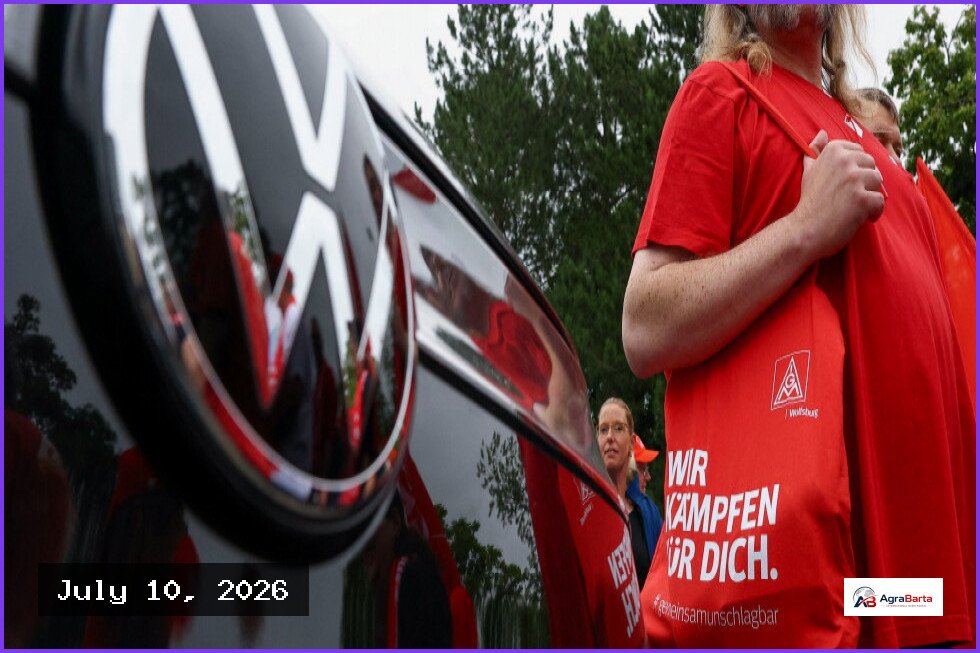
Labor tensions have also escalated in response to the company’s restructuring efforts. On Thursday, hundreds of employees gathered outside the Volkswagen plant in Zwickau to protest potential site closures and advocate for job security. The Zwickau facility, which has been fully converted to electric vehicle production, remains a central point of concern for union members and the workforce.
Employees of carmaker Volkswagen AG and IG Metall union members rally on the grounds of the Volkswagen headquarters on the day of the supervisory board meeting, in Wolfsburg, Germany, Thursday, July 9, 2026. (Lisi Niesner/Pool Photo via AP)
From left; Christiane Benner, chairwoman of IG Metall union, Daniela Cavallo, chairwoman of the General and Group Works Councils of Volkswagen, and Thorsten Groeger, IG Metall regional leader for Lower Saxony and Saxony-Anhalt take part in a march by employees of carmaker Volkswagen AG and IG Metall union members rally on the grounds of the Volkswagen headquarters on the day of the supervisory board meeting, in Wolfsburg, Germany, Thursday, July 9, 2026. (Lisi Niesner/Pool Photo via AP)