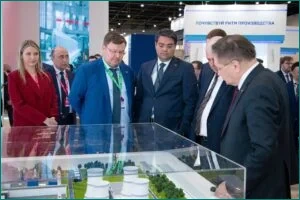
Uzbekistan has set a clear timeline for its ambitious nuclear power plant (NPP) project, with officials confirming that the first small modular reactor (SMR) is expected to be commissioned by 2029. Azim Akhmedkhadjayev, head of the national atomic energy agency Uzatom, stated that following the initial SMR launch, the first large-scale reactor is slated to come online in 2033, with the entire project reaching completion between 2034 and 2035. Once fully operational, the plant is projected to generate up to 17 billion kWh of electricity annually, accounting for approximately 20 percent of the nation's current total energy production of 80 billion kWh.
The pursuit of nuclear energy in Uzbekistan gained significant momentum under President Shavkat Mirziyoyev. In December 2017, shortly after taking office, the administration reached an agreement with the Russian state corporation Rosatom to construct a two-reactor facility. This commitment was further solidified in 2019 through the passage of a law governing the peaceful use of atomic energy, which established essential safety protocols and ownership frameworks. In 2024, the government established Uzatom as the primary body for implementing state policy regarding nuclear development.
By September 2025, Uzbekistan and Rosatom finalized an agreement for an integrated facility in Jizzakh, featuring two RITM-200N small modular reactors with a capacity of 55 megawatts each, alongside two large VVER-1000 reactors capable of generating 1 GW each. The construction was officially inaugurated in June 2026 by President Mirziyoyev and Russian President Vladimir Putin in Saint Petersburg. While initial project estimates reached up to $13 billion, Uzatom now projects costs to be capped at $9.5 billion. Given that Uzbekistan’s external debt exceeded $82 billion as of early 2026, the government intends to secure 85-90 percent of construction funding through external loans, with hopes that the plant will eventually contribute over $165 billion to the state budget.
Tashkent has emphasized its desire for a multilaterally financed project, expressing a preference to avoid direct Russian loans due to geopolitical sensitivities. Abdujamil Qalmuratov, head of the nuclear power plant construction directorate, has indicated that the funding for the smaller reactors would come directly from the national budget, framing the plant as a strictly national project. Nevertheless, President Putin has signaled Russia's readiness to offer preferential export loans and long-term support for the site. To maintain sovereignty and avoid over-reliance on any single partner, Uzatom plans to assemble an international consortium, incorporating Chinese non-nuclear technology and European hardware, all while operating under the strict oversight of the International Atomic Energy Agency.
The project faces scrutiny regarding its long-term impact on domestic energy availability. Despite being promoted as a solution to local power shortages, critics suggest that the need to repay international loans may force Uzbekistan to export a significant portion of the generated electricity to neighboring countries. With the country already exporting energy to Kazakhstan, Tajikistan, Kyrgyzstan, and Afghanistan, the government faces the challenge of managing public expectations, as citizens currently endure frequent power outages during peak demand periods.
You have reached the limit of 2 free articles this month.
“They [investors, lenders] will receive the profits generated by the nuclear power plant in the form of dividends. They will not have any involvement in the management [of the plant]. This is stupid,” explained Akhmadkhodjayev.