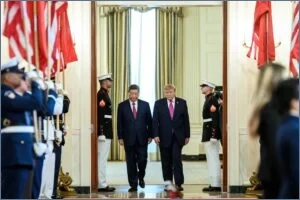
Remarks by U.S. President Donald Trump and Chinese President Xi Jinping at their September 2026 summit, recalling the United States and China's alliance in World War II, have raised significant concerns. While such statements could simply reaffirm a historical fact and shared memory, the context of China's evolving historical narrative, particularly in its relationship with Russia, suggests a deeper implication.
A decade ago, in 2015, during the 70th anniversary of the war's end, U.S.-China relations were notably more stable. At that time, China emphasized its role alongside the United States and other major Western powers as key members of the Allied coalition, jointly establishing the postwar order. China also employed the phrase “New Model of Major-Country Relations” in its dealings with the U.S. Had the recent invocation of wartime partnership aimed to evoke memories of that 2015 period and signal a desire to restore the “New Model,” it would have been understandable as a matter of Chinese policy.
However, more than ten years have passed since 2015, and China's historical narrative has undergone a substantial shift. This change, particularly evident in its alignment with Russia, transforms the meaning of the summit's historical references into a cause for concern. The COVID-19 pandemic in 2020 and China's response, coupled with Russia's war in Ukraine beginning in 2022, drew widespread international criticism for both nations. This criticism, in turn, fostered closer ties between China and Russia, leading them to more openly position themselves in opposition to Western countries.
In May 2024, marking the 75th anniversary of Sino-Russian diplomatic relations, Russian President Vladimir Putin made an official visit to China. A joint statement issued during this visit declared: “China and Russia will continue to firmly defend the results of the victory of the Second World War and the postwar world order enshrined in the Charter of the United Nations, and oppose the negation, distortion, and falsification of the history of World War II. They plan to solemnly celebrate the 80th anniversary of the victory of the Chinese People’s War of Resistance Against Japanese Aggression and the Soviet Union’s Patriotic War in 2025 and jointly promote a correct view of the history of World War II.” This statement signaled a joint commitment by China and Russia to insist on their “correct history” of WWII globally, rejecting any differing perspectives.
Further solidifying this stance, State Councilor Wang Yi stated at a press conference during China’s National People’s Congress in March 2025 that, as the 80th anniversary of WWII victory approached, China and Russia were reaffirming their shared sacrifice in fighting together across Asia and Europe. He added that, building on this past, the two countries would jointly promote a correct understanding of WWII history, defend the fruits of that victory, uphold the international system with the United Nations at its core, and advance the international order in a more just and reasonable direction. This indicated a pledge not only to reaffirm their wartime partnership but also to jointly shape the present international order based on that historical narrative.
On May 9, 2025, Russia’s Victory Day commemorating the defeat of Nazi Germany, Chinese President Xi Jinping visited Russia and issued another joint statement with the Russian president. This statement explicitly identified Japanese militarism and Nazi Germany as the adversaries China and Russia fought in WWII. It also made clear their intent to jointly resist any moves to revive past militarism or Nazism. Regarding Japan specifically, the statement asserted that “the Japanese government should learn lessons from the brutal crimes it committed in history, exercise caution in its words and deeds on historical issues such as the Yasukuni Shrine, and completely cut ties with militarism that once brought deep disasters to the peoples of the world and Japan itself.”
By 2025, China's historical narrative had made a qualitative leap, both in substance and method. It began generating narratives connected to the invalidity of the San Francisco Peace Treaty, the Taiwan issue, and the status of Okinawa, all areas directly linked to China’s interests in the First Island Chain. Concurrently, China's military activities were expanding rapidly beyond the First Island Chain, reaching into the Second Island Chain, the Western Pacific, and the South Pacific.
From around November 2025, following remarks by Prime Minister Takaichi Sanae, and continuing into 2026, China intensified its verbal attacks on Japan, introducing the term “neo-militarism” and broadening its criticism to encompass Japan's security policy as a whole. This comprehensive challenge characterized Japan's policies as “neo-militarism.”
In May 2026, during another official visit by President Putin to China, a new Sino-Russian joint statement incorporated language criticizing Japan’s “neo-militarism” and “remilitarization,” further expanding their historical cooperation on WWII. China also sought to extend this criticism beyond Russia, inserting anti-“militarism” language into joint statements with various other countries. At the UN General Assembly in September 2026, the Chinese representative strongly criticized Japan using terms like “remilitarization” and “neo-militarism,” with Russian Foreign Minister Sergey Lavrov publicly agreeing and similarly characterizing Japan's path as militaristic.
Given this evolving context, the recent U.S.-China summit's discussion of their WWII alliance is viewed as more than a simple historical acknowledgment. For Japan, in particular, China's recent discourse on WWII, intertwined with its strategic alignment with Russia and its pointed criticisms, is a significant cause for concern.