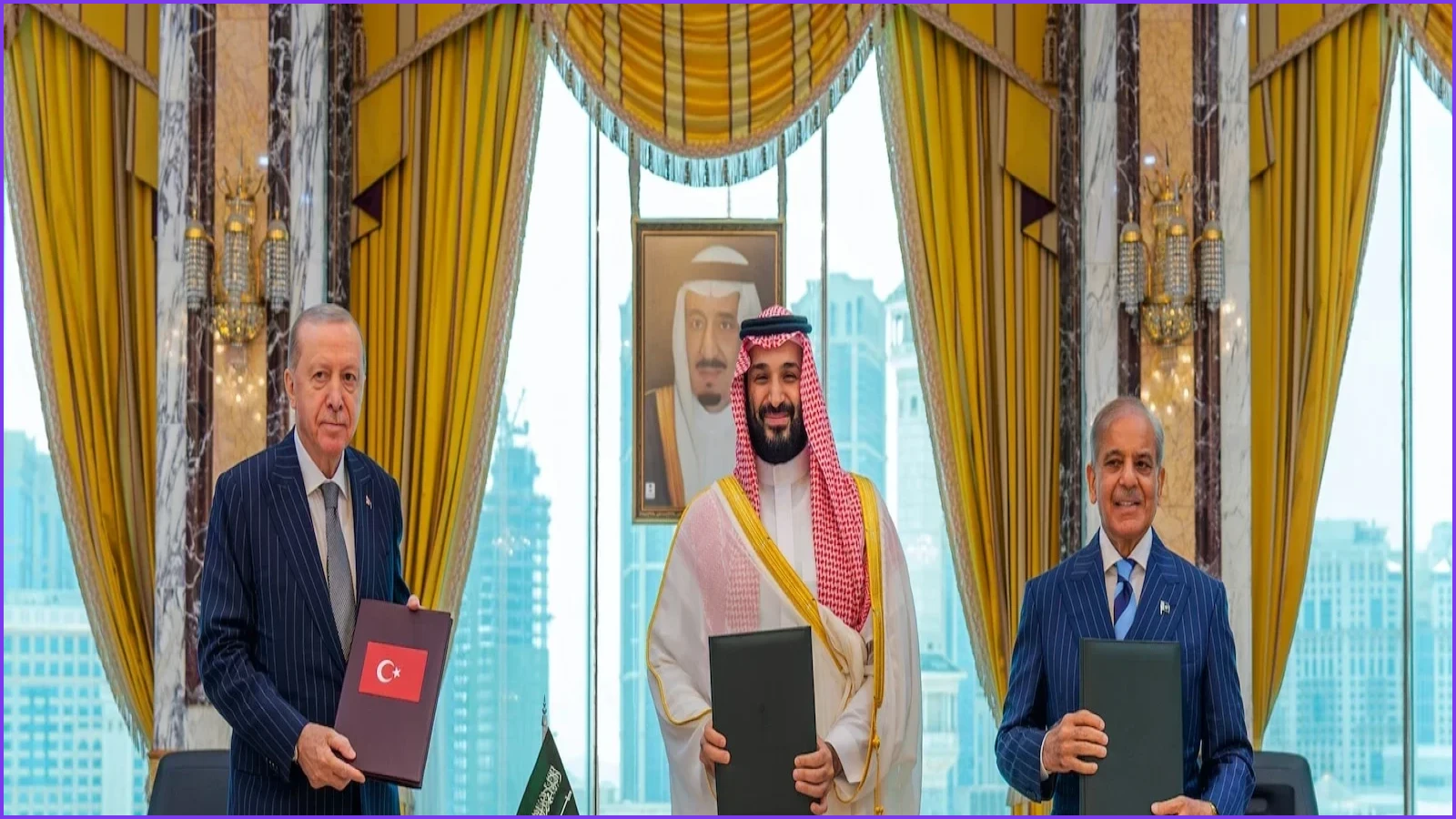
A newly signed defense agreement between Turkey, Saudi Arabia, and Pakistan is not intended to act against Iran or any other specific country, according to Turkey’s foreign minister. Hakan Fidan described the pact as a significant advancement toward fostering regional stability during an interview with Turkey's state-run Anadolu Agency.
The agreement, formally titled the “Mecca Joint Defense Agreement,” was signed on Friday in the Saudi holy city of Mecca by Turkish President Recep Tayyip Erdogan, Saudi Crown Prince Mohammed bin Salman, and Pakistani Prime Minister Shehbaz Sharif. The document establishes a mutual defense commitment, stating that an act of aggression against one participant will be viewed as an attack on all three.
Fidan emphasized that the signatories do not categorize any particular state as an adversary unless that state engages in hostile actions against them. He clarified that the agreement contains no written definition of a common threat, noting that any nation that does not initiate an attack is not considered a target.
The Turkish foreign minister compared the mutual defense clause to Article 5 of the NATO treaty, under which an attack on one of the 32 members is considered an attack on them all. Regarding the operational mechanics of the pact, Fidan explained that a member must formally request assistance. Depending on the nature and scale of the threat, the response could involve various measures, ranging from intelligence sharing and logistical support to the potential deployment of military units.
The coalition combines the oil resources of Saudi Arabia, the nuclear capabilities of Pakistan, and the military strength of Turkey, which maintains the second-largest army within NATO. Fidan noted that while the current pact involves three nations, other countries have expressed interest in joining. He specifically mentioned that he expects Egypt to participate at a future stage, describing the nation as a “natural partner.”
“These are multi‑layered matters that vary according to the scale of the threat,” Fidan said. “This is the perspective we have set out so far in our work.”