The devastating floods that struck Nepal on August 26, 2026, have triggered a dual wave of support from South Korea, blending high-profile celebrity philanthropy with structured state-level humanitarian aid. This combined effort has reinforced the long-standing bilateral relationship between the two nations, which was first established in 1974 and has since been bolstered by labor migration and cultural exchanges.
Among the most prominent contributions are those from members of the K-pop group Stray Kids. Lee Know donated 100 million won (approximately $72,600) through World Vision. Following this, his bandmate Felix marked his birthday by donating 50 million won (about $37,000) to the Korean Committee for UNICEF specifically for Nepal flood relief. The group's leader, Bang Chan, followed with a 200 million won (around $144,000) contribution, splitting the amount equally between the Korean Committee for UNICEF for Nepal flood relief and the Seoul Rehabilitation Hospital.
This wave of support mirrors past actions by other South Korean icons, such as figure skater Kim Yuna and actor Lee Min-ho, who both extended significant aid to Nepal in the wake of the devastating 2015 earthquake. Dr. Kaushal Kumar, chairperson of the Centre for Korean Studies at Jawaharlal Nehru University, noted that such donations from idols carry deep personal significance. He explained that these figures are driven by humanitarian values and a sense of reciprocity toward their global fanbase, showing up for the people who support them. This connection has inspired fans; one Stray Kids follower told the media that Lee Know's action prompted them to make their own donation, listing the donor name as "Stay," the group's official fandom name.
According to World Vision International Nepal, Lee Know's donation and other contributions are actively funding emergency relief in the flood-hit communities of Rasuwa and Nuwakot. Roslyn Hanson Gabriel, the national director of World Vision International Nepal, expressed deep gratitude for the global solidarity, noting that these contributions help reach vulnerable children and families with urgent relief while shining a light on their ongoing needs. To date, approximately 8,600 people have received critical support, including food packages, temporary shelter, hygiene kits, water tanks, and water pipeline repairs. Additionally, child-friendly spaces have been established for displaced children, with future plans focusing on livelihood recovery, temporary learning centers, and the restoration of community health and sanitation systems.
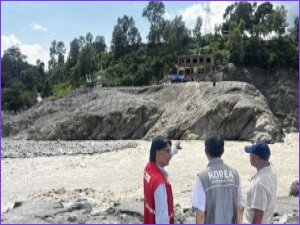
While celebrity donations offer emotional resonance and immediate visibility, state-level institutional aid from South Korea provides the infrastructure for long-term recovery. Following the August 2026 floods, the Korea Disaster Relief Team (KDRT) deployed to Rasuwa to conduct search and rescue operations alongside emergency relief. South Korea also dispatched DNA-identification experts and, at the request of Nepal's National Disaster Risk Reduction and Management Authority, sent emergency equipment through the United Nations Development Program (UNDP). This equipment included camera-equipped drones and portable generators to aid search and rescue efforts.
Chaeyoon Oh, an economic and development specialist at the Embassy of the Republic of Korea in Nepal, emphasized that this assistance transcends formal government-to-government agreements, representing a genuine human connection between the people of both nations. This track record of cooperation is well-established, according to Dr. Dhruba Gautam of Nepal's National Disaster Risk Reduction Center (NDRC Nepal). Following the 2015 earthquake, South Korea's aid agency, KOICA, provided $9 million to rebuild Trishuli Hospital and 10 health posts in Nuwakot. South Korea also provided $500,000 through UNICEF for medical tents and sanitation support after Nepal's 2024 floods.
For Nepalis, the assistance has been deeply personal. Priyanshu Kumar Chaudhary, from the flood-prone Mahottari district in Janakpur, expressed immense gratitude, noting that seeing a K-pop idol donate specifically to Nepal made him feel that someone far away truly cared. Isha Shrestha, a resident of Kathmandu, shared that although her family did not suffer direct damage, the crisis felt close due to the capital's connections to hard-hit areas like Rasuwa, Nuwakot, and Dhading. She noted that non-K-pop fans she knew were surprised and touched by the gesture, which she believes reshapes local perceptions of South Korea beyond just entertainment. Both Chaudhary and Shrestha emphasized that while immediate aid is vital, the long-term journey to recovery requires sustained support. Chaudhary highlighted the need for durable solutions such as early warning systems, stronger housing, and improved river management, while Shrestha urged international supporters to remember Nepal beyond the immediate headlines to help rebuild communities and livelihoods.
You have reached the limit of 2 free articles this month.
Diplomacy and culture reinforce the bond between two countries – with the help extended by individual personalities providing an emotional charge that state visits and MOUs find difficult to achieve, even though both work on building the trust between nations.