When Chinese President Xi Jinping conducted his visit to the United States from September 23 to 25, 2026, the contrast between official state media coverage and public discourse was stark. Beijing formally announced the trip on September 21, just two days prior to its commencement. However, in the immediate aftermath of that announcement, the news appeared to register very little impact among the Chinese public.
Before the visit began, informal interviews conducted with a dozen individuals across China and the diaspora—including students, professionals, and public-sector workers—revealed significant disparities in awareness. While overseas students and professionals often learned of the trip through foreign news outlets or private messaging, many private-sector employees in China remained unaware of the summit even after the official announcement. Public-sector employees noted that the schedules of senior leaders are traditionally kept confidential until the last possible moment.
The landscape shifted once the summit was underway. Chinese social media platforms like Weibo, WeChat, and Xiaohongshu were soon filled with reports regarding the meetings. Much of this content, however, originated from official outlets and accounts, focusing heavily on the diplomatic choreography, President Trump’s reception of Xi, and calls for “constructive strategic stability.” This influx of information raised questions about how much the average citizen knew before the state-led media campaign began.
Observers suggest that the lack of initial public discussion is not solely the result of censorship. Some respondents pointed to self-censorship, noting that certain personal views might feel inappropriate for public forums. Others indicated that interest might only peak once the summit produced concrete outcomes. The difficulty in interpreting this “visibility gap” is compounded by the fact that searches cannot distinguish between content controls, platform ranking algorithms, self-censorship, or a genuine lack of public interest.
Nonetheless, discussion was more visible in specialized, interest-driven spaces. On WeChat financial blogs, retail investors and market watchers actively debated the implications for stock prices, exchange rates, and tariffs. The economic stakes were highlighted by the CGCC-USA 2026 Business Survey Report, which found that 79 percent of Chinese companies in the U.S. reported negative impacts from tariffs, with 36 percent hoping for an improvement in trade relations. Ultimately, the Trump-Xi summit underscored that while information about such events becomes ubiquitous, the most prominent narratives in China remain overwhelmingly official.
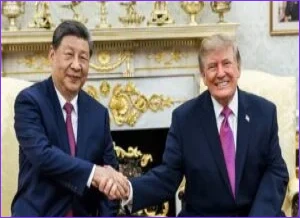
Chinese President Xi Jinping and U.S. President Donald Trump shake hands during their summit at the White House, Sep. 24, 2026.
Beijing formally confirmed Chinese President Xi Jinping’s September 23-25 visit to the United States on September 21, just two days before the trip began. The news had barely registered among many of the Chinese people I spoke with the following day. Official coverage began appearing online following the announcement,