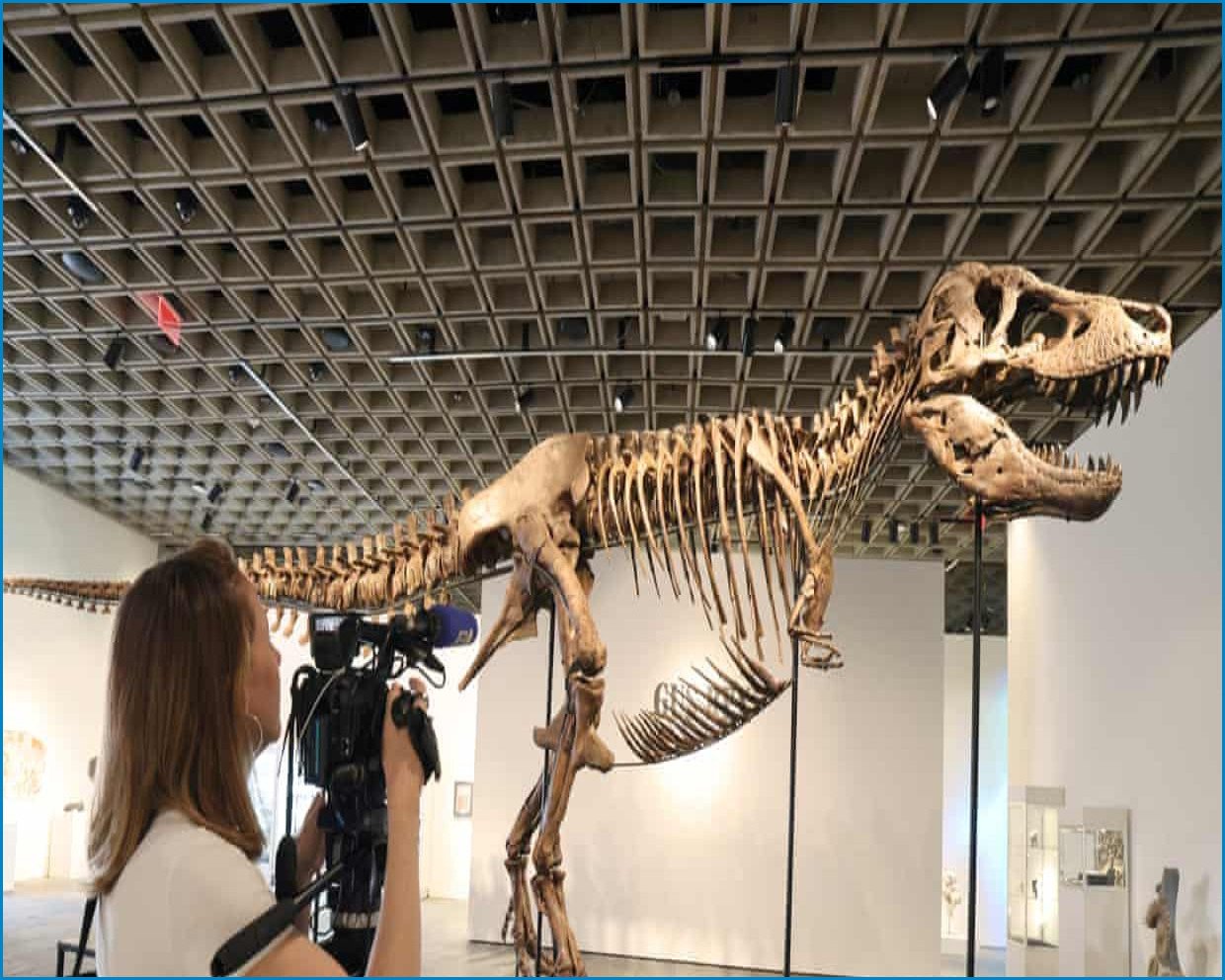
The fearsome Tyrannosaurus rex, known for its dagger-like teeth and bone-crushing bite, once dominated western North America during the late Cretaceous period. Now, its fossilized remains are set to dominate the auction house at Sotheby’s in New York, with a price tag expected to be substantial. The specimen, nicknamed "Gus," is estimated to be approximately 67 million years old and is mounted in a predatory pose standing about 3.8 metres (12.5ft) tall. The auction listing highlights the huge teeth displayed within the gaping jaws.
The fossil was discovered on a ranch in Harding County, South Dakota, by the commercial outfit Theropoda Expeditions. Excavation took place over a three-year period starting in 2021, with permission from the landowner, Gary "Gus" Licking. Cole Jacobs, a field prospector for the company, recalled in a promotional video from Sotheby’s that he spotted the metatarsal poking out of the ground on his first day at the site. The name "Gus" serves as a tribute to Licking, who passed away before the excavation was completed.
While the find is significant, palaeontologists warn that the trend of marketing dinosaur fossils as rare artworks or status symbols is deeply concerning. Prof Richard Butler of the University of Birmingham stated that fossils not held in recognized museum collections are effectively lost to research. He noted that prices are increasingly moving out of the reach of museums, which is detrimental to science. Prof Stephen Brusatte from the University of Edinburgh agreed, noting that while the auction appears legal under US law—where landowners have rights to what they find—it remains problematic. If a dinosaur like this fetches tens of millions of dollars at auction, then there is little that scientists, museums, or universities can do, as those prices can only be paid by the super-rich.
The scale of these sales is significant; a stegosaurus named Apex recently sold at a Sotheby’s auction for $44.6 million in 2024, which was 11 times its listing price. Since the 1997 sale of "Sue," a 4-metre-tall T. rex bought for $8 million by the Field Museum in Chicago with support from private donors and companies like McDonald’s Corporation, fossil collecting has become a hobby for wealthy celebrities, including actor Leonardo DiCaprio. Michael Benton, a professor of vertebrate palaeontology at the University of Bristol, acknowledged that private purchases can sometimes work well if the owner loans or donates the item to a museum, as was the case with Apex, which was loaned to the American Natural History Museum for four years by billionaire hedge fund manager Ken Griffin.
However, Dr. Thomas Carr, a vertebrate palaeontologist at Carthage College, argued that private loans are insufficient. He noted that private collections lack the guarantee of a public trust, which has a mission to maintain and conserve collections indefinitely. Because fossils serve as data, they must remain available to test observations and make new insights. Indeed, many journals now stipulate that research papers must be based on fossils housed in permanent public repositories. Brusatte emphasized that research must be repeatable, meaning other scientists can check data and verify conclusions, which is only possible if fossils are in museums with guaranteed access. Carr suggested that rare fossils should ideally have legal protection from commercial exploitation, similar to laws in countries like Mongolia, where such finds are reserved for academic institutions. He expressed hope that Gus would eventually be donated to a public trust rather than being hoarded in some McBillionaire’s living room. Conversely, experts at Sotheby’s defended the excavation by private companies, suggesting that without such outfits, some dinosaurs might never be recovered, and argued that the price reflects the fossil's importance and the effort required to extract it.