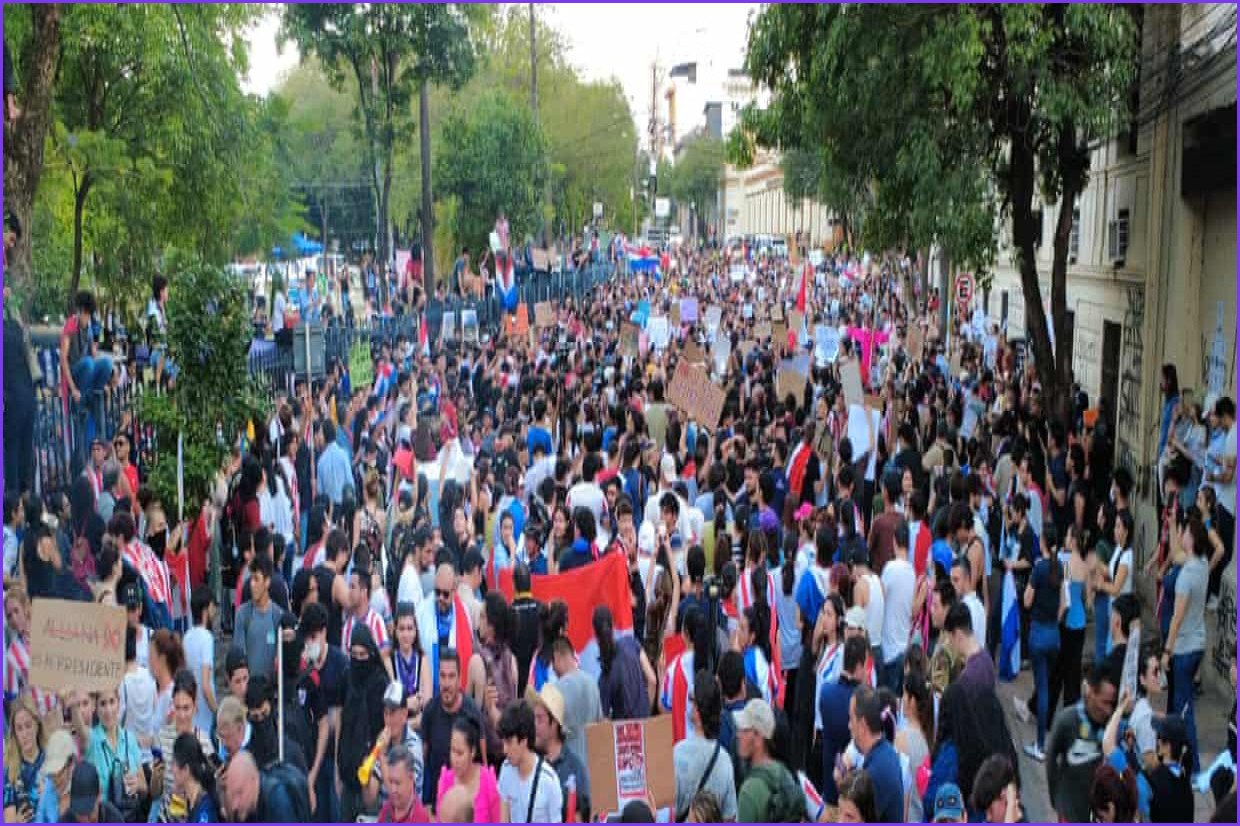
Paraguayan President Santiago Peña was placed under house arrest minutes after his impeachment by Congress concluded on Friday. The arrest followed a severe national crisis involving the suspension of Ueno bank, which left 2.9 million people—approximately 60% of the country’s adult population—unable to access their funds for basic needs such as bread and water. Protests erupted nationwide, occasionally resulting in violent clashes with police, as the banking disruption paralyzed the daily lives of citizens.
The public prosecutor’s office launched an investigation into Peña on Thursday, citing allegations of illicit enrichment, money laundering, and influence peddling. Prosecutors suspect the former president used his political influence to favor Ueno, a bank that saw exponential growth during his administration. The arrest warrant also includes Carlos Carvallo Spalding, whom Peña appointed to lead the central bank shortly after taking office. Spalding, a former Ueno CEO, later oversaw the regulatory transition that allowed the institution to become a digital bank and one of the largest in Paraguay by deposits.
As the impeachment process unfolded, opposition senator Rafael Filizzola described the situation as “one of the biggest corruption scandals since the return of democracy” and the “biggest fraud carried out from political power in the democratic era.” Peña had attempted to resign on Thursday to secure the special jurisdiction typically granted to former presidents, who serve as senators for life in Paraguay, but lawmakers rejected his resignation. This left him subject to ordinary courts throughout the proceedings.
Evidence highlighted in the investigation includes Peña’s personal financial ties to the bank. He held $1 million in shares in the company that became Ueno Holding until April 2025, claiming he was merely an investor. Additionally, the bank aggressively secured public pension funds, with an estimated $800 million to $860 million in state assets deposited into Ueno under the administration’s encouragement. Political analyst Hugo Duarte noted that because the bank had the “blessing of the presidency,” government-affiliated pension funds were heavily invested there.
Following the impeachment, Vice President Pedro Alliana was sworn in as the new leader. Prosecutor Elena Fiore Franco confirmed the status of the former president, stating: “It has been established that he is indeed inside his home. He voluntarily allowed officers to enter and made himself available for all procedural purposes.” Before the final vote and arrest, Peña had addressed the public on social media, writing: “I say goodbye with gratitude, while fully recognising the anguish of those who are now waiting for answers.”
Amid rumours he had fled to Argentina, the 47-year-old economist was expected to appear before Congress to present his defence during the impeachment proceedings, but left that to his lawyers and instead continued posting on social media.
Peña himself had about US$1m in shares he bought in 2019 in a company that would become Ueno Holding in 2022, the parent company of the conglomerate that controlled Ueno Bank. Even after becoming president, he only disposed of the shares in April 2025. He said he had bought them purely as an “investor”.