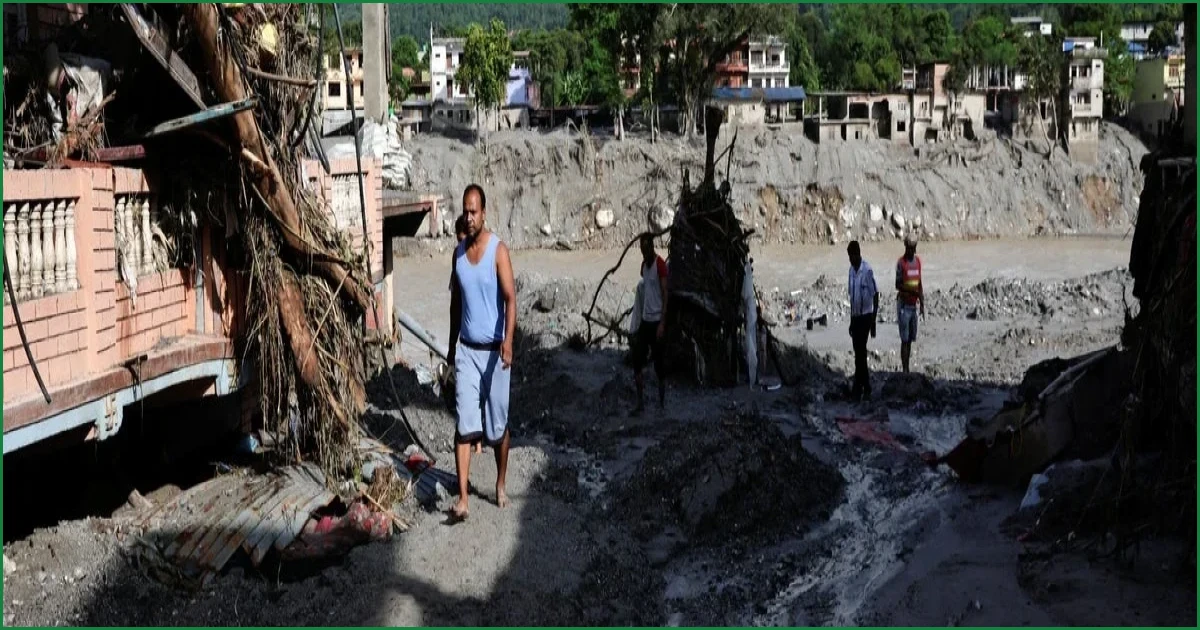
Rescuers covered in thick, dark mud are pulling survivors from debris while helicopters lift stranded residents to safety, as Nepal and China intensify emergency efforts following catastrophic flash floods and landslides. The death toll from Wednesday's disaster has risen to nearly 600 people, with approximately 2,500 others still reported missing across the rugged Himalayan border region. Amid the ongoing search, authorities in both nations are warning of a secondary threat from a newly formed lake upstream, urging communities in low-lying areas to evacuate to safer ground immediately.
According to official figures, the confirmed death toll reached 579 on Friday, as reported by Nepal's National Disaster Risk Reduction and Management Authority. While local Nepalese media outlets suggested that the number of unaccounted-for individuals could be as high as 12,000, government officials have not confirmed that figure. In Nepal alone, more than 3,700 people have been successfully rescued, but 1,924 people remain officially missing. Across the border in China, state media previously reported 558 people missing, with the confirmed death toll rising to five on Friday as evacuation and relief efforts continued under the direction of regional leaders.
The scale of the disaster has left tens of thousands of people in distress. The Red Cross estimated on Friday that approximately 90,000 people have been impacted by the sudden deluge. The disaster is believed to have been triggered by the collapse of a massive rocky ledge high in the mountains, which supported a vast portion of a glacier. When the bedrock collapsed, it caused a massive rockfall that registered as a magnitude 5.2 seismic event. The resulting debris and rapidly melting glacial water surged into the valleys below, creating violent torrents that swept away homes, concrete buildings, bridges, and vehicles in both Tibet and Nepal.
The danger is far from over, as a fresh alert was issued by the Nepal Police on Friday afternoon. Authorities received reports that a dam on the Tibetan side of the border was overflowing, prompting security personnel and emergency workers to remain on high alert and prepare for immediate relocation if water levels surge further. Nepal Police spokesperson Abi Narayan Kafle confirmed that rescue operations are continuing without pause, though personnel are operating under extreme caution due to the volatile conditions. Chinese state media reported that the newly formed barrier lake is situated at an elevation of 9,680 feet—about 3,280 feet above Gyirong Port, the border crossing that was completely devastated by a wall of mud and water on Wednesday morning. Although the lake is located more than six miles from the port, the risk of a secondary outburst remains high, even as subsequent assessments indicated that the flood risks from the overflowing lake were currently deemed "manageable."
In the Rasuwa district of Nepal, military personnel are focused on saving individuals trapped inside a hydropower tunnel at the Upper Trishuli-1 Hydropower Project. Dramatic footage from the scene showed military rescuers pulling a man caked in dark brown mud from the mouth of the tunnel. Dozens of workers are believed to have been trapped inside when the mudslide struck. Nepali Army spokesperson Brigadier General Raja Ram Basnet explained that the rescue operation is exceptionally difficult. Basnet stated that identifying the entry and exit points of the tunnel has become highly complicated because the entire area is buried under deep mud, but emphasized that rescuing the stranded workers remains the military's absolute priority.
Climate scientists are pointing to rapid regional warming as the underlying cause of the disaster. The Hindu Kush Himalayan region is experiencing accelerated warming, which is causing rapid changes to glaciers, snow cover, permafrost, and mountain slopes. Approximately 78 percent of the glacial area in this region, situated between 14,760 and 19,685 feet above sea level, is highly exposed to rising temperatures. Jakob Steiner, a geoscientist at the University of Graz in Austria who is currently based in Bangladesh, analyzed satellite images of the collapse. Steiner noted that the lower portion of a glacier appeared to have completely sheared off, describing the satellite data as looking like a giant knife had cut directly through the rock and ice. He warned that such events represent a dangerous "new normal" for the region, which is expected to worsen in the coming years.
The tragedy has also affected a large number of international visitors who were in the region for work, trekking, or religious pilgrimages. Hikmat Singh Ayer, the CEO and senior director of the Nepal Tourism Board, confirmed that at least 65 American citizens are among the missing foreign nationals, a figure that nearly doubled from earlier reports. In a subsequent update, the tourism board announced that 27 foreign nationals had been successfully rescued from the flood zone in Rasuwa, including an American man and woman in their 50s. A U.S. State Department spokesperson stated that the government is tracking approximately 90 Americans who may have been affected by the floods. While three U.S. citizens have been confirmed rescued, the department has not received any reports of American deaths.
Among the missing is a large group of pilgrims participating in a journey organized by the Isha Foundation, a volunteer-run organization founded by Indian spiritual leader Sadhguru Vasudev. Leslie Crespi, a community liaison for the foundation based in McMinnville, Tennessee, revealed that about 80 pilgrims from 19 different countries are currently unaccounted for. Out of approximately 1,000 total participants on the pilgrimage to Mount Kailash in Tibet, 22 of the missing are American adults, comprising 13 women and nine men. Crespi expressed shock over the situation, noting that the foundation has organized these pilgrimages for 21 years without ever losing a life, and stated that they are actively working with the State Department and the U.S. Embassy to establish contact.
Deepak Dandu, an American citizen, shared that his wife, Sridevi Vejella, is among the missing pilgrims. He explained that traveling to Mount Kailash, a sacred site for Hindus and Buddhists, had been a lifelong dream for her. She was crossing the border from China into Nepal when the flood struck, and the foundation confirmed she was at the Gyirong Port immigration complex at the time. Dandu was preparing to fly to Hyderabad, India, to support his son, who has been deeply distressed by the news.
The physical destruction left behind by the floodwaters is immense. Video footage captured the moment massive torrents of water destroyed sturdy buildings, bridges, and vehicles as residents fled. In the aftermath, the vibrant border town of Timure was left unrecognizable, buried under vast expanses of brown mud and shattered concrete. Karbir Gaire, a customs officer in Timure, recalled working on his computer at around 8 a.m. on Wednesday when the ground began to shake. Gaire, who managed to survive, stated that his 15 colleagues are currently missing. He described the sudden onslaught as resembling a scene from a Hollywood movie, calling it a "tsunami" rather than a flood. Before the disaster, Timure was a bustling hub of more than 1,500 residents, home to government offices, hotels, cafes, banks, a primary school, and residential buildings.
In Washington, President Trump addressed the disaster during a meeting in the Oval Office, describing the destruction of strong, well-built buildings as looking like they were "wiped out like they were toothpicks." He stated that the United States has communicated with Nepalese leaders and offered to provide any assistance they might require as the rescue and recovery efforts continue.
"What happened yesterday is unfortunately the new normal. It's going to get worse from here onwards," Steiner said.
"He is going through a lot, hearing all the news," Dandu said of his son. "I think he is really upset. I'm trying to go there and be with him."