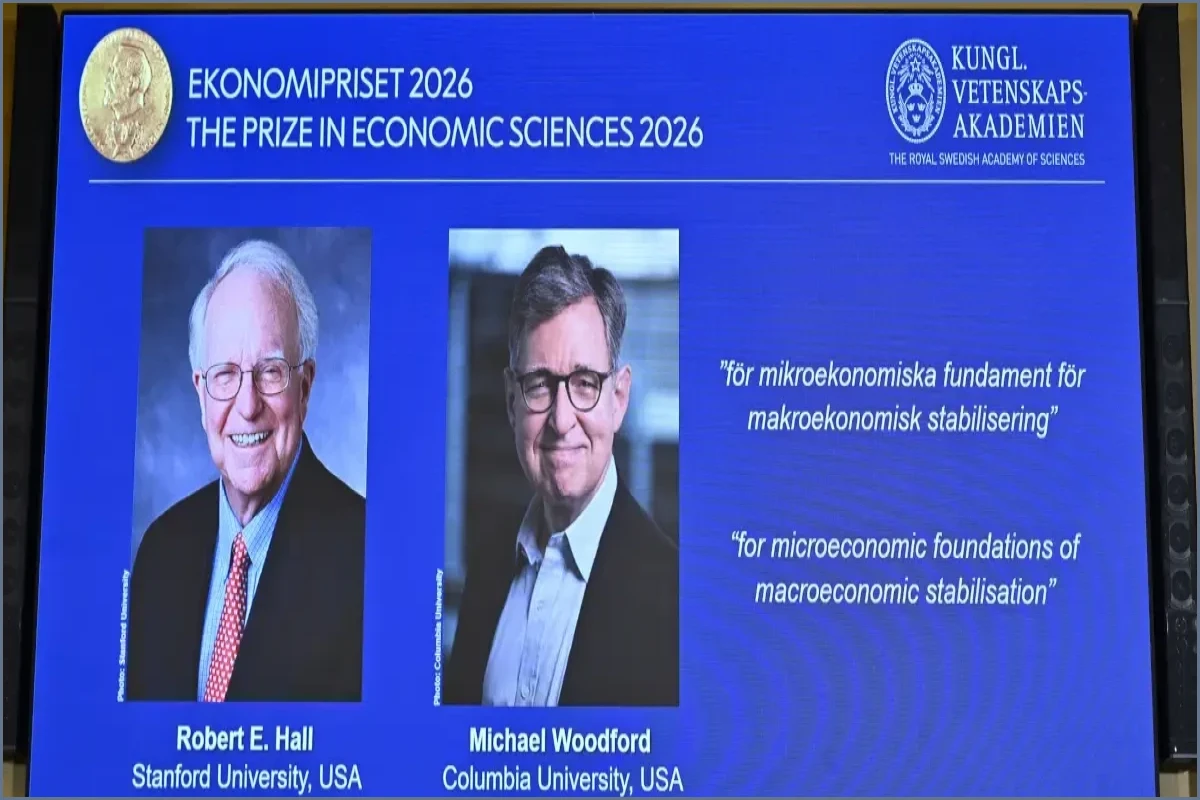
American economists Robert Hall and Michael Woodford have been awarded the Nobel Prize in Economics for their research into how monetary and fiscal policy can effectively stabilize economic fluctuations. The Royal Swedish Academy of Sciences, which oversees the selection process, stated that the laureates provided a stable theoretical foundation for the models currently utilized by central banks and governments around the world.
The development of these tools was prompted by the oil crises of the 1970s, a period when traditional Keynesian models—long used to determine how to address recessions and economic shifts—ceased to function effectively. In response, Hall and Woodford sought to create more robust policy responses. The academy noted that rather than relying on statistical links between macroeconomic variables such as inflation, production, and consumption, the pair built their models on a microeconomic foundation. This approach incorporates an understanding of how the collective actions of individual households and businesses influence the economy.
While the economics prize is the only Nobel not included in the original five categories established in the 1896 will of Alfred Nobel, it follows the same selection process as the prizes in physics and chemistry. Created in 1968 through a donation from the Swedish central bank, the award has occasionally been dubbed a "false Nobel" by detractors. Like the other categories, the economics prize includes a diploma, a gold medal, and a $1.2 million cheque.
The laureates are scheduled to receive their awards during formal ceremonies on December 10th, the anniversary of Alfred Nobel's death. Last year, the prize was awarded to American-Israeli economist Joel Mokyr, France’s Philippe Aghion, and Canada’s Peter Howitt for their research into how technology drives and affects economic growth.