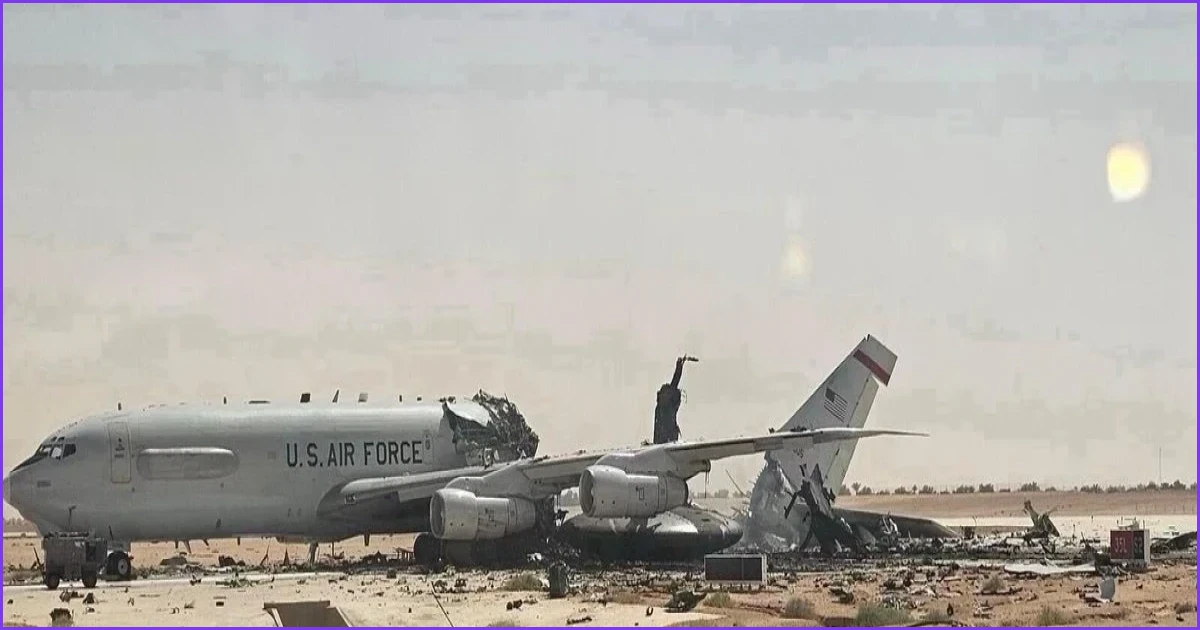
Newly leaked photographs have revealed the extensive damage and destruction of buildings and vehicles at several U.S. military positions across the Middle East following Iranian missile and drone strikes. The images, provided by active-duty service members on the condition of anonymity due to strict military media restrictions, offer the first public look at the scale of the devastation.
"This is major damage to our bases that hasn't been communicated to the American public," one deployed service member stated. "We're standing there with our eyes closed getting punched in the face."
Among the photographs is an image from Prince Sultan Air Force Base in Saudi Arabia, which depicts a direct hit on the rear section of a Boeing E-3 Sentry four-engine aircraft. The strike severed the plane's tail from its charred fuselage, which also supported a rotating radar system vital for gathering midair intelligence. Other pictures from the same base show hollowed-out buildings and barracks. Notably, the destroyed structures stand adjacent to undamaged concrete "T-wall" barriers, which were originally designed to protect against ground-level grenade and mortar attacks but proved entirely ineffective against aerial bombardments.
Similarly devastating images were captured at Camp Buehring in Kuwait. Located in a remote desert region far northwest of Kuwait City, Camp Buehring serves as a major staging area for U.S. Army ground forces, armored vehicles, and aircraft.
These visual revelations coincide with a new report released this week by the Defense Department's inspector general. The first-of-its-kind mandatory report to Congress on the war in Iran disclosed "equipment losses" totaling up to $3.7 billion, which includes nearly 60 aircraft. According to the inspector general, U.S. Central Command reported Iranian strikes targeting U.S. military installations across eight nations, including Kuwait, Bahrain, Qatar, the United Arab Emirates, Saudi Arabia, Iraq, Oman, and Jordan. The Pentagon did not respond to a request for comment regarding the damage or the report.
Commenting on the lack of defense, the anonymous service member rejected official characterizations of the strikes. "These are not 'squirters' getting through," the service member said, referencing a term used by Defense Secretary Pete Hegseth after a March 1 attack on the Port of Shuaiba in Kuwait that killed six U.S. troops. "We're not defending these bases. We're just watching them get destroyed."