With the highly anticipated midterm elections less than 100 days away, the balance of power in the United States Congress hangs on a razor-thin margin. As Republicans fight to preserve their narrow majorities in both the House of Representatives and the Senate to advance President Donald Trump's legislative agenda, both major political parties are finding themselves forced to appeal to a rapidly growing and highly unpredictable segment of the population: independent voters. Often described as the political fulcrum upon which the American middle shifts, these unaffiliated citizens are poised to play a decisive role in key battleground contests across the country.
According to recent polling from Gallup and the Pew Research Center, approximately four in ten registered voters in the United States now identify as independents. This rise comes at a time of intense political polarization, marked by legislative battles such as the president's push to pass the SAVE America Act—a measure that John Opdycke, the founder and president of the voter advocacy nonprofit Open Primaries, warns could jeopardize voting rights. Opdycke notes that the traditional party structures are losing their grip, as more Americans choose to distance themselves from both the Democratic and Republican brands, a trend that politicians are increasingly unable to ignore.
Data compiled by the Washington, D.C.-based nonprofit advocacy group, the Independent Center, highlights just how influential these voters have become. During the 2024 elections, independents shifted between 8 and 11 percentage points toward Donald Trump, a swing that likely decided the presidency. Furthermore, the organization points out that 43 congressional races were decided by a margin of 5% or less, outcomes that were almost certainly determined by independent voters. In that election, independents made up 34% of the total electorate—matching the proportion of self-identified Republicans and outnumbering Democrats, who accounted for 32% of voters.
The shift away from major parties is particularly pronounced among younger generations. The Independent Center found that 52% of Gen Z and millennial voters identify as politically independent, with only 7% of these younger independents reporting that they are locked into voting for a major party. This stands in stark contrast to older voters, 67% of whom remain committed to a major party. Gallup similarly reports that a record 56% of Gen Z adults identify as independents or unaffiliated.
Opdycke describes independents as the "ultimate swing voters," but points out the systemic limitations they face in a rigid two-party system. "I think that the problem with swinging is, it's so binary in America. Like, your options are really limited to ‘Do I do this, or do I do that?'" Opdycke observed. "So you find independents kind of going back and forth because they look at, 'Oh my God, the Democrats are screwing up. How do I send them a message? Well, I vote Republican. Oh, the Republicans just screwed the pooch. What do I do? Well, I have to vote Democrat.’ It's not a perfect way to make yourself heard. But in America it's kind of like the only way right now."
In St. Petersburg, Florida, 63-year-old John Marvin is feeling the direct impact of these systemic limitations. A recently retired education administrator, married father of two adult children, and a lifelong independent, Marvin is highly motivated to participate in the political process but finds himself locked out of Florida’s upcoming August 18 primary. Florida operates under a closed primary system, meaning only registered members of the Democratic or Republican parties are allowed to cast ballots.
Marvin, who moved to Florida from Massachusetts over two decades ago for a job, recalls when the Sunshine State felt more like a "purple state." Today, he views it as "staunchly red," dominated by the Republican Party, which holds the governorship, the offices of the secretary of state and attorney general, and majorities in both chambers of the state legislature.
Marvin refuses to register with either major party simply to gain access to the primary ballot. "My tax dollars pay for these elections," Marvin said. "I feel like I’m an outsider looking in. I have a constitutional right to make my voice heard, and I shouldn’t be forced to associate with either of those parties in one of the most consequential midterm elections of this century." He believes that while independents now represent the plurality of the American electorate, they are continually being "squeezed out of the process" by closed, party-based primaries.
Marvin's political views do not align neatly with either side. He has voted for candidates from both parties over the years, seeking out leaders who have the best interests of all Americans at heart. "I just don’t like the constant fighting," Marvin said, expressing frustration over political debates that deteriorate into shouting matches. "I get so befuddled when the debates become shouting matches on even the simplest of issues to the point where nothing gets done. It’s so frustrating. So much time and money are being wasted."
While Marvin is not a personal fan of Florida’s current Republican governor and former presidential candidate Ron DeSantis, he acknowledges DeSantis's effectiveness in certain areas, such as managing hurricane responses and balancing the state budget. "He’s been pretty effective on hurricane response and balancing the state budget, and I guess that has a trickle-down effect on voting for Republicans," Marvin observed. "With him now being term-limited, I wonder if Florida just might be more open to a Democratic governor or someone more willing to work across party lines?"
Marvin is deeply critical of other aspects of DeSantis's tenure, including his divisive stances on education and immigration, as well as his aggressive push to redistrict congressional maps to favor the Republican Party. He is also troubled by legislative actions, such as the quiet elimination of ranked-choice voting and a Republican-backed law passed last year that imposes severe restrictions on citizens' ability to launch ballot initiatives. Although several advocacy groups filed lawsuits arguing that the ballot initiative restrictions violated their First Amendment rights, a federal judge ruled in favor of the state in April following a two-month trial.
Despite these concerns, Marvin has no plans to relocate. Instead, he is closely monitoring the upcoming primary races ahead of the general election in November. In the gubernatorial race, he is watching to see who will emerge from the Republican primary—either the Trump-endorsed U.S. Rep. Byron Donalds or Lt. Gov. Jay Collins—and who will win the Democratic primary, where former Republican lawmaker David Jolly is the front-runner among six candidates. Marvin is also keeping tabs on the high-profile U.S. Senate primary, watching whether GOP incumbent Ashley Moody will defeat three primary challengers, and tracking the Democratic primary matchup between Alexander Vindman, the former National Security Council director for European affairs, and state Rep. Angie Moore.
Once the general election arrives, Marvin plans to be fully engaged. "I’m going to look at all of the players and races carefully, with a fine-tooth comb," he said. "And now that I’m retired, I’m going to look at them even more intensely and serve as a conduit of sorts for others who may not know the issues."
Over in Dallas, Texas, 77-year-old Sandi Hebley shares a similar fiercely independent spirit. A retired hospice nurse, married mother of two adult children, and an active member of both the League of Women Voters and Braver Angels—a nonpartisan nonprofit dedicated to reducing political polarization through cross-party discussions—Hebley cannot remember ever voting a straight party ticket.
"I’ve always prided myself in making my own decisions," Hebley explained. "It’s not unusual for me to vote for a Democrat, a Republican and an independent all on the same ballot. I tend to think that I’m voting for the best candidate. Regardless of their affiliation."
Her history of independent voting dates back decades. In 1980, she cast her presidential ballot for independent candidate John Anderson, a 10-term Republican congressman from Illinois who broke away from his party to challenge Democratic incumbent Jimmy Carter and Republican nominee Ronald Reagan. Hebley admired Anderson, a World War II veteran who had been one of the first Republicans to call for Richard Nixon's resignation during the Watergate scandal, for his moderate views and his critique of the broken two-party system. Anderson ultimately finished third with 7% of the popular vote. "To this day, I’ve never felt like I wasted my vote. I went with my gut; I always do," Hebley recalled.
In the upcoming midterms, Hebley’s vote in Texas could help decide a critical U.S. Senate race that will impact control of the chamber. The contest pits 37-year-old Democratic state Representative James Talarico against 63-year-old Republican incumbent Ken Paxton, a staunch Trump ally and Texas Attorney General who was previously indicted and impeached on securities fraud charges but not convicted.
Hebley revealed she is "leaning" toward Talarico, drawn to his platform of lowering the cost of living, increasing school funding, making healthcare more affordable, and raising the minimum wage. She has little regard for Paxton and is eager to see if the two highly polarized candidates will agree to a televised debate, which would undoubtedly attract national attention.
Like Marvin in Florida, Hebley is frustrated by partisan maneuvering around voting maps. She remains upset by Governor Greg Abbott's decision last year to redraw Texas's congressional districts after Donald Trump urged state Republicans to flip five U.S. House seats. The redistricting map was signed into law and subsequently upheld by the U.S. Supreme Court in April, a move that triggered similar partisan gerrymandering efforts by both parties in other states. "I think a lot is on the line – again," Hebley said. "The future of our country is at stake."
Hebley's commitment to democracy extended to serving as a poll worker in Dallas County during the height of the COVID-19 pandemic in 2020, where she used her nursing background to implement infection control and help anxious voters. Looking ahead to the upcoming elections, she is concerned about new forms of voter intimidation. "I’m worried the state will send National Guard troops or ICE agents to try to intimidate voters, but I’m not going to let that stop me from trying to help them," she said. "I want to make sure everyone has a chance to vote."
She is also watching the campaign of Mike Collier, who is running as an independent for lieutenant governor after previously running and losing as a Democrat in 2018 and 2022. Collier faces the daunting task of gathering more than 81,000 signatures to secure a spot on the November ballot, and has filed a federal lawsuit challenging the state's restrictive ballot access laws, arguing they violate the constitutional rights of independent candidates and voters. "I think there are more obstacles to voting, to run for office, than I’ve ever seen before," Hebley remarked. "There's always a fight."
Despite her decades of voter advocacy, Hebley faces a personal challenge closer to home: her 21-year-old eldest grandson refuses to participate in the elections. "I’m heartbroken. It’s so sad," Hebley said. "He said: 'Don’t even talk to me about it. (The candidates) are all crooks.' I told him they all aren’t and that it might be better to have a say on which crook is worse than the other. I’ve tried to let that simmer in his brain. He’s a good young man, and I think he will come around. It may not happen (in November), but I’ve planted the seed, and hopefully it will germinate. Every vote counts."
In Pennsylvania, another critical swing state, 27-year-old Sophie Gelling is channeling her frustration with the political status quo into direct activism. Gelling, who grew up in a family of independent voters in West Chester, Pennsylvania, initially registered as a Democrat when she first voted and worked as a poll worker in her hometown in 2016.
During that election, Gelling was deeply affected by having to turn away independent voters who did not realize Pennsylvania’s closed primary system prevented them from voting. "I decided that it was important for me to be an outspoken advocate for voter independence," Gelling said.
Now living in Philadelphia and running a small events-organizing business called All I Want, Gelling officially registered as an independent in 2025. She is part of the massive wave of Gen Z adults who reject major party labels, viewing the traditional two-party system as rigid and unresponsive. She pointed to a recent example of partisan gridlock: last month, Donald Trump refused to sign a landmark affordable housing bill, complaining that Congress had failed to pass election overhauls under the SAVE America Act.
"Being an independent to me means progress even though there are lines we need to work within to change rules for those who still feel locked out," Gelling explained. "It’s a civil rights issue – a voting rights issue."
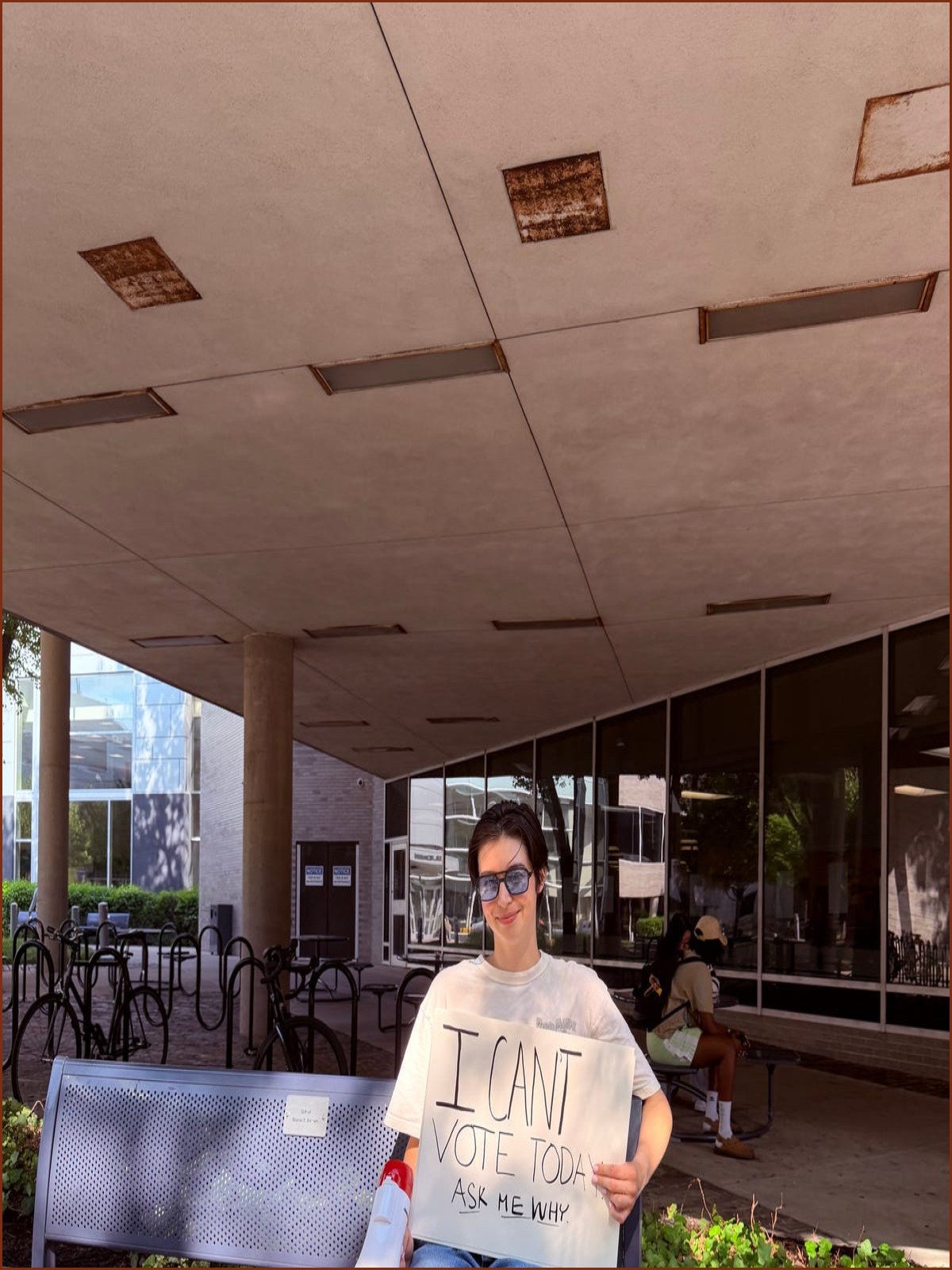
Gelling is encouraged by recent progress elsewhere; Nebraska and New Mexico both updated their primary systems over the past year to allow registered independents to participate, leaving 17 states with fully or partially closed primaries. To push for similar reforms in Pennsylvania, Gelling organized a demonstration calling for open primaries near a polling site at the Community College of Philadelphia on May 19, the state's primary day.
"I feel very lucky to have a very robust, independent-minded community in a purple state," Gelling said. "Independents paving the way for more people to vote is what brought me in and what will keep me here. The system can’t shut us all out."
Despite their growing numbers, independent voters face significant hurdles, according to Anthony Fowler, a political science professor at the University of Chicago who specializes in political polarization. Fowler notes that major political parties have become increasingly nationalized, pushing highly polarized agendas even in local and state-level contests.
However, Fowler emphasizes that independents hold immense power. "But moderates and independent voters are more influential on elections than they realize," Fowler said. "Instead of blind party loyalty, they are highly swayed by the qualities of a particular candidate’s ideologies and willing to switch their votes between parties."