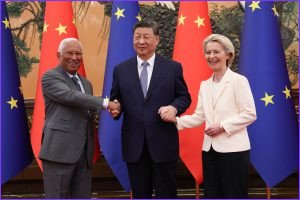
European Union relations with China are currently defined by two disparate and potentially conflicting approaches. A visual representation of this tension was captured at the China-EU Summit in Beijing on July 24, 2025, featuring António Costa, Xi Jinping, and Ursula von der Leyen. While Brussels continues to seek practical economic cooperation with Beijing, it is simultaneously hardening its security stance toward the country. This dual-track strategy creates a significant diplomatic paradox, as European institutions attempt to balance the desire for stable trade against concerns over long-term strategic risks.
On June 29, during a visit to Brussels by Chinese Commerce Minister Wang Wentao, both parties agreed to define their economic relationship as that of “stable and balanced key trading partners.” To operationalize this, a new trade and investment consultation mechanism (TIC) was launched, focusing on balancing trade, export controls, intellectual property rights, and WTO reform. This terminology has since been adopted in various Chinese official statements and publications, including the People’s Daily. Despite this, the EU has updated its threat assessment since 2022, moving beyond the 2019 European Commission definition of China as a “partner, competitor, and systemic rival” toward a more explicit security-driven framework.
The economic track remains active, with both sides striving to prevent trade friction from escalating into a full-scale trade war. Following the summer negotiations, the Chinese Ministry of Commerce announced that a second round of TIC talks is scheduled for this fall, with EU Trade Commissioner Maroš Šefčovič expected to visit Beijing. Additional vice-minister level meetings are set for August and September to meet an October deadline for tangible progress. Denis Redonnet, the European Commission’s deputy director general for trade and economic security, noted that China has committed to reducing its trade deficit by increasing imports of European goods, with a joint monitoring mechanism under discussion.
Diplomatic engagement has also continued at the member-state level, with Chinese Foreign Minister Wang Yi visiting Denmark, Sweden, Finland, and Norway from July 2 to 7 to promote cooperation in areas such as the green transition, innovation, and AI governance. Dutch and Chinese officials have also worked to resolve the Nexperia dispute to improve the business environment.
However, this cooperation is shadowed by Europe’s evolving security perception, largely driven by the Russia-Ukraine war. The EU has sanctioned China-based companies for alleged support of Russia’s military-industrial complex, a charge Beijing consistently denies. The situation is further complicated by reports that Ukraine has utilized a 6 billion euro EU defense-loan tranche to acquire Chinese-made drone components, highlighting the intricate nature of the existing economic ties. The EU’s new security assessment of China extends beyond the Ukraine conflict, framing China as a systemic competitor, a source of geoeconomic leverage, and a security factor in the Indo-Pacific region, including the Taiwan Strait. You have read 1 of your 2 free articles this month.
Whether these two narratives can coexist remains a subject of intense debate. While tactical cooperation helps manage immediate disputes, the strategic divide is widening. Beijing may attempt to downplay the EU’s security rhetoric to maintain trade momentum, but if the EU’s Foreign Affairs Council formally adopts a more confrontational framework, the internal friction within Brussels could significantly complicate future China-EU engagement.