Europe is enduring a relentless heat wave that is exacerbating drought conditions, leading to destructive wildfires and raising significant concerns about the continent's energy supply, particularly impacting nuclear power operations. The Danube River, a vital waterway, has reached historic lows, forcing Hungary's sole nuclear power plant, Paks, to the brink of a shutdown. Prime Minister Péter Magyar stated that the plant was "a few millimeters away from completely shutting down" early Tuesday morning, but a slight rise in water levels allowed operations to continue. "Around 1:30 a.m. we were a few millimeters away from completely shutting down the Paks Power Plant, but then the water level stopped falling and by morning it had risen 1.5 centimeters. The last turbine is currently operating safely," Magyar said.
Romania has also faced challenges, with low Danube water levels compelling the closure of two of its nuclear reactors. Authorities recently conducted a controlled explosion in the river to redirect cooling water to its single operational nuclear plant, as captured in images by AFP. While a nuclear power plant in Bulgaria has not yet reduced its capacity, the low water levels have caused disruptions. In Bulgaria, a cruise ship carrying almost 200 tourists ran aground near the port city of Vidin due to the receding river, according to the Associated Press.
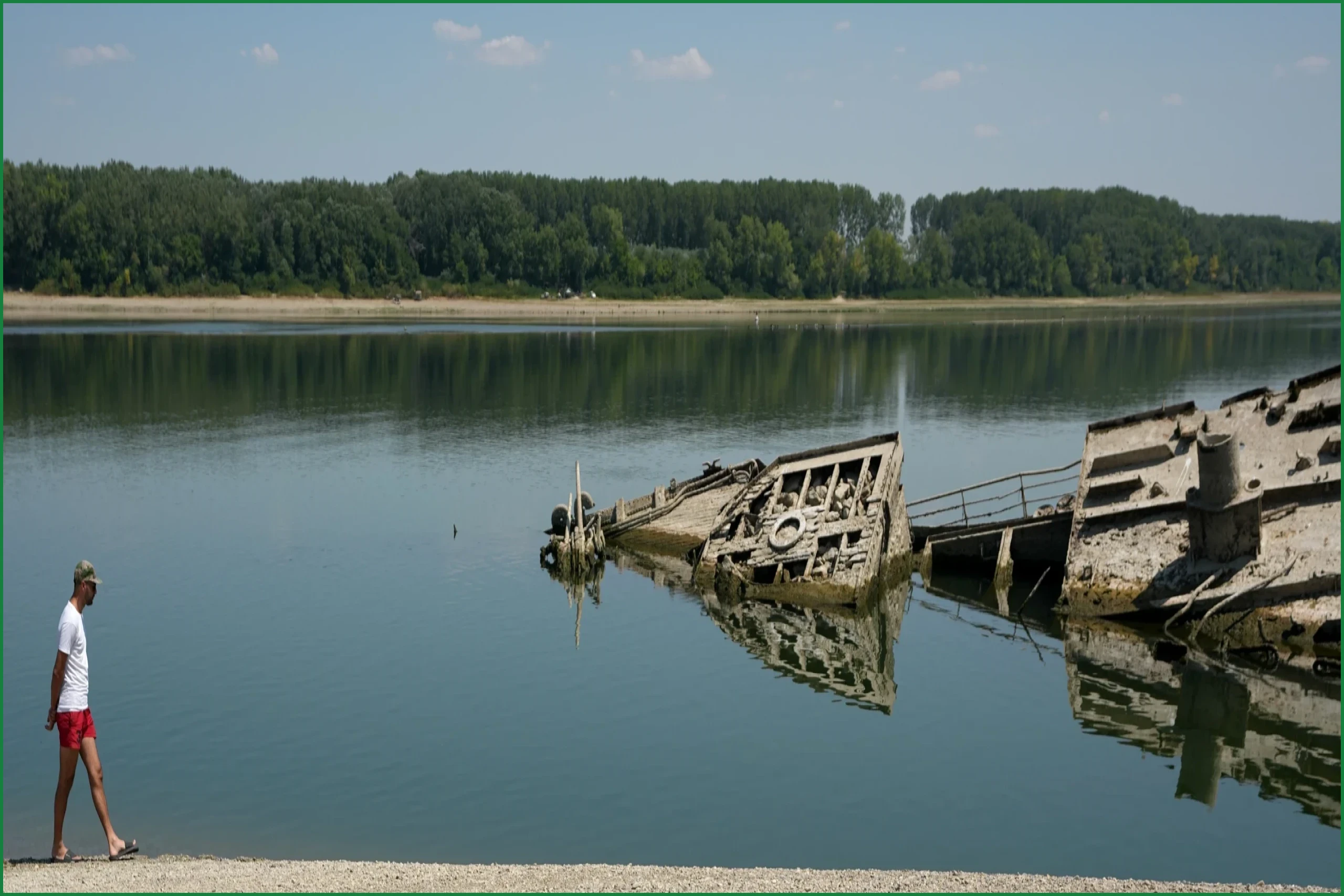
The drought's impact is also revealing historical relics. In Serbia, dozens of World War II German warships, scuttled by the Nazis during their 1944 retreat, have emerged from the Danube's depths near Prahovo, a stark visual reminder of how dramatically the river has receded. A man was seen walking on a sandbank by the wreckage of one such warship on Aug. 4, 2026.
Weeks of hot weather have created ideal conditions for wildfires across Europe, which have been particularly destructive in Greece in recent days. In the region of Western Attica, close to Athens, firefighters aimed to take advantage of a break in high winds to control a fire that has been burning since last week. On Monday, the flames had jumped containment lines, threatening to spread further. Greek state media outlet ERT News reported on Tuesday morning that over 500 firefighters were tackling the blaze, supported by multiple helicopters. Fire department deputy spokesman Yiannis Artopios told the outlet that conditions were constantly changing, making the flames difficult to tackle. The situation has tragically resulted in midair collisions between two firefighting helicopters on Sunday while they were tackling the Western Attica fire, killing two crew members. Earlier in the week, two firefighters died fighting a fire on Crete, and a third was killed on the Peloponnese region in southern Greece, according to the Greek fire service.
In France, many of the major wildfires that raged last week are now under control, though maps showed some active fires in the southeast on Tuesday. Over the weekend, most of the population of the southwestern Gironde region, near Bordeaux, were allowed to return home. The fires in France have also led to unexpected discoveries: what are thought to be unexploded munitions from World War II. On Monday, Martial Zaninetti, the mayor of the commune of Le Porge, told French media outlet France Info that bomb disposal experts had been directed to the area.
The record-breaking high temperatures have prompted official health warnings across the continent. In a heat wave bulletin published on Tuesday, the Italian Health Ministry said that 25 of the country's 27 major cities are on "red alert." The ministry added that all Italian cities would be elevated to red alert by Thursday. In the United Kingdom, the Health Security Agency (UKHSA) issued heat health alerts for eight regions of England for the first half of the week, warning that rising temperatures may increase health risks, particularly for vulnerable groups.
Record heat continues to be observed across Europe. Overnight into Tuesday, the Czech Republic recorded its highest overnight temperature ever – more than 82 degrees Fahrenheit or 27.9 degrees Celsius– in the eastern town of Bystřice pod Hostýnem, the local media outlet CT24 reported.