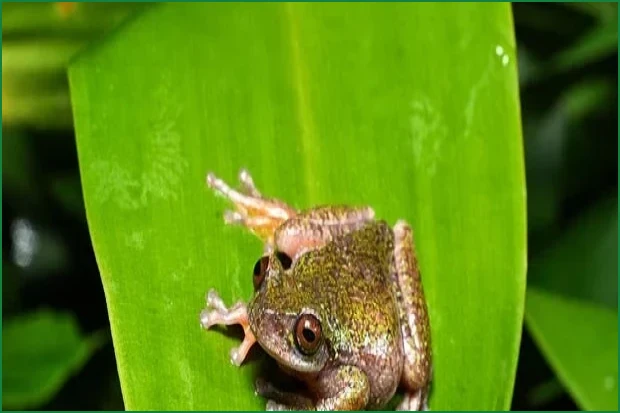
Researchers have confirmed the existence of a new tree frog species in Costa Rica's central Pacific region, a tiny amphibian that has become known as the "coffee frog" or "spring frog." As reported on August 8, 2026, at 3:48 PM EDT, measuring less than 4 centimeters in length, the dark green-spotted creature was observed by reporters in San Lorenzo de Tarrazu. While the species was first noted in the 1960s, it was historically misidentified, according to Costa Rica's National Alliance for the Conservation of Amphibians and Reptiles (ANCAR). The species was officially confirmed in 2021 following rigorous genetic and morphological studies.
Researcher Wagner Chaves-Acuna, who worked alongside colleagues from the University of Costa Rica and Argentina's National Council for Scientific and Technical Research, described the amphibian as endemic to the country. The frogs are nocturnal and possess a unique physical trait: males feature a translucent throat that inflates when they emit their characteristic short, high-pitched call. According to Chaves-Acuna, these frogs are frequently heard singing while perched on coffee shrubs at night, where they hunt for small insects rather than consuming coffee berries.
Despite their ability to thrive in the shade and moisture provided by the plantations, the frogs face significant environmental dangers. Chaves-Acuna expressed concern that the use of pesticides on these farms poses a direct threat to the population. He explained that these chemicals travel through the air and seep into the soil, eventually reaching the aquatic systems where the tadpoles develop. Beyond chemical exposure, ANCAR reports that the species is also vulnerable to the loss of vegetation, the encroachment of tourism, and the illegal dumping of waste within their habitats.