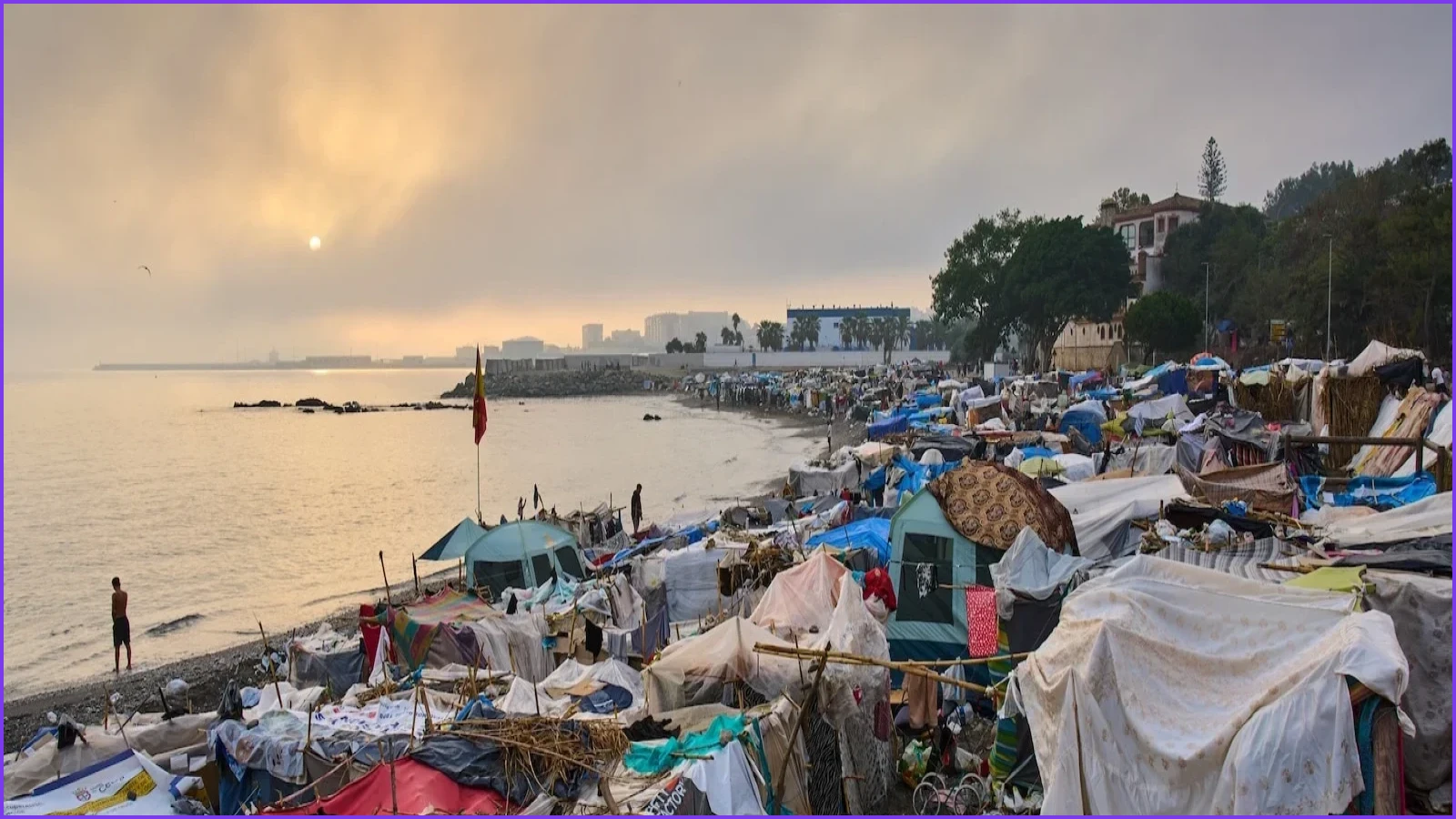
CEUTA, Spain – A humanitarian crisis is unfolding in Ceuta, Spain, where migrants in a sprawling tent village are grappling with alleged abuse by Spanish soldiers and fears of returning to persecution in their home countries.
Many arrived seeking better economic opportunities, while others fled war, violence, or sought refuge due to their gender or sexuality.
Among the allegations, a Moroccan migrant recounted a harrowing experience one September morning. He claims a group of Spanish soldiers tied his head to a tree, struck him repeatedly on the head, back, and arms, and then forced him and another migrant into a car trunk. He stated his mouth was covered with gray electrical tape during the ordeal.
“When they were beating me, I saw death, only death,” he said in an October 1 interview, adding, “Imagine your face being tied to a tree while they strike your head, taking hit after hit, right to the front of your face.” He received staples for his head injuries and showed healing wounds to The Associated Press.
He has since filed a police report, which the AP reviewed, and seeks to hold the soldiers accountable. Spanish prosecutors are currently investigating reports of torture and mistreatment of migrants in Ceuta, including minors.
In September, Amnesty International also published a report detailing allegations of inhumane treatment by Spanish soldiers.
“I never thought anything like this could happen,” the artisan migrant expressed. “We truly believed the people here are good and that the government is decent. Sometimes I ask myself why I even came here, but other times I tell myself that God will help me.”
The motivations for seeking protection are varied and deeply personal. A transgender teen, who swam to Ceuta from the Moroccan city of Fnideq in July, initially hoped for shelter but instead spent nearly two months at a beachside camp.
He left home due to the challenges of being transgender, stating in a September 29 interview, “People in Morocco don’t have any mercy.
They look at the outside of you, not the inside.” After briefly living with extended family in Ceuta, he was reportedly expelled upon the discovery of his identity. “They didn’t accept my situation,” he said. In early October, he returned to Morocco after police cleared the camp.
Another migrant, a soft-spoken 34-year-old man from Tetouan, northern Morocco, fled after his brother found pictures of him and his boyfriend on his phone and threatened to report them to the police.
Consensual same-sex sexual activity is illegal in Morocco, punishable by fines and up to three years imprisonment, with hundreds prosecuted annually, according to the U.S.
State Department. “I left Morocco because being gay is so hard,” he explained. Homosexuality is frequently cited as a ground for asylum claims by Moroccans.
A 28-year-old Moroccan asylum seeker reported receiving death threats for posting content critical of Islam online. He hosted TikTok livestreams focused on religion in 2025 and claims he was kidnapped in Marrakech by a follower.
“That was the tipping point,” he said. Publicly criticizing Islam in Morocco can lead to criminal prosecution, prison sentences, and fines. He crossed into Ceuta in July, joining tens of thousands of others.
“The first week was pure survival,” he recalled. “It felt like running from zombies; some people wanted to attack you, others wanted to rob you.” He fears for his safety if repatriated to Morocco. The Associated Press could not independently verify his claims but reviewed his asylum paperwork detailing them to Spanish authorities.
Spain’s asylum law recognizes gender identity and sexual orientation as valid grounds for seeking protection, with cases assessed individually.