Beijing has executed a calculated diplomatic shift in how it approaches the term "Global South," transforming from an outspoken critic of the phrase into an active proponent attempting to shape its definition on the world stage. Originally rooted in academic discourse to describe issues that transcend strict spatial boundaries between developed and developing nations, the terminology began to shift significantly around 2020. Following the outbreak of the war in Ukraine, Western nations increasingly drew a sharp distinction between advanced democracies and an axis comprising China, Russia, Iran, and North Korea, framing the remaining nations as the "Global South."
Initially, Chinese officials viewed the concept with deep suspicion, regarding it as a Western-crafted framework designed to drive a wedge between Beijing and the developing world. Because China consistently self-identified as a developing country and a representative of the developing world, it rejected any label that sought to separate it from those nations. However, Beijing received a major diplomatic jolt on January 12 and 13, 2023, when India hosted the virtual "Voice of Global South Summit" and did not extend an invitation to China.
Despite continuing its vocal criticism after the Indian summit, Beijing began recalibrating its policy following the enactment of its Foreign Relations Law on June 28, 2023. Article 4 of that law explicitly calls for upholding the five principles of peaceful coexistence while twice incorporating the specific phrase "developing country" (发展中国家), formally reaffirming China's identity as a developing nation.
A clear shift in diplomatic rhetoric emerged in July 2023, when Chinese Foreign Minister Wang Yi suddenly began incorporating "Global South" into his speeches at international forums, albeit initially enclosed in quotation marks. During the BRICS National Security Advisers and High Representatives on National Security meeting in Johannesburg on July 25, Wang deployed the term in quotation marks, prompting Chinese Foreign Ministry Spokesperson Mao Ning to offer an official definition during a subsequent press briefing. Mao stated that "The 'Global South' is the family of emerging markets and developing countries."
Framing China's distinct perspective, Wang Yi outlined "independence," "development," and "justice" as the fundamental attributes of the Global South, explicitly declaring that "China is a natural member of the Global South and will always be part of the developing world." Although Beijing provided no formal explanation for its change in strategy, analysts indicate the move represents a calculated effort to pursue what China terms "discourse power." As the phrase gained widespread adoption among developing world leaders without a universally agreed definition, Beijing stepped in to define the term on its own terms and steer global narrative in its favor.
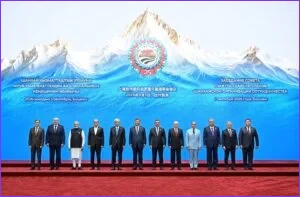
The domestic acceptance of the term grew as both Wang and President Xi Jinping repeatedly used "Global South" in quotation marks. By the end of 2024, Chinese official documents began dropping the quotation marks altogether. In an article published by Wang in the official journal Qiushi in 2025, the quotation marks were omitted as well. Although minor usage inconsistencies persisted into 2025, the transition culminated at the Shanghai Cooperation Organisation (SCO) and BRICS summits in 2026, where Xi used "Global South" without quotation marks.
On the broader international stage, the term "Global South" still lacks a unified global definition, leaving room for competing global actors to imbue it with their own geopolitical meanings. By defining the Global South as "the family of emerging markets and developing countries"—effectively equating it to the non-Western world—China has positioned itself as both a member and a leading representative of this grouping. This ongoing competition over a single phrase underscores fundamental differences in worldview dividing China and the developed world.
You have reached the limit of 2 free articles this month.