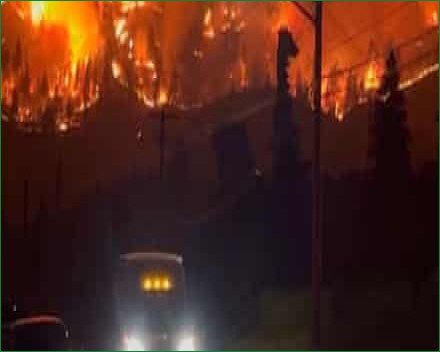
The Canadian federal government has committed to providing urgent assistance to British Columbia following a series of unprecedented and fast-moving wildfires that have forced roughly 22,000 people to evacuate their homes. As of Sunday, the BC Wildfire Service reported 102 active fires across the province, with nearly half classified as out of control. Alarmingly, 78 of these blazes ignited within the past week.
The evacuations included the entire community of Summerland, located 50km south-west of Kelowna and home to 12,000 people, as well as 8,000 residents from the nearby Peachland area. An additional 10,000 people have been placed on standby, warned to prepare for evacuation at a moment’s notice. Eleanor Olszewski, Canada’s minister of emergency management and community resilience, confirmed on social media that she approved a request for federal aid to help provide shelter and accommodations for those displaced. She has tasked federal officials, led by the government operations centre at Public Safety Canada, to coordinate with provincial authorities to ensure support reaches those in need.
Efforts to contain the Bald Range wildfire have been particularly difficult due to its rapid spread. The blaze was first detected late on Friday evening, and grew within hours to more than 100 sq km (39 sq miles) – nearly twice the size of the island of Manhattan – as it raced nearly 15km (9 miles) toward Okanagan Lake. British Columbia Premier David Eby declared a state of emergency late Saturday, describing the intensity of the blaze as being "like a bomb going off." Cliff Chapman, director of provincial operations for the BC Wildfire Service, attributed the "explosive" conditions to a long period of hot, dry weather, warning that incoming thunderstorms and lightning could further complicate the situation.
Residents described a chaotic escape, with many woken in the night to flee. Jennifer Pascoa of Summerland told the Canadian Broadcasting Corporation that the speed of the fire was overwhelming, noting that the sky turned black with smoke within an hour of her seeing a plume while returning from the beach. While the BC Wildfire Service has deployed 10 helicopters and a specialized night-vision aircraft, their efforts have been hampered by thick smoke and severe turbulence. The Royal Canadian Mounted Police are currently investigating a potential fatality near the Summerland fire.
Mike Flannigan, a professor of wildland fire at Thompson Rivers University, noted that the current fires are indicative of increasingly extreme conditions driven by human-caused climate change. Before this decade, fire agencies’ policy was that if a blaze was 20km away from a community, there was no cause for immediate concern. The ferocity and speed of today’s fires meant that such calculations no longer held, said Flannigan, warning that all homes in at-risk regions should have an emergency kit ready to go. "If a fire can run 60km in a day, you should be worried about it," he said.
With parts of southern BC and the US Pacific North-west having seen little to no rain for six weeks, the landscape is extremely dry. Flannigan emphasized that traditional firefighting strategies are no longer sufficient, as modern fires can now maintain momentum through the night. He warned that the fire season could extend into the fall, potentially leading to "fire years" rather than a traditional summer season, and expressed significant concern for the weeks ahead.
Drought and the sheer power and size of the fires during the day allow them to keep momentum even in the dark. Fire management agencies in BC and Alberta now fight fires at night, using night vision helicopters.