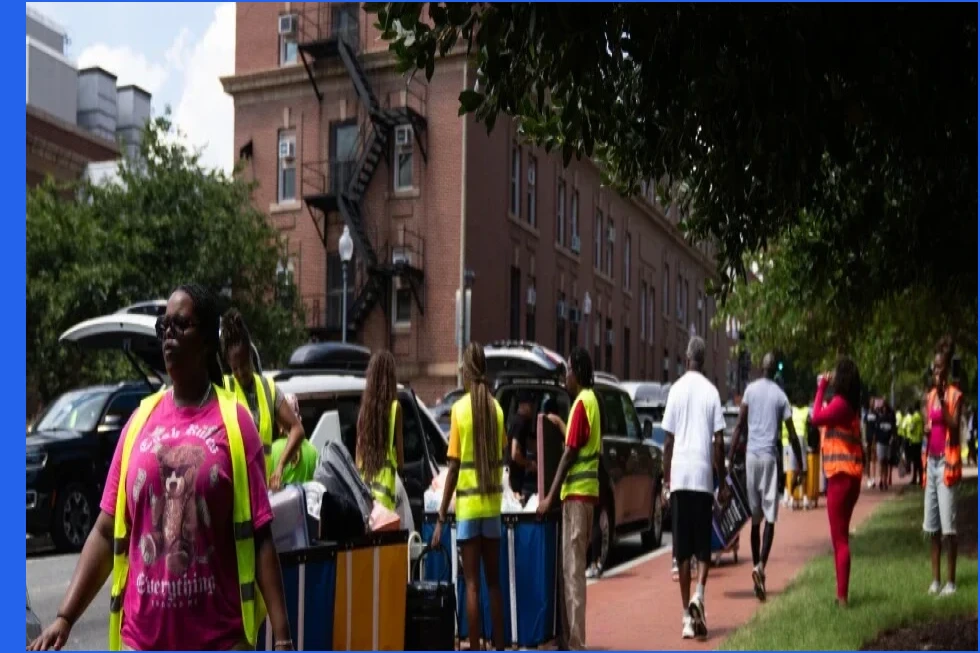
WASHINGTON — Carrying five boxes and a backpack, 17-year-old Nikiyah Clark finally received the keys to her Howard University dorm room. Just weeks earlier, administrators at the historically Black university had told her this moment would never happen. After being informed that she was permanently unenrolled for missing a tuition payment deadline, Clark had ridden a bus from Cleveland, Ohio, to plead her case in person, only to leave the campus in tears.
Having pinned her hopes on Howard as a peaceful path to financial freedom after years of growing up in what she described as survival mode, Clark felt she had lost both her dream and her way out. Though the university eventually restored her enrollment, she remained anxious as she moved into her campus housing, worrying the decision could be reversed again and hoping the school would reform its processes to protect future students.
The administrative disruption has cast a shadow over the start of the new academic year. Howard University officials confirmed that more than 500 incoming first-year students were unenrolled after missing a July tuition payment deadline. While about 200 of those students have since had their enrollment restored, the incident has drawn intense scrutiny from students, families, and alumni.
Adding to the tension, reports emerged that the mass unenrollment occurred roughly a month after Howard offered voluntary early retirement buyouts to 600 eligible employees. The university has stated that the employee buyouts are entirely unrelated to the student enrollment issues, describing them as part of a pre-existing plan for long-term financial sustainability.
For many within the Howard community, the situation has raised difficult questions about the administrative operations of one of the nation's most prestigious historically Black colleges and universities (HBCUs). Zy’Aira Blackmon, an 18-year-old freshman from Grand Rapids, Michigan, had her heart set on attending the school, which is widely regarded as a premier Black institution.
However, after her enrollment was revoked and then reinstated within a matter of days, Blackmon said the university's luster had been dulled. She explained that her scholarship had not been properly factored into her outstanding balance, prompting her to send constant emails and make phone calls until she was reinstated without much of an explanation from the administration.
Other families experienced even harsher interactions. When 17-year-old Yuisa Davis had her enrollment rescinded, her mother, Karina Polen-Davis, flew from their home in Puerto Rico on July 28 to seek clarification. Upon arrival, an administrative official told Polen-Davis and her husband, who was participating via speakerphone, that she could not answer their questions, and subsequently called security.
The Davis family maintained that they had paid what they believed they owed, but the university canceled Yuisa's enrollment without offering an explanation or a clear path to resolution.
Consequently, Yuisa Davis is now working with The New School in New York City to secure financial aid, with her father, Kenneth Davis, describing the difference in how they were treated by the two institutions as night and day.
Howard University's Interim President, Wayne A. I. Frederick, defended the institution's actions, stating that the university was simply enforcing its established payment policy. He pointed out that 2,200 students successfully met the payment requirements.
According to Frederick, the unenrolled students and their parents failed to properly read official communications regarding a July 10 deadline to pay half of their remaining balance after financial aid was applied.
He argued that students who followed the rules deserved to arrive on the first day of classes on August 17 with their housing and course schedules fully secured, noting that in previous years the university had to scramble to accommodate late registrants by rushing to find housing and hiring adjunct professors.
However, some education advocates and alumni believe the university must share the responsibility. Ashley Christopher, an attorney, Howard alumna, and founder of HBCU Week—a foundation that awards scholarships—stated that students likely received bad information from the school.
Christopher, whose son is currently a sophomore at Howard, argued that the university should take accountability for its administrative missteps rather than placing the entire burden on families.
Despite the controversy, which she described as a scandal, Christopher does not believe the issue will permanently damage Howard's reputation as "The Mecca" of Black education, noting its historical role as a blueprint for other HBCUs.
The nearly 160-year-old institution remains a cornerstone of American higher education, counting prominent figures such as Vice President Kamala Harris and the late actor Chadwick Boseman among its alumni. According to the U.S. Department of Education, Howard boasts a 90% student retention rate and a 70% six-year graduation rate.
With annual attendance costs exceeding $66,000, the university's graduates earn a median income of approximately $73,000 four years after graduation.
Frederick emphasized that Howard has graduated more Black doctors than any other institution in the United States, asserting that the administrative handling of the unenrollment issue will ultimately strengthen the university's legacy and administrative performance moving forward.