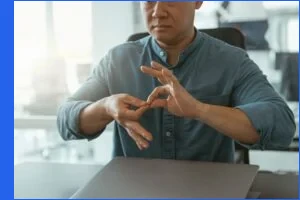
Learning to communicate through sign in China presents a multifaceted challenge due to the existence of several distinct systems. At one end of the spectrum is "Signed Chinese," or shoushi hanyu, which functions as a one-to-one transcription of written standard Chinese, even including punctuation like signed question marks. In contrast, "Natural Sign Language," known as ziran shouyu, is the language actually used by native deaf signers. This natural form features syntax and grammar that differ significantly from spoken Chinese, relies heavily on abbreviations, and incorporates essential facial expressions, as is typical of natural sign languages globally.
The academic landscape further complicates these definitions by introducing terms such as "Literary Sign Language" (wenfa shouyu) and "Society Sign Language" (shehui shouyu), which are often used interchangeably or exhibit overlapping meanings. Since 2018, the Chinese government has actively promoted Guojia Tongyong Shouyu, or Chinese General Sign Language (CGSL). The Chinese Ministry of Education positions CGSL as the sign language equivalent to Standard Mandarin. While CGSL has moved away from a direct basis in spoken or written Chinese and incorporates elements of natural sign languages to appear less alien to native deaf speakers, it remains unclear whether the deaf community considers this standardized variety a truly natural language.
For those attempting to learn the official CGSL lexicon, a user-friendly app offers tools such as daily quizzes, targeted tests, and themed glossaries. However, the app suffers from a significant lack of lexemes. Essential words like "curious" or "already" are absent from the dictionary. Furthermore, the selection of vocabulary often reflects official political priorities rather than practical utility; for instance, while the "Taiwan Democratic Self-Government League" is included, common terms like "weekend" are missing. The dictionary also lacks vocabulary related to sexuality or "taboo" body parts, which poses practical difficulties for professionals such as sign language interpreters in medical settings.
Individual experiences with learning these languages highlight the divide between official instruction and community usage. Previous attempts to learn through online classes often involved "old-school" methods that taught Chinese words without grammar or facial cues, failing to reflect how deaf individuals actually communicate. Conversely, learning from native speakers is complicated by regional and individual variations. This lack of a standard is so prevalent that even native deaf speakers sometimes struggle to understand one another.
This communication gap extends to official media. A study found that up to 84 percent of deaf participants struggled to comprehend the sign language used in television programs. This phenomenon is often attributed to xingshi zhuyi, or pointless formalism. While the 2008 Law of the People’s Republic of China on the Protection of Disabled Persons mandates sign language for television, state-owned broadcasters may prioritize checking a regulatory box over producing content that is actually comprehensible to the deaf audience.
Despite these barriers, social media platforms like WeChat and Xiaohongshu have become hubs for the deaf community. Content creators are using these spaces to teach, discuss linguistic differences, and critique the artificial nature of official sign language. Some users are even using these platforms to openly discuss governmental policies. While the future of "Signed Chinese" appears limited, the rise of media-savvy younger generations suggests a dynamic evolution for the future of sign language in China.
What I had not foreseen was how the natively spoken natural sign languages not only vary from region to region, but seemingly even from speaker to speaker. Without classroom instruction and with different speakers signing in different ways, it soon became hard to know which was the “correct” way to sign. Apparently, I was not the only one with this problem: one of my deaf acquaintances said he would often not understand what other native deaf speakers were saying.
Surprisingly enough, some deaf users are also openly discussing governmental policies, seizing a rare opportunity for a marginalized group to talk about the political reforms directly affecting them. That these topics apparently have a low level of political sensitivity might, however, not be something to view entirely as a positive. Perhaps it simply speaks to the level of neglect of the deaf community.