Firefighters in southwestern France reported on Friday that they were actively working to suppress four remaining hotspots, marking a critical phase in the effort to extinguish massive wildfires that have consumed 100,000 acres of forest, farmland, and villages over the past week. Lt. Col. Eric Pitault, the spokesman for the Gironde region's fire services, stated that while the overall situation has reached a state of stabilization, there are still specific zones that remain difficult for emergency crews to access.
Authorities are currently aiming to achieve full control over the fires by the coming weekend.
A significant milestone in the recovery effort occurred Thursday night when tens of thousands of residents near Bordeaux were permitted to return to their homes. Sophie Brocas, the prefect of the Gironde region, described the development as the first somewhat optimistic day of the crisis. According to data from the Associated Press, this follows an earlier wave of returns on Tuesday, when 60,000 people were cleared to go back. Brocas noted that the region is finally beginning to return to the path of a normal life.
Despite these returns, thousands of people remain in temporary shelters, including the Bordeaux convention center. Among the 6,000 displaced individuals currently housed there is 90-year-old Marie Lalana, who recounted to reporters that she was forced to flee her home with such urgency that she left behind essential personal items, including her hearing aids, glasses, and dentures.
While the mass evacuations were largely preemptive and resulted in no known civilian casualties, the fires have proven deadly for emergency responders. Two firefighters lost their lives earlier in July while battling a forest fire in the vicinity of the Bordeaux-Merignac Airport. Aurélien Costes, a scientist with San José State University, explained that the erratic nature of these fires mirrors blazes seen in California.
He noted that intense downdrafts hitting the ground can generate winds blowing in any direction, creating unpredictable fire behavior that makes it exceptionally difficult for firefighters to anticipate the path of the flames. Costes warned that such intense fire conditions are likely to become more frequent as global temperatures continue to rise.
The crisis in France is occurring against the backdrop of an unusually prolonged and intense heatwave affecting the entire European continent. Scientists from World Weather Attribution have stated that these weather conditions have significantly increased the likelihood of wildfires across Europe. A new study from the group indicates that human-induced climate change has made fire-prone conditions at least twice as likely in southwestern France and at least 20 times as likely in central Spain.
In Spain, major wildfires earlier this month near Madrid and in the Castellón region forced tens of thousands to evacuate, resulting in at least one death in the town of Manises.
The impact of the heatwave is widespread. In Greece, thousands were evacuated from the island of Crete this week due to fires on the south coast. The situation in Greece has been particularly tragic, with two firefighters dying on Crete and a third losing his life while battling a separate blaze on the Greek mainland.
Meanwhile, in Turkey, responders have been tackling forest fires across four western provinces, and in Germany, crews have deployed helicopters and drones to combat a forest fire near the Austrian border.
The United Kingdom has also faced significant challenges. In the county of Suffolk, firefighters worked to contain a 350-acre blaze that broke out Wednesday afternoon just three miles from the Sizewell B nuclear power station. While the situation was reported as stabilizing by late Thursday, the broader region is struggling with a declared drought.
The Environment Agency stated that half of England is currently in drought due to weeks of low rainfall and high temperatures, leading to low river levels and strict water usage restrictions for millions of residents.
The energy sector has also been affected by the heat; both Hungary and Romania have been forced to shut down reactors at their respective nuclear power plants. In both cases, officials cited record-low water levels in the Danube River, which is essential for cooling the plants. In the southeastern French town of Brignoles, fires also forced hundreds to evacuate, including actor George Clooney and his family.
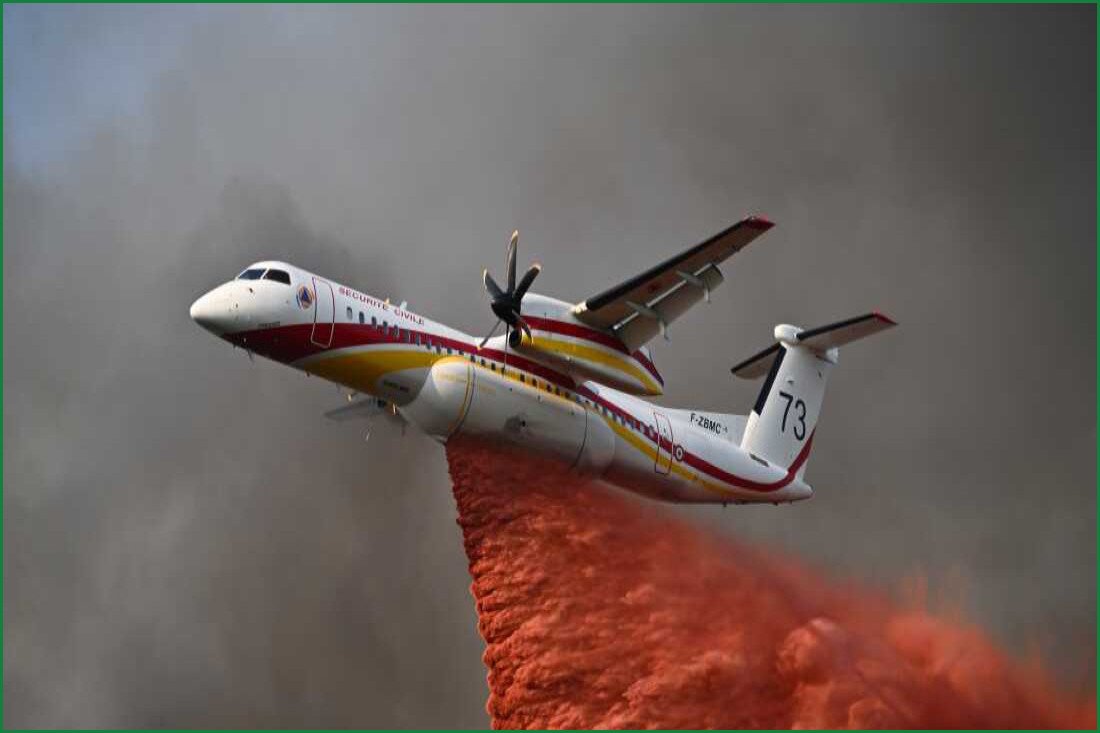
A plane releases fire retardant as it flies over a forest near Blagon, during wildfires in southwestern France, July 29, 2026. Emma Da Silva/AP hide caption
A firefighter walks in front of burning trees as a wildfire rages near Marcheprime, outside, Bordeaux, France, July 26, 2026. Emma Da Silva/AP hide caption