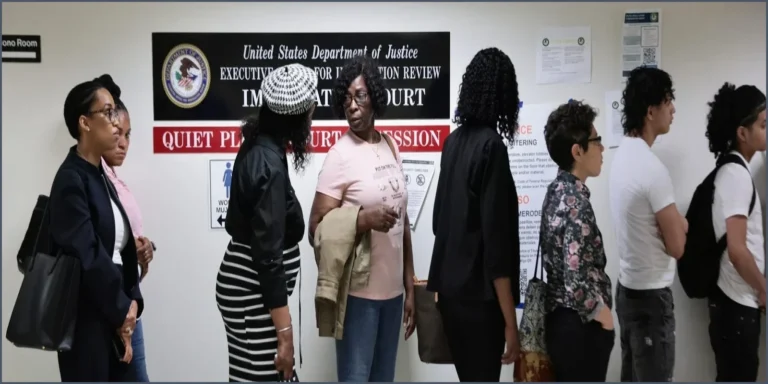
The second Trump administration has significantly ramped up its deportation efforts, utilizing a potent and often overlooked tool: accelerated mass hearings within the US immigration court system. While public attention has often focused on the visibility of enforcement agents, the quieter transformation occurring inside courtrooms is driving record-breaking numbers of removal orders. In June alone, more than 100,000 immigration cases were closed, with the vast majority resulting in deportation orders.
These proceedings, colloquially referred to by attorneys as “mega-masters,” deviate sharply from the traditional purpose of master calendar hearings. Master calendar hearings are also typically a group affair, with more than one person or family on the schedule. But the sheer scale of today’s “mega masters” – 70, 100, 150 cases at once – was relatively rare up until May, when the phenomenon started ballooning, before exploding in June. In Chicago, for instance, a single judge recently oversaw 185 cases in a single sitting, a dramatic increase from the typical volume of 20. Between March and June, deportation orders issued by Chicago judges surged by 120%.
A critical component of this trend is the rise of removal orders issued “in absentia,” meaning the judge orders deportation because the individual failed to appear at their hearing. Last month, more than 78% of completed cases ended in such orders. Nationwide, these mega-masters accounted for over 20,000 absentia orders in June alone, representing nearly two out of every five such rulings, despite only a fraction of the nation’s roughly 700 immigration judges presiding over these mass hearings. Many immigrants report never receiving notification of rescheduled court dates, which are often moved up by months or years. Others fear attending due to the threat of courthouse arrests.
The logistical burden of these sudden schedule changes is immense, requiring immigrants to secure time off work, travel long distances, and arrange childcare on short notice. Data from Kansas City illustrates the impact of these timelines: a docket with a median lead time of 15 days saw 56 absentia orders among 93 people, while a second docket, where 96 people had a median lead time of 196 days, resulted in only nine such orders. At the same time, absentia orders constituted more than two-thirds of all removal decisions from immigration judges last month, which clocked in at just under 79,000 in total. Only 1,883 completed cases – or fewer than 2% – ended with the person winning any form of relief.
With fewer than 2% of completed cases resulting in any form of relief in June, the path to legal status is narrowing. Only one in five immigrants had legal representation when they were ordered deported, making it extremely difficult for those labeled as “no-shows” to reopen their cases. Once a removal order is issued, individuals become immediate targets for detention by federal, state, or local law enforcement. This erosion of due process has led to an increase in arrests and is effectively shutting off the opportunity for many to present their claims for asylum or other protections.
Notwithstanding that many immigrants have said they never received a letter telling them their appointments had been rescheduled, often to months or years earlier than their previous dates. Or that people are scared to attend their hearings after high-profile arrests at immigration courts across the country. Or even that the Chicago court is scheduling so many of these mass hearings with different judges around the same time that up to 611 people are being told to arrive at the courthouse at once, causing chaos.
Historically, master calendar hearings have been for basic administrative tasks, like the judge reading immigrants their rights and responsibilities, determining if the allegations in their immigration records are accurate, and setting dates for hearings to determine if they qualify for asylum or another form of immigration relief.