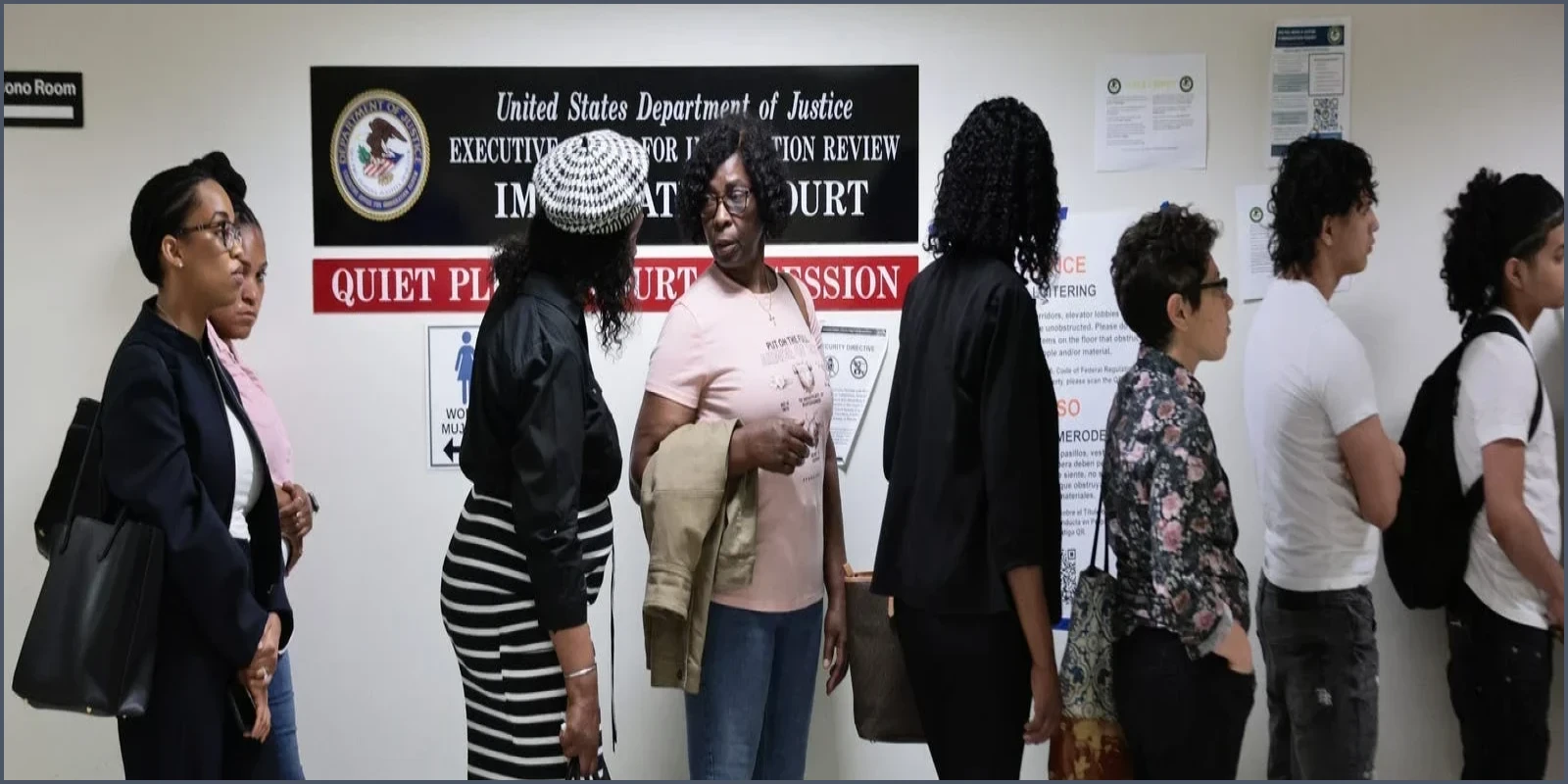
Lines stretching out courthouse front doors, overflow seating set up in hallways, and classroom-style exchanges where judges ask large crowds to raise their hands in response to generic questions have become the new normal in federal immigration courts. Across the United States, the Trump administration is increasingly relying on mass hearings in an effort to rapidly push cases through the heavily backlogged immigration system.
These proceedings, known as "mega master" hearings, pack between 50 and 100 cases—and sometimes far more—into a single court session. Federal officials state that the format is designed to cut down the massive backlog of cases in immigration courts, which are run by the Department of Justice (DOJ). However, critics argue that the practice slashes the already limited due process available to immigrants, leaving them with little to no meaningful time to present their cases before a judge.
The frequency of these large hearings has ticked up significantly since May, coinciding with a surge in detentions and deportations in recent weeks, according to data from U.S. Immigration and Customs Enforcement (ICE). At the same time, the administration has made it easier for immigration authorities to deny asylum claims, and legal observers report that more children, including unaccompanied minors, are being brought before judges for these mass proceedings.
While master hearings involving 20 to 30 people have been commonplace in the immigration system for years, the sheer size of these recent sessions is alarming immigration attorneys, who describe them as chaotic and intentionally rushed. One of the central concerns is that immigrants are having their scheduled court dates moved up by months or even years, leaving them with very little time to prepare. Critics also note that the rapid pace and general confusion surrounding the hearings have caused more people to miss their court dates, which often results in automatic removal orders.
"This will push many more people into deportation proceedings," warned Muzaffar Chishti, a senior fellow with the nonpartisan Migration Policy Institute.
Supporters of the strategy, however, argue that the hearings are a necessary tool to address the more than 3.4 million cases pending in the immigration court system, which has been severely strained by backlogs for years. "This is a very effective way to reduce the backlog," said Matt O'Brien, a former immigration judge who serves as the deputy executive director of the Federation for American Immigration Reform, a group that advocates for stricter limits on immigration.
In a statement addressing the strategy, the Department of Justice said: "Reducing the immigration court backlog remains one of the highest priorities for this administration. The Justice Department is restoring integrity to our immigration system by hearing cases fairly, expeditiously, and uniformly, in accordance with the law.”
Master hearings are brief initial proceedings where judges review the government's charges, ask what legal relief an immigrant is seeking, and determine if they have legal counsel. Judges then schedule subsequent individual hearings where specific requests, such as asylum, are litigated. In recent months, immigration attorneys have reported a sharp rise in these large-scale hearings in courts nationwide, spanning states such as Iowa, Texas, New Jersey, and Massachusetts. Data analyzed by Mobile Pathways, a nonprofit that tracks immigration court data, shows that over 1,300 such hearings were held in June alone, representing a nearly threefold increase compared to the same period in 2025.
Joseph Perez, an immigration attorney based in Virginia, noted that while smaller hearings of 20 to 30 people are manageable for immigrants, judges, and court staff alike, the new massive sessions are highly problematic. "These larger hearings go on all day," Perez said. "It’s unreasonable."
In Chicago, immigration lawyers described chaotic scenes where nearly 200 people were scheduled before a single immigration judge. Respondents crowded into courtrooms and packed the hallways. Once the proceedings began, individuals at the back of the room struggled to hear the judge ask basic collective questions, such as "How many of you have a lawyer?" and "Are you claiming asylum?"
“The sheer scale of these ‘mega master’ hearings is truly unprecedented,” said Kiki Moseley, chair of the American Immigration Lawyers Association, during a July news conference in Chicago.
Even some supporters of the larger hearings have expressed concern that the high-volume format could lead to severe burnout among immigration judges. "There is a danger there," said Andrew Arthur, a resident fellow in law and policy at the conservative Center for Immigration Studies.
This pressure led to the resignation of former Chicago immigration judge Elizabeth Treacy on June 22. Treacy stepped down after presiding over three large master hearings that each listed between 130 and 150 people. “Whenever you have a high volume of anything in any field, it leaves a possibility for error because of fatigue [and] because of the repetitive nature of what you’re reviewing,” Treacy said. “I never wanted to make a mistake in those kinds of circumstances.”
The Executive Office for Immigration Review (EOIR), the agency within the DOJ that oversees immigration courts, defended the scheduling system in a statement. The agency said it "prioritizes the timely completion of all cases and makes scheduling adjustments as needed to ensure cases do not languish." The EOIR added, "Unnecessary delay hurts both aliens with meritorious claims and the American public who wish to see aliens with non-meritorious claims removed as quickly as possible. As it continues to add new immigration judges, EOIR will continue to make scheduling adjustments to ensure all cases are handled in a timely and lawful manner.”
The rise of mass hearings has coincided with a dramatic increase in the number of cases ruled in absentia, in which a judge issues a deportation order because the respondent failed to appear in court. According to DOJ data analyzed by Mobile Pathways, 58% of the 10,370 people assigned to hearings in June were ruled absent and ordered deported.
Moseley and other immigration attorneys stated that officials provided little to no notice to individuals whose court dates were advanced by months or years. Advocates also noted that some immigrants did not show up out of fear of being arrested inside the courthouse—a enforcement tactic employed by the Trump administration for months before being blocked by a court order last year. Other immigrants allegedly arrived at the courthouse on time but were still issued removal orders due to overcrowding and confusion.
“We have witnessed immigrants being ordered removed for missing their court dates – not because they did not come to court, but because they arrived on time and amid the overcrowding and confusion, could not find the correct courtroom or hear their case being called,” Moseley said. Immigration attorneys argue that the administration is relying on these high rates of in absentia orders to quickly close cases, issue removal orders, and funnel more people into deportation proceedings.
University of Iowa law student Chase McLaren attended what is believed to be the first "mega master" hearing in Omaha, Nebraska. McLaren reported that the judge issued deportation orders in a "rapid fire" manner, and that every single person who did not attend the day's hearing received a removal order.
However, Andrew Arthur of the Center for Immigration Studies attributed the high number of absentia orders primarily to the Biden administration, which he argued failed to properly screen undocumented immigrants at the border. Arthur noted that the federal government bears the burden of proving it served a hearing notice to an immigrant's last known address. If the government fails to do so and a removal order is issued, the respondent can file a motion to reopen the case. "There's a lot of due process built into the system," Arthur said, adding that the Trump administration has "made great progress at driving down the backlog," pointing out that pending cases decreased in fiscal year 2025 for the first time in over a decade.
According to the EOIR, the immigration court backlog stood at over 3.4 million cases as of June. This is a decrease from 3.7 million a year earlier and down from a peak of 3.9 million during the final year of the Biden administration, which saw the backlog more than double starting in 2021.
To support its broader deportation agenda, the administration has also carried out a record hiring spree of immigration judges. Records show that many of these new judges have past ties to the federal government and lack direct experience in immigration law. For example, an investigation in Omaha, Nebraska, revealed that all the immigration judges handling cases there had served as legal counsel for ICE within the last decade, with some working in that capacity just months before their appointments.
Unlike federal district judges, immigration judges are part of the executive branch and are appointed directly by the U.S. attorney general rather than being confirmed by the Senate. This structure has drawn criticism from immigration attorneys and legal experts who argue that the hiring process has become partisan, emphasizing loyalty to the president's agenda over objective adjudication.
The EOIR countered this criticism, stating that it evaluates all immigration judges on factors such as conduct, impartiality, adherence to the law, productivity, and professionalism, regardless of their professional background. The office emphasized that all judges are under a legal, ethical, and professional obligation to remain impartial and neutral when deciding cases.