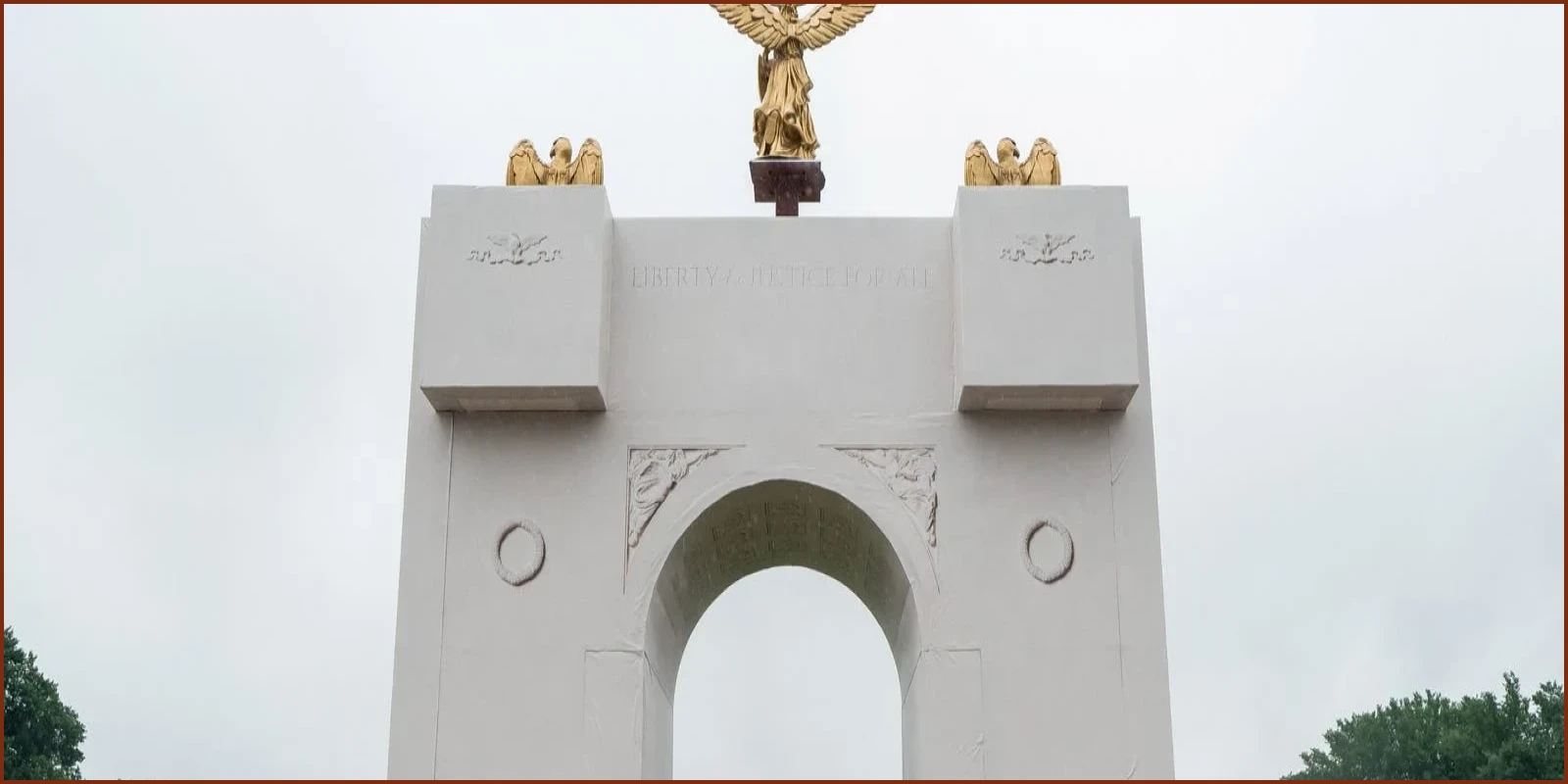
The National Park Service has issued its support for President Donald Trump's proposed 250-foot "Triumphal Arch" near Arlington National Cemetery, despite acknowledging that the massive monument will negatively impact the historic vistas of numerous iconic Washington landmarks.
According to a report released on August 28, the federal agency decided to back the project, which is designed to commemorate 250 years of American independence by honoring the nation's founding principles. The planned location sits at the intersection of Arlington Memorial Bridge and George Washington Memorial Parkway, directly in front of the entrance to Arlington National Cemetery. The Park Service's report noted that placing the monument at this site aligns with the avenue's traditional function as a ceremonial gateway and "Avenue of Heroes" that honors valor, sacrifice, and American heritage.
Standing 250 feet tall—a height deliberately chosen to symbolize America's upcoming 250th anniversary—the arch will tower over the nearby Lincoln Memorial and approach the 288-foot height of the U.S. Capitol building. Despite initial concerns regarding its scale, the Park Service rejected proposals to build a smaller arch. The agency explained that a scaled-down version would actually block views of the Lincoln Memorial rather than frame it properly.
The proposed Triumphal Arch is designed as a reinforced concrete structure finished with a granite facade. It will feature a central winged figure, two eagles, and an observation deck offering visitors elevated views of the surrounding historic landscape. This monument represents one of several major initiatives spearheaded by the Trump administration to reshape the capital's visual identity. Other projects include the controversial remodeling of the Lincoln Memorial Reflecting Pool, a new ballroom addition to the White House, and a granite helipad on the executive mansion's grounds.
While the Park Service endorsed the plan, its report detailed "adverse effects" on dozens of historic sites. These impacts are primarily visual, disrupting the scenic views to and from these historic spots rather than causing physical damage to the structures themselves. Under federal guidelines, an adverse effect occurs when a project alters the characteristics of a historic property in a way that diminishes its integrity of location, design, setting, materials, workmanship, feeling, or association. The most heavily impacted locations will include Memorial Circle, Arlington Memorial Bridge, Memorial Avenue, Arlington National Cemetery, Arlington House, and the Lincoln Memorial corridor.
To address these concerns, the Park Service dismissed alternative proposals to relocate the arch, stating that moving it would defeat the purpose of its site-specific design. Instead, the agency pledged to mitigate the negative impacts by minimizing construction disruptions, rehabilitating existing architecture along Memorial Avenue and the bridge, and developing educational materials for visitors. Explaining its decision, the agency stated that while Memorial Circle is part of a highly sensitive historic and commemorative landscape that contributes to the project's adverse effects, those very same sensitive characteristics make it the most historically appropriate location for the monument.