The military landscape on the Korean Peninsula is undergoing a significant transformation as both North and South Korea ramp up their development and deployment of long-range drones and missiles. Drawing lessons from recent conflicts in Ukraine and Iran, both nations are increasingly focused on "deep strike" capabilities, moving beyond traditional artillery and nuclear deterrence to integrate low-cost, long-range attack drones into their arsenals.
For South Korea, the rise of these systems poses a growing challenge to its surveillance capabilities. North Korea’s expanding missile and nuclear programs, combined with a wider array of launch platforms, have created a difficult environment for the South to monitor. The proliferation of affordable attack drones further complicates this, as North Korea’s ability to conceal and deploy offensive firepower continues to outpace South Korea’s current capacity to neutralize it. This shift poses a significant hurdle for the Lee administration’s goals regarding the transition of wartime operational control from the United States, as South Korean forces will require enhanced capabilities to meet established qualitative standards.
The competition for aerial dominance has evolved over the last two decades. While North Korean reconnaissance drones were first noted during the 2010 Yonpyeong Island shelling, recent years have seen more frequent incursions. Notably, in December 2022, five North Korean drones flew over Seoul, reaching the presidential office. In response, then-President Yoon Suk-yeol proposed reciprocal incursions, and in October 2024, North Korea alleged that South Korean drones had overflown Pyongyang, a claim that was officially denied despite public analysis linking the imagery to South Korean systems.
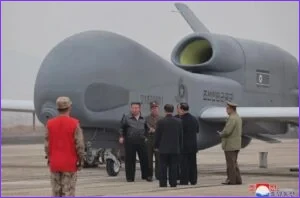
North Korea has long pursued indigenous drone development and imports from China and the Soviet Union. In 2023, the regime unveiled high-altitude, long-endurance (HALE) and medium-altitude, long-endurance (MALE) reconnaissance drones, with the latter possessing missile-firing capabilities. Furthermore, Kim Jong Un has directed officials to establish mass-production systems for "suicide attack drones." Reports also indicate that North Korean personnel have been sent to the Yelabuga factory in Russia to assist in producing copies of Iranian Shahed-style one-way attack drones.
South Korea’s own efforts have accelerated as well. The Agency for Defense Development (ADD) is currently developing the KUS-LM, or "K-LUCAS," which is expected to reach deployment before 2030. This follows earlier procurements, such as the American-made Global Hawks delivered by 2020, and the domestic KUS-FS MALE drone, which is slated to enter service in 2027. While both sides have utilized rudimentary, unarmed platforms for symbolic incursions to date, the introduction of armed, long-range systems marks a new phase in the inter-Korean military competition.
In 2014, South Korea recovered the wreckage of three North Korean drones less than 50 miles from the border. In December 2022, five North Korean drones overflew Seoul, including the presidential office,and returned North. In response, then-President Yoon Suk-yeol floated the idea of South Korean forces conducting recip
North Korea has been importing Chinese and Soviet drones and has been developing indigenous models for reconnaissance missions since the 1980s. In 2023, North Korea unveiled a high-altitude, long-endurance (HALE) reconnaissance drone and a medium-altitude, long-endurance (MALE) multi-role drone. Both are qualitatively