President Volodymyr Zelenskyy has defended his decision to dismiss Defence Minister Mykhailo Fedorov, citing an irreconcilable rift between the ministry and the nation’s military command. Speaking at a press conference in Kyiv alongside outgoing British Prime Minister Keir Starmer, Zelenskyy admitted that a “challenging dialogue” between Fedorov and the commander in chief, Col Gen Oleksandr Syrskyi, had reached a point where he was forced to choose sides. The president stated that he had hoped for unity, but ultimately, the failure to reconcile necessitated the change.
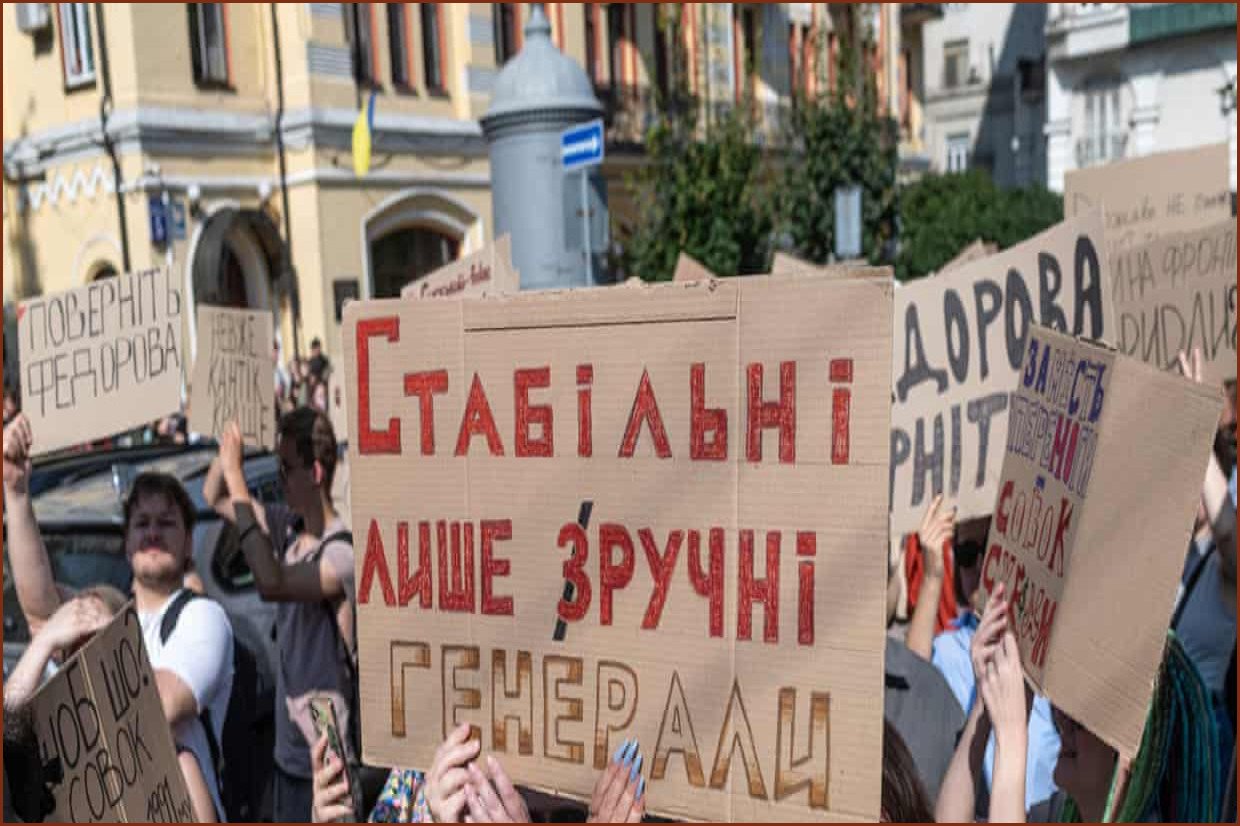
In the wake of the dismissal, Zelenskyy has nominated Yevhenii Khmara, the acting head of Ukraine’s security service, to serve as the new acting defence minister, pending parliamentary approval. The decision has drawn significant backlash from civil society, with over 1,000 protesters gathering outside the presidential office in Kyiv on Thursday. Demonstrators carried placards questioning the move and chanting for the removal of Syrskyi, marking a rare instance of large-scale anti-government protest since the 2022 Russian invasion.
Fedorov, who held the post for six months, held his own press conference to challenge the military leadership, accusing them of using Soviet-style tactics and obstructing essential reforms. He claimed that decisions regarding military support and drone allocation were driven by loyalty rather than data, and that his proposals to create centers of excellence were blocked by bureaucratic interference. Fedorov revealed that he had suggested replacing Syrskyi, a move that likely preceded his own firing on Wednesday. He argued that the current culture within the general staff must be eradicated to effectively counter the enemy.
Despite the domestic political turmoil, the visit by Keir Starmer proceeded as planned, with the two leaders holding discussions in the garden of the presidential palace. Zelenskyy awarded Starmer the Order of Freedom, while the British leader presented a framed flag that had flown over Downing Street in February 2022. Starmer reaffirmed the UK's commitment to Ukraine, asserting that the fight against Russian aggression is shared by both nations.
The political crisis has drawn comparisons to last year's aborted attempt by Zelenskyy to close two anti-corruption agencies, which also triggered public outcry. Critics, including protester Andrii Dligach, have characterized the administration’s actions as an effort to suppress political ambition and maintain an old-fashioned management style. As the situation develops, the dismissal of Fedorov—who oversaw a period of improved battlefield performance, including successful strikes on Russian oil infrastructure and naval routes—remains a flashpoint for debate over Ukraine's future political and military direction.