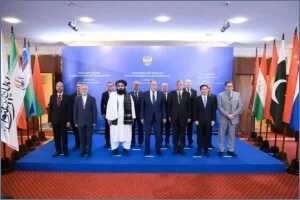
A high-profile regional meeting on Afghanistan has highlighted a growing diplomatic divide, as neighboring nations continue to withhold support for Pakistan’s military campaign against the Taliban. On October 5, 2026, the Russian capital hosted the eighth meeting of the Moscow Format consultations, bringing together special representatives and senior officials from Afghanistan, China, India, Iran, Kazakhstan, Kyrgyzstan, Pakistan, Russia, Tajikistan, and Uzbekistan to discuss political, economic, and security cooperation.
Despite the gathering of these key regional players, the summit failed to adopt a joint statement. The impasse arose from a direct disagreement between the Afghan and Pakistani delegations regarding the language used to address terrorism. The Taliban representatives strongly objected to the frequent references to terrorism in relation to Afghanistan. According to Russia’s special envoy for Afghanistan, Zamir Kabulov, the Afghan delegation had accepted similar terminology during the previous year's meeting, suggesting that the recent deterioration in relations between Islamabad and Kabul was the primary driver behind the sudden objection.
This diplomatic friction occurred just a week after a sharp military escalation between the two nations. Following deadly militant attacks in Pakistan's northwestern Khyber Pakhtunkhwa province on September 18 and 26, which claimed approximately 44 lives and injured 138 others, Islamabad launched retaliatory airstrikes inside Afghanistan. Pakistan targeted locations it identified as training camps and hideouts for the Tehreek-e-Taliban Pakistan (TTP) and its allied factions. At the Moscow summit, Pakistan accused the Taliban of harboring these groups and allowing them to operate with impunity. In response, the Taliban condemned the airstrikes as acts of military aggression that violate international law, arguing that security concerns should be resolved through political dialogue rather than force.
The reluctance of Afghanistan's other neighbors to back Pakistan's military response stems from their vastly different security calculations, border geographies, and experiences with Taliban cooperation. For these nations, direct military intervention is viewed as an ineffective tool for managing the regional militant threat.
China, for instance, shares a narrow 92-kilometer border with Afghanistan along the rugged Wakhan Corridor, which is dominated by the nearly 5,000-meter-high Wakhjir Pass. Beijing's primary security concern in the region is the East Turkestan Islamic Movement (ETIM). Rather than confronting the group militarily, China has pressured the Taliban to act, resulting in the reported relocation of ETIM fighters away from the border into more dispersed areas. Consequently, the immediate cross-border threat to China remains low and highly manageable due to the easily monitored terrain.
Uzbekistan similarly shares a short 144-kilometer border with Afghanistan, running primarily along the Amu Darya river, with movement concentrated at the heavily fortified Termez-Hairatan road and rail crossing. The militant groups of concern to Tashkent have demonstrated very limited capability for cross-border operations, with the only notable incident being a 2022 rocket attack toward Termez that resulted in no casualties. This makes the threat relatively easy for Uzbekistan to contain without risking its relationship with Kabul.
Tajikistan faces a more complex situation, sharing a long and porous 1,374-kilometer border along the Panj River, which runs through remote, mountainous terrain that is difficult to patrol. Dushanbe has experienced direct spillover, including a November 2025 cross-border attack from Afghanistan's Badakhshan province that killed five Chinese workers in Tajikistan. However, the Taliban has actively offered assistance in investigations and arrested suspects following such incidents, encouraging Tajikistan to maintain diplomatic channels.
In contrast, Pakistan is dealing with a security crisis of an entirely different magnitude. Islamabad faces active threats from the TTP, the Balochistan Liberation Army (BLA), and the Islamic State Khorasan Province (ISKP), all of which it alleges operate from Afghan territory. United Nations monitors estimate that the TTP alone maintains approximately 6,000 fighters inside Afghanistan. By September 2026, Pakistan's security situation had deteriorated severely, with 1,232 militant attacks recorded in the first nine months of the year—surpassing the total for the entirety of 2025 by 169 attacks. This relentless wave of violence has placed intense domestic pressure on the Pakistani government to take decisive military action.
Compounding the issue is the Taliban's refusal to cooperate with Pakistan in the same manner it has with other neighbors. The Taliban leadership categorizes TTP members as Pakistani refugees rather than active militants, and UN observers note that the group operates with considerable freedom under Taliban authority. While Kabul offered to relocate TTP fighters away from the immediate border, Pakistan rejected this as insufficient to secure the long, porous frontier. Pakistan's demand for written guarantees that Afghan territory would not be used to launch attacks led to the collapse of bilateral talks in Istanbul in November 2025.
While Pakistan maintains that its military operations will persist until the Taliban takes verifiable action against cross-border militants, its regional neighbors remain unified in their refusal to publicly endorse the airstrikes. Instead, regional powers like China, Russia, and Iran have repeatedly urged restraint and offered to mediate the dispute, while Uzbekistan has called for a strictly diplomatic resolution. Previous mediation efforts, including informal talks hosted by China in Urumqi in April, have concluded without an agreement, leaving the regional deadlock unresolved.