U.S. President Donald Trump has actively pushed for a fourth summit with North Korean leader Kim Jong Un, though the North Korean leader has thus far rejected these overtures, potentially playing hard to get. Despite this public resistance, experts with decades of experience analyzing North Korea and participating in numerous face-to-face meetings suggest that Pyongyang may believe a fourth summit could offer significant benefits, albeit for reasons that differ from Washington’s expectations.
Based on the experience of the three summits held during Trump’s first term and an analysis of his current foreign policy, the North Korean Foreign Ministry would likely construct a strong case for such a meeting. Pyongyang currently views itself as being in a position of strength, bolstered by advancements in military and economic fields and by taking advantage of shifts in international geopolitics, particularly its close relationships with Russia and China. Conversely, the ministry would argue that the United States and President Trump are in a much weaker position than in the past. They believe the president’s overconfidence and erratic personality will likely lead to missteps that further weaken the U.S. position, failing to grasp that a new summit would primarily benefit North Korea as it works in opposition to Washington.
The North Korean Foreign Ministry maintains that the past—referring to the summits in Singapore, Hanoi, and at the Demilitarized Zone—is gone. While those meetings were focused on improving relations in exchange for nuclear concessions and economic modernization, a new summit would serve different objectives. Today, Pyongyang would use a meeting to improve its global position by supporting its allies, China and Russia, undermining Washington’s international influence, and nudging President Trump to accept North Korea’s growing nuclear arsenal. Furthermore, the ministry would note that Trump’s missteps have created an environment ripe for increasing tensions within the already fraying South Korea-U.S. alliance.
Should Kim decide to proceed, the timing and venue would be subject to intense negotiation. North Korean officials may believe the results could be more consequential now due to Trump’s personality and his growing domestic political weakness. The ministry would applaud Kim’s strategy of delaying a decision, noting that Trump’s eagerness to meet has already led to unilateral concessions, such as the shortening of South Korea-U.S. military exercises. Furthermore, Trump has inched away from the long-standing pursuit of denuclearization, creating internal debate within the U.S. State Department and sending confusing signals to allies.
Looking ahead, the North Korean Foreign Ministry would predict that if Republicans lose the upcoming November congressional elections, President Trump will be in a significantly weakened position, making him anxious to secure any outcome—even just a meeting—to frame as a personal victory. While North Korean media avoids direct criticism of Trump, private analysis by foreign ministry experts suggests they view his worst personality traits as having worsened since 2018 and 2019. They emphasize seven traits that will affect his performance: his age of 80 and associated physical and mental decline, his susceptibility to flattery, his inflated opinion of his own negotiating ability, his reliance on gut feelings over expert advice, his loss of grip on reality, his tendency to roll out the red carpet for leaders like Vladimir Putin and Xi Jinping, and his lack of strategic thinking. Ultimately, advisors would warn Kim that Trump fails to grasp the wider picture, as seen in his approach to the war with Iran, and will likely not understand that North Korea’s current objectives are fundamentally inimical to U.S. interests.
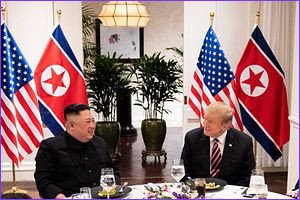
In this Feb. 27, 2019, file photo, U.S. President Donald Trump shakes hands with North Korean leader Kim Jong Un at the Sofitel Legend Metropole hotel in Hanoi, Vietnam, for their second summit meeting.
You have reached the limit of 2 free articles this month.