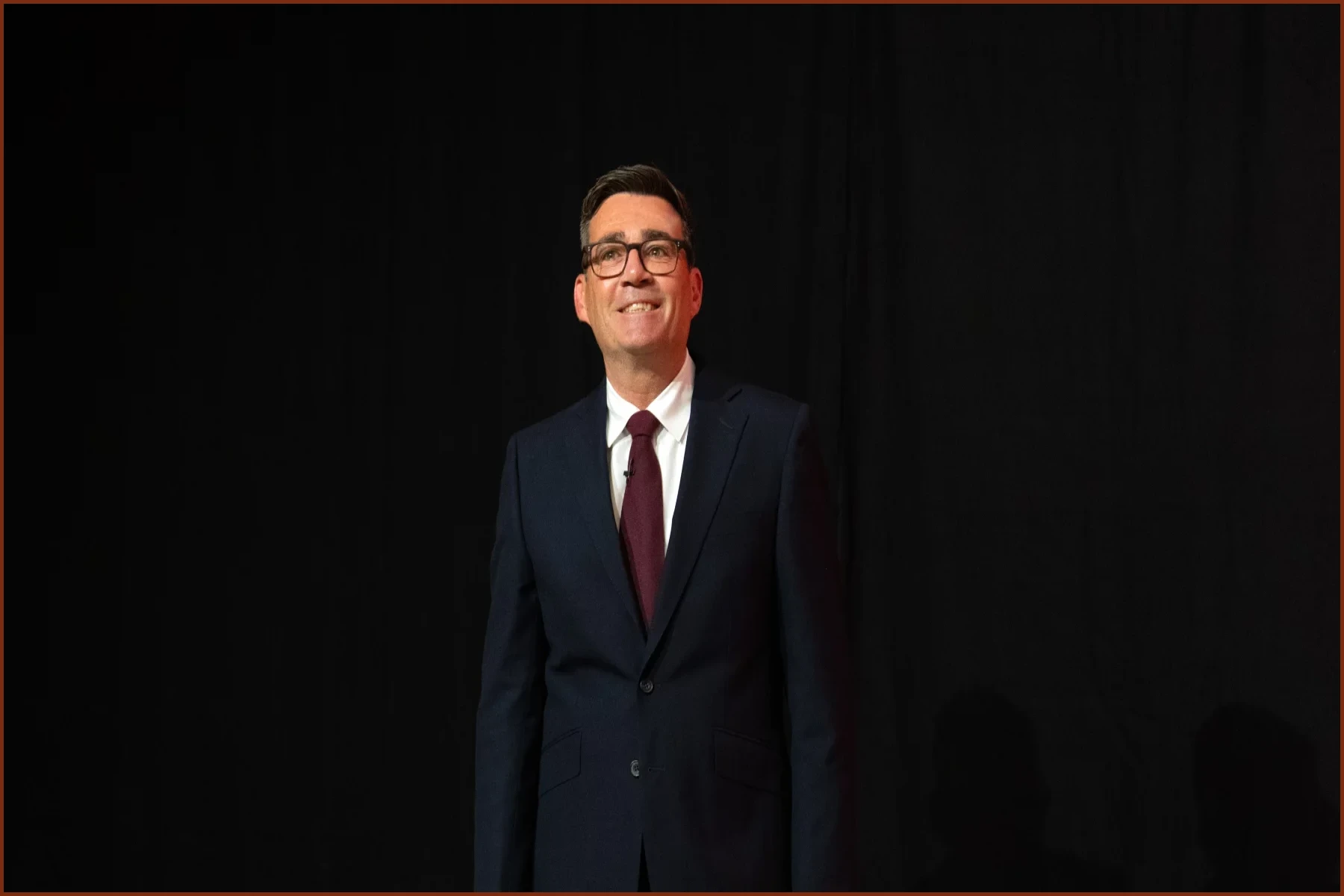
On Monday, Andy Burnham officially takes office as the United Kingdom's new prime minister, succeeding Keir Starmer who resigned in June. Burnham, the 56-year-old Member of Parliament for Makerfield, England, secured his path to Downing Street after running unopposed to become the leader of the Labour Party, with his victory announced on July 17 at the Trades Union Congress in London. His ascension marks a dramatic return to national politics for a leader who spent years championing the English north and redefining municipal governance.
Burnham’s political identity is deeply rooted in his working-class upbringing in northern England. Born in a Liverpool suburb to a telephone engineer and a receptionist, he was raised in a village situated between Liverpool and Manchester. He eventually moved south to study English literature at the University of Cambridge. His time at the elite institution highlighted a distinct cultural contrast; his former professor, John Mullan, recalled to the Times of London that Burnham would wear a soccer jersey to class. Mullan described him as a soccer-obsessed young man who recited Shakespeare and dated Marie-France van Heel, a Dutch-born student who was considered the coolest girl in the college and is now Burnham's wife. This early attachment to his soccer jersey foreshadowed the blue-collar, working-class identity that would define his later political career.
After graduating, Burnham and van Heel initially stayed in the south, moving to London. Burnham’s rise in politics was swift, winning election to Parliament with the Labour Party at the age of 31 to represent a northern district. Under Prime Minister Gordon Brown, he rose to serve as the Secretary of State for Culture, Media and Sport. It was during this ministerial tenure in 2009 that Burnham faced a defining moment. He was sent to Liverpool to speak at a memorial marking the 20th anniversary of the 1989 Hillsborough disaster, in which 96 soccer fans died. At the time, the victims had been widely demonized as hooligans, and many families felt the government had failed them. When Burnham took the stage, the crowd initially heckled him. Fighting back tears, Burnham abandoned his prepared speech and nodded in solidarity as the crowd chanted for justice.
He subsequently launched a government inquiry that ultimately revealed police failures, rather than the actions of the fans, were responsible for the tragedy. This intervention helped dismantle a deeply entrenched national stereotype that demonized northern, working-class men as violent and criminal, according to researcher Wildman. This advocacy earned Burnham early and lasting loyalty from a demographic that often felt ignored by affluent southern politicians in London.
Despite his rising profile, Burnham’s ambitions for national leadership faced setbacks. He ran twice for the leadership of the Labour Party, even being nominated in 2015 by his friend and fellow lawmaker Keir Starmer. After losing both bids, Burnham decided to leave Westminster entirely after 16 years in Parliament. He returned to the north, where he was elected Mayor of Greater Manchester in 2017. It was in this local government role that he would build the national reputation that ultimately propelled him to the premiership.
In the 1980s and '90s, Manchester was known for two things: post-industrial blight, and a vibrant indie music scene (with bands like The Smiths, New Order, The Stone Roses and Oasis). Burnham set out to fix the former, and immerse himself in the latter. He accelerated ongoing redevelopment efforts, took control of the city's bus network, and successfully lobbied the central government to devolve local powers over housing and education to the municipal level. Under his leadership, Manchester underwent a dramatic physical and economic transformation, turning canal areas and old industrial warehouses into modern arts spaces and erecting glass skyscrapers, such as those visible in the skyline behind Deansgate station on June 22. Today, Manchester boasts one of the fastest-growing municipal economies in the United Kingdom. Wildman noted that this regeneration functioned almost like a massive branding exercise, successfully reversing Manchester's historic association with negative images of industrial decline.
Burnham's transition from London politician to northern champion was also cultural. Rose Marley, the CEO of Co-operatives UK and a former adviser to Burnham, recalls meeting him first in Manchester's indie music scene, where Burnham frequently moonlights as a DJ. Marley remembers that when Burnham first arrived from London, he was "suited and booted," behaving like a typical Westminster lawmaker. However, she notes that the tie was loosened on his very first day, and the Westminster persona quickly vanished in favor of the "Mancunian way" of trainers and t-shirts, which is when he began his DJing activities.
Now, Burnham is preparing to bring what he terms "Manchesterism" to the national stage as a blueprint for countrywide economic growth. His policy proposals include shifting power away from London's central government to other UK cities and regions, and even opening a northern branch of Downing Street. In a policy speech delivered on June 29, Burnham urged voters to imagine good growth in every postcode and hope in every heart, declaring, "Imagine no more, let's make it happen." His platform also promises to build the largest volume of public housing seen since World War II, cut tax rates for retail businesses, and reduce welfare spending in a manner that is both fair and lasting.
Rose Marley describes "Manchesterism" as a philosophy of people coming together to drive change with a "can-do attitude," which Burnham views as an end to neoliberalism from an economic standpoint. This approach could prove vital as Burnham seeks to reconnect the center-left Labour Party with working-class voters who have shifted toward right-wing parties in recent years. Burnham previously expressed his commitment to making Labour a party that working-class people can believe in again. Meanwhile, his tenure as mayor also saw clash points with the central government, particularly during the coronavirus pandemic. On April 15, 2020, people wore protective suits as they walked along Market Street in the near-deserted city center during the nationwide lockdown to combat the pandemic. When the UK government implemented localized lockdowns based on regional infection rates, Manchester was subjected to stricter rules than many other areas, leading to confusing regulations and political tension over local autonomy. As prime minister, Burnham will now have the opportunity to implement his vision of decentralized power on a national scale.