Vietnam's rapid economic transformation is driving an escalating crisis of land seizures and forced evictions, as the government aggressively pursues double-digit GDP growth. Under the leadership of To Lam, who became the Communist Party of Vietnam (CPV) chief in 2025 and president in 2026, land has been designated as a primary engine for national growth. This policy is fueling large-scale real estate developments across the country, but it is also leaving hundreds of thousands of residents displaced under Hanoi's ambitious 100-year master plan, which is projected to displace over 860,000 people—more than 10 percent of the capital's population.
The human toll of this rapid development is illustrated by the story of 68-year-old Thanh, a lifelong theater enthusiast who now views the capital's modernization with deep bitterness. Her entire neighborhood was demolished to make way for the upcoming $520 million Pearl Theater, a massive megaproject covering 40,980 square meters with a capacity for 2,000 people, scheduled for completion by 2030. At the end of August, local authorities demolished Thanh's two-story, 230-square-meter home near West Lake, which she had completed in 2020. Despite the property being valued at over 300 billion Vietnamese dong (approximately $11.5 million) in the current market, she received just 3 billion dong in compensation—a mere 1 percent of its estimated value—along with a small monthly allowance that barely covers basic rent.
Thanh and her neighbors spent considerable time and money petitioning local authorities and paying unofficial fees to expedite bureaucratic processes, but their efforts yielded no concessions. Although the government has designated resettlement areas, the infrastructure remains far from ready. This has left Thanh scrambling for months to secure alternative housing for her family of seven. Despite her anger, she refuses to join local protests or air her grievances on social media platforms like Facebook and Zalo. She explained her caution by stating, "Nowadays, between a victim and a criminal lies only a fragile line. We have to be careful."
The push to accelerate land clearance is occurring even as the legal framework governing property rights undergoes rapid changes. The National Assembly's Standing Committee held an extraordinary session in August to deliberate on a series of draft laws, including an amended Land Law scheduled for final approval in October. The draft legislation, prepared by the Ministry of Agriculture and Environment, was released for public consultation on July 21, giving citizens less than a month to submit feedback. Furthermore, the online portal for public input lacked an option for anonymous submissions. The rush to amend the Land Law comes only two years after it was initially passed, reflecting an unprecedented legislative pace in Vietnam; in 2025 alone, a record 86 laws and 371 other legal documents were enacted.
Currently, Hanoi is executing land acquisition and site clearance for 1,428 projects across the city. According to a master plan approved in March 2026, the capital aims to become one of the ten happiest capitals in the world, defined by prosperity, harmony, civility, and character. However, domestic experts have raised serious concerns about the haste of these changes. Tô Kiên, an architect and professor at the University of Economics Ho Chi Minh City, criticized the process in an opinion piece on Vnexpress, pointing out that the public was given only 10 days to review and provide feedback on the highly complex, 1,000-page master plan and its extensive maps. Expert consultation workshops were held just days before the plan was approved, leading Kiên to argue that the consultation process failed to fulfill its intended role.
Legal provisions within the current Land Law heavily favor state and party institutions over individual land users. Articles 12 and 13 allow the state to expropriate land to build headquarters and offices for the CPV, state agencies, the Vietnam Fatherland Front, and various affiliated public service units. Crucially, a final provision allows the National Assembly to use a simplified, expedited legislative procedure to add new categories for compulsory land acquisition if a project is deemed to serve the national or public interest, even if it does not fall under the 33 categories already listed in the law. While Article 158 mandates that land pricing must follow market principles and remain transparent, in practice, local authorities impose compensation terms without negotiation.
This aggressive land acquisition strategy is being mirrored in major infrastructure projects across Vietnam. The Red River Scenic Avenue Corridor Project spans 16 communes and wards, covering 11,418 hectares and potentially displacing 200,000 residents. In Bắc Ninh province, the Gia Bình International Airport Project requires nearly 1,960 hectares of land, affecting approximately 7,100 households and 118 organizations. Meanwhile, the Long Thành Airport Project in Đồng Nai province requires about 5,000 hectares, impacting 4,600 households.
Public discontent over land seizures is not a new phenomenon in Vietnam. Similar to trends in China, peaceful peasant protests began in the early 2000s and became widespread by the mid-2000s. Today, approximately 70 percent of all long-term citizen complaints, lawsuits, and denunciations in Vietnam stem from state land acquisition, site clearance, and compensation disputes. However, the state increasingly treats public opposition to land expropriation as criminal activity. Domestic media outlets regularly warn citizens that sharing stories about the struggles of displaced victims is a tactic used by "hostile and reactionary forces" to spread false information and sow divisions between the public and authorities.
Political voices advocating for the rights of displaced landowners have also been systematically silenced. Lưu Bình Nhưỡng, a prominent CPV member and former legislator in the 14th National Assembly (2016–2021) who served as deputy head of the Commission for Members' Opinions and Petitions from 2021 to 2023, was once a vocal critic of unjust land confiscations. In 2021, he intervened when a worker in Ninh Thuận Province was beaten by an unidentified group for defending his land rights against a private company. At the time, Nhưỡng warned that private companies do not have the authority to use force to ‘intimidate’ the people. Referencing the historical "bloodshed in Đắk Nông" where land confiscation by a company drove residents to open fire, he argued that while the shooter was wrong, the company's actions had no legal basis. Therefore, if the authorities stand aside and take no action, they are effectively covering up for the company. In 2025, Nhưỡng was sentenced to 13 years in prison—three years for extorting property and ten years for abusing his position. Many observers believe these charges were fabricated to silence his criticism of the police and his support for unjustly prosecuted individuals.
During the National Conference on the Implementation of Resolutions from the 3rd Plenum of the Central Committee of the CPV's 14th Term, To Lam addressed the delicate balance between national development and citizen rights. He urged strict discipline and emphasized that "social consensus must first and foremost be built through correct policies, fair and transparent implementation, and results that people can perceive." Lam stated that the government should "not trade off long-term interests for short-term achievements" and should "not allow disadvantaged people to bear unreasonable costs." However, he simultaneously urged civil servants to recognize that “willingly stepping back for development is also a brave and noble action – something to be proud of and deserving of recognition.” Tellingly, no official so far has “stepped back” for the sake of project development.
Despite Lam's public rhetoric, coercive land clearance has intensified, bolstered by the growing power of the Vietnamese security apparatus. Unlike past land seizures, local police are now involved in the process from start to finish. Utilizing a national population database, officers meet with residents, assess properties to determine compensation, and monitor relocations. The pressure also extends to the legal profession. In a country lacking an independent lawyers' association, defending victims of land seizures carries severe personal risk. Võ An Đôn, a prominent defense attorney known as the "Lawyer of the People" for his pro bono work, had his license revoked in 2018 and faced years of state harassment before fleeing the country to seek refuge overseas in 2023.
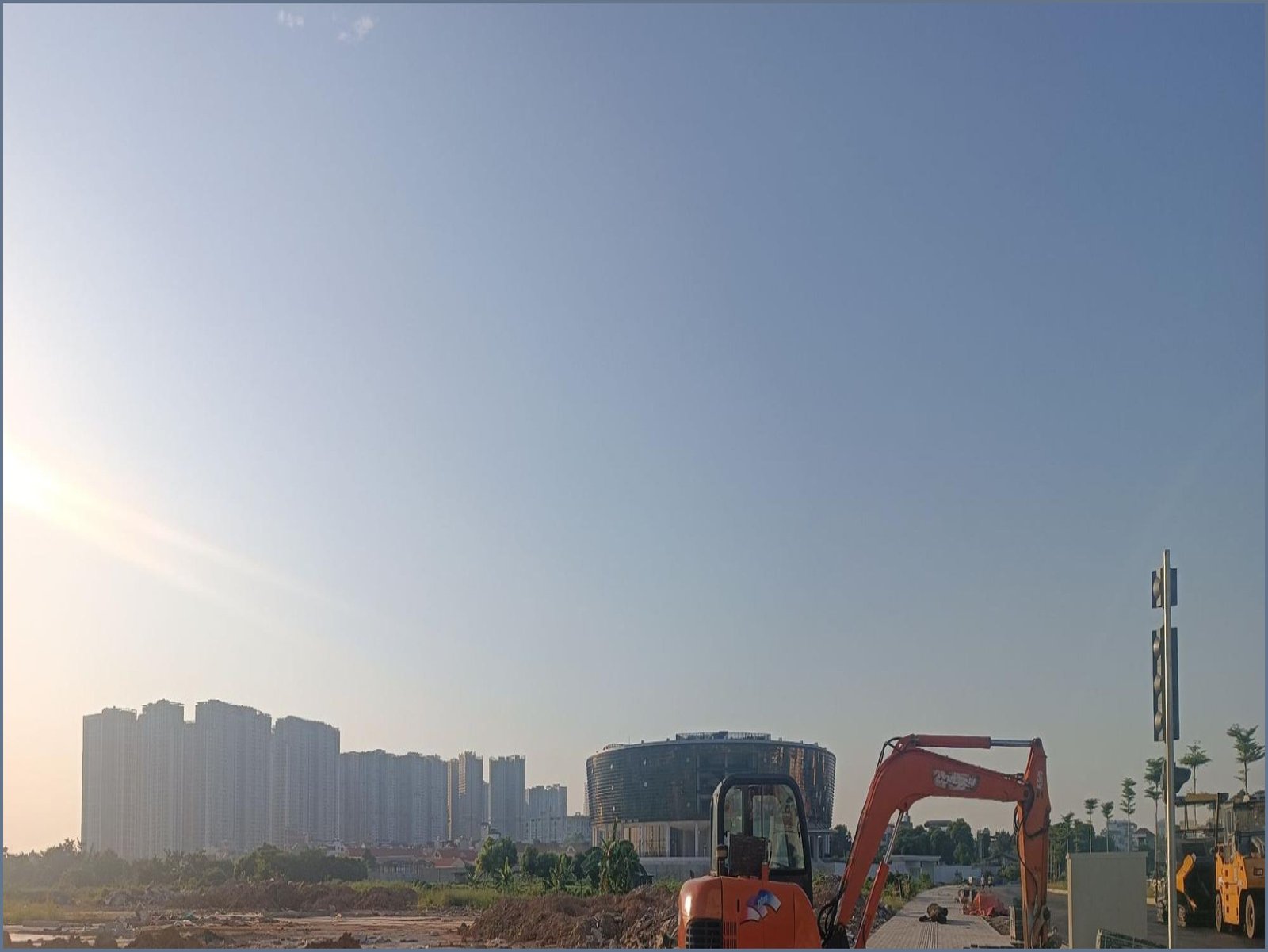
A part of confiscated land in Dương Nội still under construction. Photo by Christelle Nguyen.