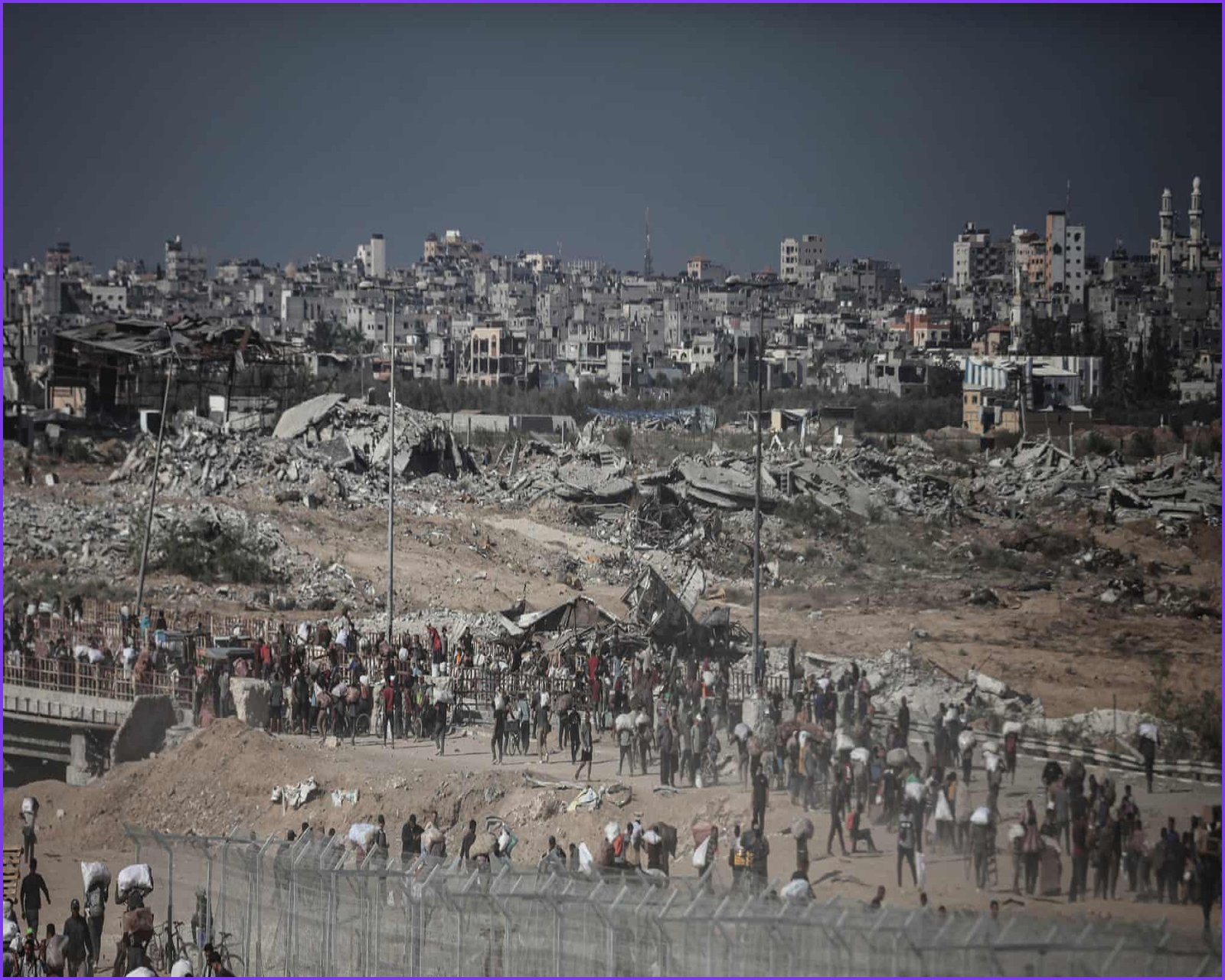
The ambitious Gaza recovery plan initially championed by Donald Trump’s Board of Peace (BoP) has been significantly downsized, shifting from a territory-wide reconstruction blueprint to a modest pilot project located in the southern Gaza Strip. Officials now acknowledge that even this limited scheme, which intends to establish a temporary camp for a small fraction of the 2 million displaced residents, is unlikely to be operational before the end of 2026.
Preparations for the project remain in the early stages. While some Moroccan and Kosovar officers have arrived in Israel to form the nucleus of an International Stabilization Force (ISF) tasked with guarding the camp, no physical construction has begun at the site near Rafah. Satellite imagery confirms that while some earth has been disturbed, no structures exist. Furthermore, a logistical base at the Kerem Shalom crossing, intended to support the ISF, remains incomplete. Substantial movement is not anticipated until after Israel’s October 27 elections, which could potentially displace Prime Minister Benjamin Netanyahu’s current coalition.
Diplomats in Jerusalem suggest the BoP is attempting to maintain momentum to prevent more extreme political factions from seizing control of the agenda. There is growing concern that Netanyahu, facing possible electoral defeat, might launch an all-out offensive in Gaza before the vote. Since the October ceasefire, Israel has carried out frequent strikes on Gaza killing more than 1,100 Palestinians, and Israeli forces have repeatedly moved forward from the ceasefire line agreed in October which split the strip roughly evenly between Israeli- and Hamas-controlled sections. Such a return to full-scale conflict would likely render the pilot plan obsolete.
The pilot program is a stark departure from the January proposal by Jared Kushner, who had promised the rapid restoration of essential infrastructure across the entire territory within 100 days. The current, scaled-back version was finalized two weeks ago in Cyprus by BoP officials, including Nickolay Mladenov and Aryeh Lightstone, alongside representatives from the Tony Blair Institute and the National Committee for the Administration of Gaza (NCAG). The NCAG, a group of 13 Palestinian technocrats, remains based in Cairo as they are currently barred from entering Gaza by Israel.
The proposed camp would utilize portable cabins for displaced civilians near the Rafah ceasefire line. Security would be managed by the ISF—aiming for a force of 5,000 personnel—and a vetted Palestinian police force. However, the legal framework for the ISF remains under negotiation, and training for the local police force is expected to take several months. Critics, including former Israeli prime minister Ehud Olmert, have labeled the project a potential “concentration camp,” though BoP officials maintain that residents will have freedom of movement.
Funding for the initiative remains uncertain. Very little of the $17bn (£12.6bn) originally pledged for Trump’s 20-point peace plan for Gaza has actually materialised. The EU’s Palestine Donor Group announced on Monday that it had raised €883m (£770m) for Gaza. The BoP is currently negotiating to redirect $11bn in withheld Palestinian tax revenue and frozen assets currently held by Israel. This proposal has faced fierce opposition from the Palestinian Authority, with Foreign Minister Varsen Aghabekian stating that these funds must be released unconditionally and warning against using fragmented measures as a substitute for a comprehensive solution.
Internally, the NCAG remains divided over the pilot scheme, fearing it would prove divisive within Gaza’s 2.1 million Palestinian population, and put the vast majority on a lower priority second tier in the provision of humanitarian relief. Meanwhile, talks in Cairo regarding the disarmament of Hamas and other militias have stalled, with Palestinian sources insisting that there is no basis for negotiations as long as Israel continues its military expansion and airstrikes within the territory.