U.S. President Donald Trump sparked political waves during his weekend visit to Ireland by declaring that a unified Ireland would be "fantastic" and is bound to happen eventually. The remarks, made during a highly sensitive diplomatic trip, waded directly into a complex and historically charged subject.
Trump made his comments during a meeting in Dublin with Irish Prime Minister Micheál Martin. When asked by a reporter for his stance on the reunification of the Republic of Ireland with Northern Ireland, which remains part of the United Kingdom, Trump did not hold back. "I don’t want to cause any problems but I’d love to see it unified," Trump said. "It’s going to happen eventually. It may as well happen now." He added, "I think it would be a fantastic thing," while noting that "the U.K. will have something to say about it, obviously."
Later in the day, the president acknowledged the deep-seated complexities of the issue. Addressing business leaders from both nations at the U.S. ambassador's residence, Trump conceded that there is "no good answer" to the reunification question. The subject remains incredibly delicate, given that competing British and Irish nationalist identities fueled decades of sectarian violence in Northern Ireland, a six-county region with a Protestant majority. Previous American presidents, including Democrat Joe Biden, who has strong emotional ties to Ireland, have traditionally avoided commenting directly on the matter.
The division of Ireland dates back a century, when the self-governing, Catholic-majority Republic of Ireland was established, leaving Northern Ireland split between Catholic nationalists seeking unity with the south and Protestant unionists who wanted to remain British. The violence, known as the Troubles, was largely resolved by a 1998 peace accord that the United States helped negotiate, though the agreement left Northern Ireland's ultimate status open. Under the accord, a referendum on unification can be held if it appears a majority of the population would support it. UK Prime Minister Andy Burnham stated on Wednesday that Britain would only consider such a referendum "when public opinion has changed to the point where the call has to be considered." Burnham's office pointed back to those remarks when asked about Trump's comments.
Observers suggest Trump's statements, along with his recent remarks about the Falkland Islands—a British overseas territory in the South Atlantic claimed by Argentina as Las Malvinas—could be seen as a dig at London. Trump has reportedly been frustrated by Britain's refusal to join the U.S.-led military effort in the U.S.-Israeli war against Iran. Argentina's President Javier Milei, a close ally of Trump, recently renewed his country's claim to the islands, which are home to about 3,500 people and sit roughly 300 miles (480 kilometers) east of the Argentine coast.
On Saturday, Trump expressed skepticism about Britain's ability to retake the Falkland Islands today as it did following Argentina's 1982 invasion, suggesting a potential shift in Washington's neutral stance on the dispute. "I’m sure I’ll be called into that potential disaster, but if they do, I’ll probably be able to settle, settle it out," Trump remarked.
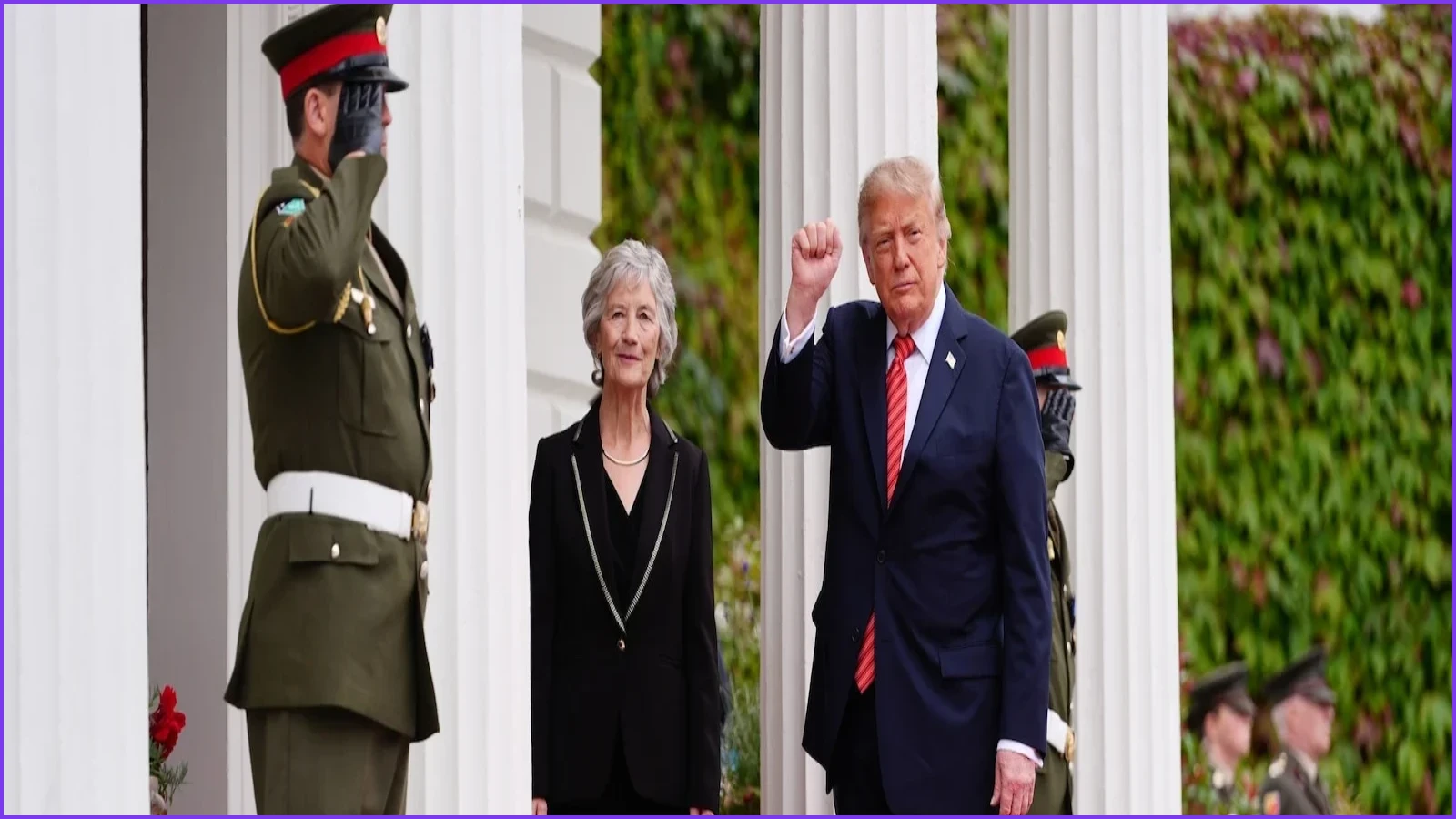
While in Dublin, Trump also met with Irish President Catherine Connolly, a left-wing politician and ceremonial head of state who previously protested Trump's 2019 visit and once called him a "bully." Connolly, a supporter of the Palestinian cause, has been a vocal critic of U.S. Middle East policy. In a statement released after the meeting, Connolly said she conveyed "the strong view of the Irish people that the normalization of war and genocide can never be accepted." She presented Trump with several gifts, including a book by the late Irish poet Michael Longley containing the sonnet "Ceasefire." Asked about the exchange, Trump initially had his protocol chief, Monica Crowley, address the question before describing the brief meeting as "very nice" and stating they "discussed a lot of things, quickly."
Security was tight during the visit, with police establishing a cordon around Dublin's 1,750-acre (700-hectare) Phoenix Park, where Connolly, Martin, and U.S. Ambassador Edward Walsh have residences. By the time Trump left the capital for his golf resort in Doonbeg on the Atlantic coast, thousands of protesters had gathered in central Dublin. Many waved Irish and Palestinian flags, chanting "Donald Trump not welcome here" and "Irish government, shame on you!"
Among the demonstrators was Paula Butler, who attended with a group from the Dublin Rape Crisis Centre to protest Trump's policies on women, refugees, and migrants. "What he knows about Irish unity, I’d say I know more on my little finger," Butler said. Kim Mathis, who moved from Florida to Dublin last year with her partner, remarked that she relocated "to get away from Trump and all of his horrific policies," calling the global management of Trump "a global conundrum" and wishing politicians would simply tell him to "stay home."
In Doonbeg, Trump's son Eric defended the family's presence, telling Irish national broadcaster RTE on Friday that the golf course is the largest employer in the area. He urged critics to "go down to Morrissey’s tavern in Doonbeg and hear from a real Irish person" about the family's local investments and the "love and respect" they have shown the community.
Trump regularly spends weekends playing golf at his properties in Florida, New Jersey, and Virginia. His attendance at the Irish Open continues his practice of appearing at high-profile sporting events that benefit his family's business. Last year, Trump spent five days in Scotland visiting his clubs in Turnberry and Balmedie, Aberdeenshire, where he held talks with the British prime minister and the president of the European Commission. Asked if he would return to Ireland next year for the Ryder Cup, Trump confirmed, "I will. Absolutely."