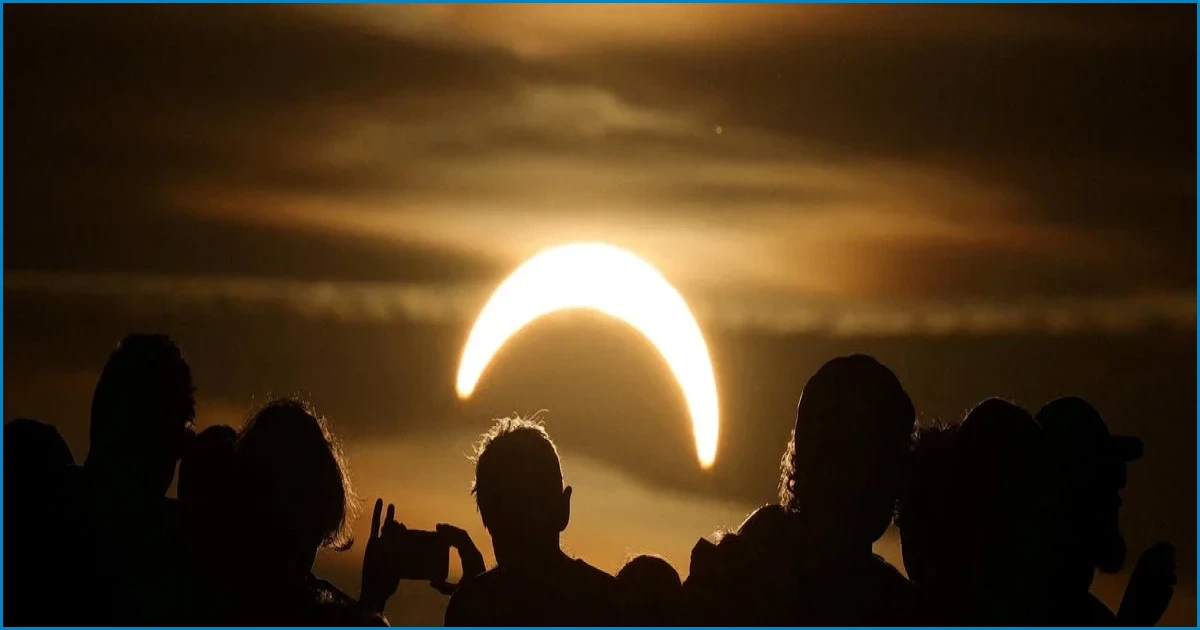
A rare total solar eclipse descended upon the Northern Hemisphere on Wednesday, drawing crowds across Europe to witness the moon passing directly in front of the sun. While solar eclipses occur somewhere on Earth roughly every 18 months, experiencing one in a specific location is a rare event that can be separated by hundreds of years. For Spain, this event was particularly significant, as the country had not experienced a total solar eclipse since 1905.
The path of totality included remote, uninhabited regions such as northern Greenland, as well as western Iceland and northern Spain, which served as prime viewing locations. The celestial event spanned approximately one hour and 45 minutes from start to finish. The first glimpse of the total eclipse became visible in extreme northern Russia at 1 p.m. Eastern time. It reached northeast Greenland about 30 minutes later and western Iceland 15 minutes after that. After traversing the northern Atlantic for 45 minutes, the path of totality reached northern Spain at approximately 2:30 p.m. ET.
Beyond the narrow path of totality, a partial solar eclipse was visible across a much broader region. According to population data from the Center for International Earth Science Information Network at Columbia University, approximately 230 million people lived in areas experiencing 90% totality. This included most major European cities, such as London, Paris, and Madrid. In London, the eclipse reached a maximum of 91% totality at 2:13 p.m. ET.
Parts of North America also experienced a partial solar eclipse, though it was not as impressive as the total eclipse the United States witnessed in 2024. The best viewing location in the U.S. was Fairbanks, Alaska, which reached 37% totality at 8:27 a.m. local time. Other cities saw lower percentages, including Boston at 16%, New York City at 9%, Toronto at 8%, and Philadelphia at 7%. Maximum visibility for the partial eclipse in Toronto occurred at 1:40 p.m. local time, while New York City reached its peak at 1:54 p.m. local time.
For those lucky enough to be in one of the locations where the solar eclipse reached totality, the event provided a dramatic, sudden plunge into darkness that lasted for about two minutes. Experts and officials emphasized the critical importance of using certified solar eclipse glasses to protect retinas from permanent damage. It is only safe to remove these glasses for the brief period of totality; during any partial phase, the glasses must remain on at all times to avoid eye injury.
Looking toward future events, the next total solar eclipse to cross the United States will occur in 2044, though it will be limited to three states: Montana, North Dakota, and South Dakota. A more widespread opportunity follows in 2045, with a path stretching from Northern California to Florida, crossing numerous cities such as Reno, Nevada; Colorado Springs; Tulsa, Oklahoma; Little Rock, Arkansas; Jackson, Mississippi; and Orlando, Florida. Another eclipse is expected in 2052, impacting the Southeast, including Florida, Georgia, and South Carolina. For those hoping to see a total eclipse in the northeastern United States, the next occurrence will not be until May 1, 2079.
This animation from NASA shows the path of totality for the eclipse:
Enthusiastic viewers came out to watch across Europe, with most seeing a partial but still dramatic view.