An ancient wall unearthed in the heart of Paris this summer has been hailed as a significant archaeological breakthrough, potentially resolving a long-standing debate regarding the true location of the city’s original settlement. The discovery, a roughly 20-metre, or 66-foot, structure dating back to the Gallo-Roman period, was found beneath the Hotel-Dieu hospital on the Ile de la Cite, located just steps from Notre Dame Cathedral. French culture ministry officials suggest the stone-and-wood find is likely a fragment of the ramparts of Lutetia, the ancient precursor to Paris. These fortifications were constructed by the Gallic Parisii tribe during the Iron Age.
While the Ile de la Cite has historically been considered the center of Lutetia, a competing archaeological theory has long argued that the original settlement was actually situated in Nanterre, a suburb located to the west. Culture Minister Catherine Pegard described the find as a major breakthrough, noting that it may represent one of the most important remnants discovered for understanding Gallic Lutetia. Although Pegard emphasized that scientific caution is necessary to verify the wall's exact function and chronology, she noted that the current convergence of evidence is particularly remarkable. The site was first mentioned in book seven of Roman leader Julius Caesar’s "Gallic Wars" series, which described Lutetia as an island in the Seine connected by bridges—a description that has fueled decades of speculation.
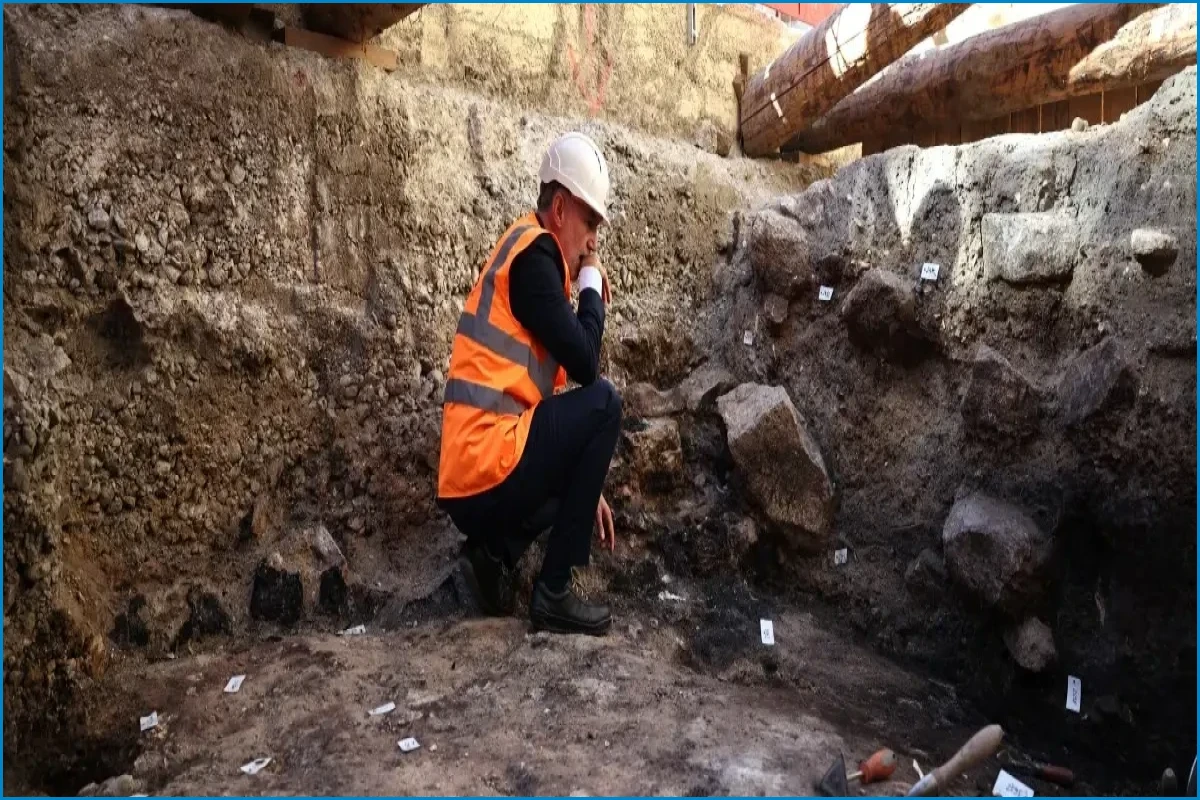
The excavation, which began in February, revealed the wall buried four metres deep within a courtyard of the Hotel-Dieu, the oldest hospital in the capital. The structure, which stands barely a metre high, also bears distinct traces of fire. This physical evidence may align with Caesar’s historical accounts, which claim the Gauls set fire to their town ahead of the Battle of Lutetia against the Romans. Carbon-dating analysis of the charred material suggests a timeframe between 10 and 200 BC, a period that encompasses the Battle of Lutetia in 52 BC.
Paris Mayor Emmanuel Gregoire visited the site on Wednesday to examine the findings, remarking that it is dizzying to discover what is likely the origin of the city. Dorothee Chaoui-Derieux, coordinator of archaeological operations for the culture ministry, noted that predecessors had long dreamed of finding such traces of Gallic presence on the Ile de la Cite. She added that the team feels fortunate to be in the right place at the right time as the wall, built in the Gallic tradition, gradually reveals its historical secrets.