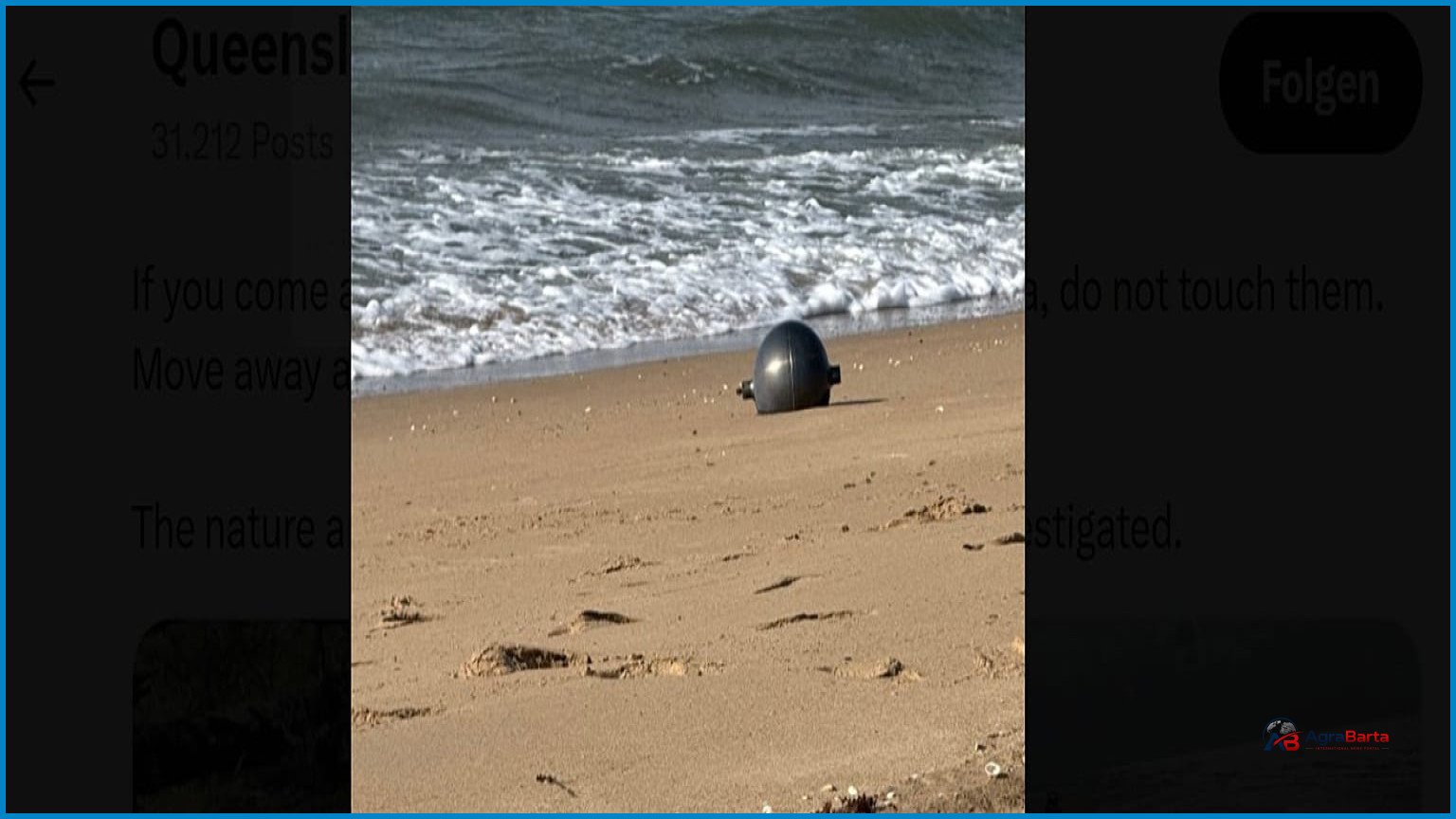
Authorities in Queensland, Australia, are cautioning the public about potentially hazardous objects discovered on Forrest Beach, north of Brisbane. These mysterious spheres, described as ‘Space Balls,’ are believed to be debris that has fallen to Earth from space.
A safety zone has been put in place around the areas where the objects have been found, leading to the closure of parts of the beach. The Queensland Fire Department advised on social media, “If you come across suspicious items in this area, do not touch them. Move away from the location and immediately call the Triple Zero (000) emergency number.” The department has also released images of the discovered items.
Initial assessments by the Australian Space Agency (ASA) indicate that the recovered objects are likely pressure vessels from a space launch vehicle. The agency stated that the location and characteristics of the debris are consistent with fragments from a foreign rocket body that recently re-entered the atmosphere. These pressure vessels may contain toxic substances.
Queensland’s fire service has also released several photos of the Space Balls. The ASA is collaborating with international partners to identify the specific rocket responsible for the debris found at Forrest Beach. This incident highlights growing concerns about space debris, with a recent study by the European Southern Observatory (ESO) warning of the increasing number of fragments in orbit, projecting over 1.7 million satellites to be launched from 2027.
Space debris is generated when objects like satellites or launch vehicles do not entirely disintegrate upon re-entering Earth’s atmosphere. Australia’s space agency has previously documented instances of space debris, including fragments from the Skylab space station in Western Australia in 1979, a SpaceX Dragon rocket part in New South Wales in 2022, and another launch vehicle pressure vessel found on an Australian beach in 2023.
This vast number of satellites also interferes with our view of the night sky. Even now, you are far more likely to spot a satellite than a shooting star.