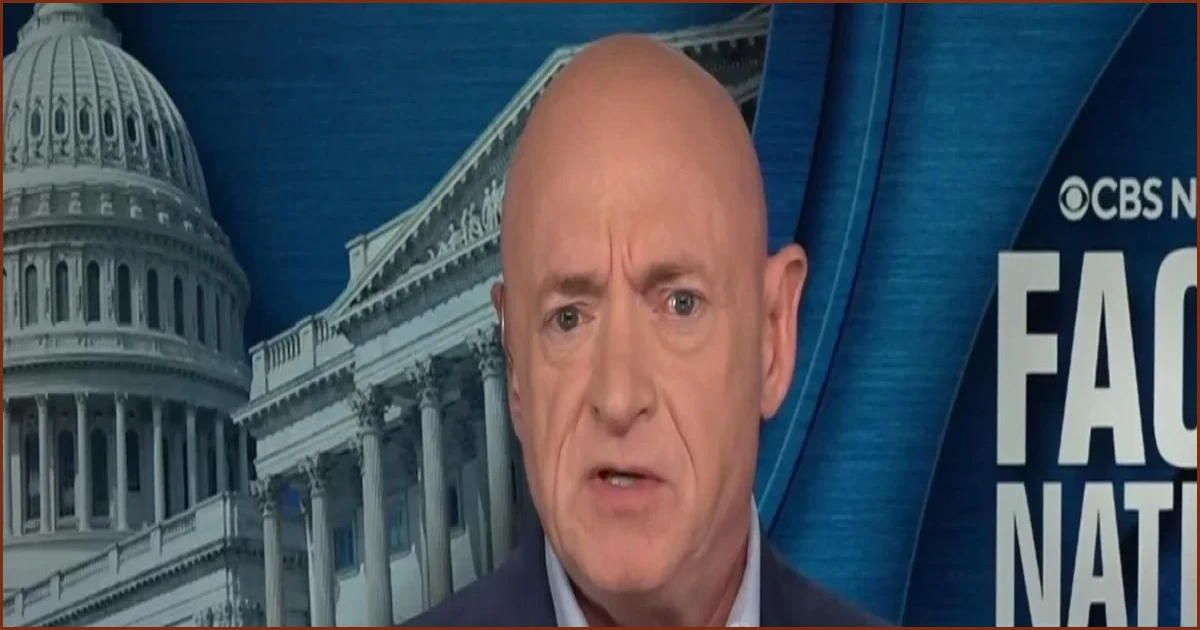
On August 2, 2026, Arizona Democratic Senator Mark Kelly expressed deep concerns regarding the trajectory of the ongoing Middle East conflict, warning of critical military supply issues and criticizing the Trump administration's execution of the war. Speaking from Columbus, Ohio, during a national television interview with Margaret Brennan, Kelly highlighted the stark contrast between the current reality of the war—now entering its sixth month—and the initial predictions from officials who claimed the conflict would last only four to five weeks. The situation has escalated significantly over the past week, with targets expanding as Iran launched strikes against Egypt, and Saudi Arabia joined forces with the United States to conduct bombing campaigns against Iranian-backed militias. The interview occurred just hours after President Donald Trump publicly stated he was considering military actions at levels not witnessed since World War II. Kelly, who serves on both the Senate Intelligence Committee and the Senate Armed Services Committee, provided a candid assessment of the administration's lack of strategic foresight.
Kelly did not hold back in his criticism of President Trump's handling of the military campaign, arguing that the administration entered the conflict without a clear strategic goal, a cohesive plan, or a defined timeline. According to the Arizona senator, this lack of preparation has left the administration "flailing" and "stuck" in a difficult position with no obvious exit strategy. Kelly suggested that the president needs to change his approach entirely rather than continuing with the same unsuccessful methods. He specifically criticized Trump's decision to place his "real estate buddy" and his "son-in-law" in charge of critical diplomatic negotiations. Instead, Kelly urged the president to appoint experienced professionals who understand how to engage in complex diplomacy with the Iranians and who possess the skills necessary to rebuild fractured international coalitions. He noted that the administration's current approach has alienated key allies, including both European nations and members of the Gulf Cooperation Council (GCC), making a diplomatic resolution far more difficult to achieve.
A central point of Kelly's criticism was directed at Secretary of Defense Pete Hegseth and his management of military operations. Kelly accused Hegseth of failing to understand how to properly manage a war, alleging that the Defense Secretary's primary metric of success at the start of the conflict was simply to drop as many munitions as possible on as many targets as could be identified. Kelly stated that Hegseth seemed focused on setting records for the number of targets hit rather than pursuing a sustainable military strategy. This approach, Kelly argued, has directly resulted in a severe and predictable munitions shortage for the United States military. With American forces having struck over 14,000 targets using multiple munitions, the senator emphasized that such high-volume operations have placed an immense and unsustainable strain on the military's overall magazine depth, leaving commanders in a precarious position.
The strain on military resources was further highlighted by a recent report in the Washington Post, which indicated that General Grynkewich, the top U.S. general in Europe, warned the Pentagon that he lacks the necessary resources to protect Israel from incoming ballistic missiles. According to the report, without an additional Navy destroyer, Grynkewich could be forced to choose between defending the United States homeland and defending Israel. While Kelly noted that he had not heard these specific resource concerns directly from General Grynkewich, he remarked that the situation is "not rocket science" and is easy to understand given the sheer volume of munitions expended. He explained that commanders in Europe and other regions are naturally feeling the stress of trying to balance homeland defense with commitments to international allies. Although the Pentagon has dismissed the report as media speculation and declined to comment on specific operational capabilities, Kelly maintained that the resource dilemma is a direct consequence of launching a major military campaign without a clear strategic objective.
In response to these supply shortages, Secretary Hegseth has requested $67 billion in supplemental funding from Congress to replenish depleted munitions stockpiles and cover military salaries. When asked how he would vote on this additional funding, Kelly stated that he remains undecided and refused to offer a guarantee of support. He pointed out that Congress passed a historic defense budget exceeding $1 trillion last year, which was presented to lawmakers as a "one-time generational investment" in the Department of Defense. Kelly argued that the administration "squandered" those massive resources and is now returning to Congress to ask for an unprecedented $1.5 trillion budget in addition to the $67 billion supplemental request. He characterized this request as an irresponsible demand for a "blank check," noting that the proposed defense budget is twice the size of the budget when he first joined the United States Senate in 2021.
Kelly emphasized that the United States does not possess unlimited financial resources, pointing to the nation's staggering $39.5 trillion national debt. He stated that the Pentagon must present a reasonable and justified approach before receiving additional funding, rather than expecting automatic approval from Congress. The senator expressed strong skepticism regarding several expensive systems included in the $1.5 trillion budget request, specifically pointing to ongoing development of space-based interceptors for intercontinental ballistic missiles (ICBMs). Kelly, a former astronaut, argued that the physics involved in space-based missile defense are exceptionally challenging and that such systems are highly unlikely to work or make the American public any safer. He insisted that Congress must scrutinize these requests to prevent the waste of public funds on unproven and unnecessary military technologies.
The conversation then shifted to domestic politics and the upcoming midterm elections, which are approximately 90 days away. Brennan pointed to recent Quinnipiac polling showing that public approval for Democrats stands at a dismal 23 percent, a rating lower than President Trump's own approval numbers. She also noted significant political headwinds facing the Democratic Party, including a substantial fundraising advantage for Republicans, redistricting challenges, and intense interparty disputes in key states like Minnesota and Michigan, where Democrats have struggled to unite behind common candidates. Kelly acknowledged these significant challenges, pointing specifically to Republican gerrymandering efforts that began in Texas as an attempt to "rig the deck" and create an unfair advantage. However, he expressed strong confidence that Democrats still have a viable opportunity to win back control of the House of Representatives.
Regarding the battle for the Senate, Kelly admitted that the political landscape is highly challenging and refused to present an overly optimistic view. However, he argued that President Trump is historically unpopular for a midterm president because his administration is failing to meet the basic needs of the American people. Kelly detailed the severe economic struggles facing ordinary citizens, noting that gas prices have risen above $4 a gallon, half of all Americans are struggling to afford food and rent, homeownership rates are declining, and rental costs continue to climb. He asserted that these economic hardships have created an opening for Democrats that did not exist six months or a year and a half ago. Kelly explained that he was in Ohio to campaign for Sherrod Brown, noting that although Brown was unsuccessful in his 2024 campaign, he has a strong chance of winning in 2026 if the party puts in the necessary effort to mobilize voters.
Finally, Kelly addressed the impending leadership transition at the Office of the Director of National Intelligence (ODNI). Acting Director Bill Pulte is scheduled to hand over control of the agency to Jay Clayton, who was recently confirmed by the Senate. Kelly launched a scathing critique of Pulte's tenure, declaring that Pulte was entirely unqualified for the position and should never have been appointed. He criticized Pulte's decision to fire approximately half of the staff in the director's office, particularly while the nation is actively involved in a war. While Pulte had claimed the office was overstaffed, Kelly argued that Pulte did not understand the basic functions of the national intelligence apparatus and likely dismissed key personnel who were vital to national security. Kelly expressed hope that Pulte's departure on Monday would allow the agency to begin recovering from his mismanagement.
The transition of leadership at the ODNI is also expected to have immediate legislative consequences. Democratic objections to the renewal of the Foreign Intelligence Surveillance Act (FISA) authorities had previously stalled the legislation in Congress. Kelly indicated that while he cannot speak for all of his Democratic colleagues, his own personal objections to the FISA renewal will completely disappear once Pulte is officially out of the office. He expressed optimism that with Jay Clayton taking over the leadership role, Congress can move forward with constructive discussions to resolve the outstanding issues and successfully renew the critical intelligence-gathering authorities.