The Philippine government has formally protested to China regarding an AI-generated video produced by the state-controlled outlet China Daily. The 58-second clip, released on July 10, features a monkey dressed in traditional Filipino attire being manipulated by the United States and Japan to parrot the 2016 arbitral award from The Hague. The video concludes with the monkey being discarded into the ocean and struck by a Chinese Coast Guard water cannon, a tactic recently observed in the vicinity of Thitu Island on Oct. 12, 2025, while a whale dismisses the international legal ruling as mere litter.
Foreign Affairs Undersecretary Leo Herrera-Lim met with Chinese Ambassador Jing Quan to convey the Philippines' firm objection to this material. In a formal diplomatic protest, the Department of Foreign Affairs (DFA) condemned the video as demeaning, dehumanizing, and racist, stating that the content exceeds the boundaries of legitimate political debate. The Philippines has demanded the immediate takedown of the video, with similar requests sent directly to the editor-in-chief of China Daily in Beijing.
Defense Secretary Gilberto Teodoro issued a sharp critique of the production, describing it as a revealing look at how the Chinese communist apparatus perceives the Filipino people. He stated that the mockery of the 2016 Arbitral Award and the glorification of violence against Philippine citizens and soldiers demonstrate the moral and intellectual bankruptcy of China’s propaganda machine.
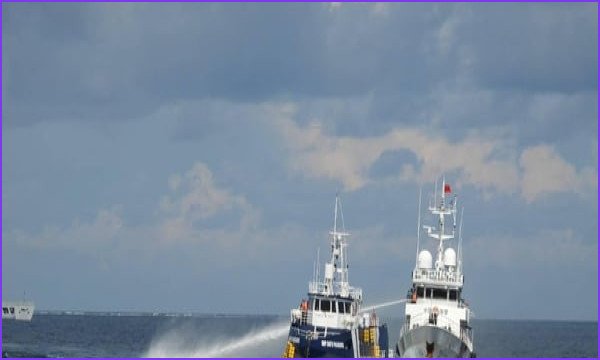
The controversy arises shortly after the Philippines marked the 10th anniversary of the South China Sea arbitral ruling, which concluded the legal case brought against China in 2013. Despite the final and binding nature of the tribunal's decision, China has consistently labeled the award as null and void. Tensions remain high in the region, where Chinese Coast Guard vessels have frequently engaged in aggressive maneuvers, including ramming Philippine ships and using high-pressure water cannons against them.
While the video was produced by a media entity, observers note that it reflects a broader Chinese narrative that dismisses the Marcos administration's actions as a mere proxy for U.S. policy rather than a response to legitimate security concerns. International support for the Philippines remains notable, with 14 nations and the 27-nation European Union recently issuing statements affirming the 2016 ruling as a landmark decision for the peaceful settlement of maritime disputes. The Philippine government warned that the continued dissemination of such dehumanizing content only serves to further deepen distrust between the two neighboring nations.
You have reached the limit of 2 free articles this month.
Last week, 14 nations issued a joint statement in support of the ruling, stating that it was “final and legally binding,” and rejecting any “destabilizing” actions in disputed waters. The 27-nation European Union also released a statement that reaffirmed the ruling as a “landmark decision in the peaceful settlement of disputes.”