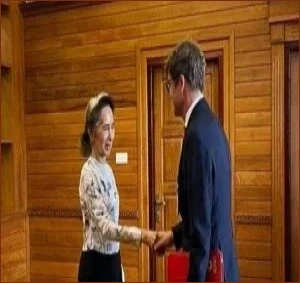
You have reached the limit of 2 free articles this month. In a rare development, Myanmar’s detained former leader Aung San Suu Kyi met with a representative of the International Committee of the Red Cross (ICRC) in Naypyidaw on August 3, 2026. The military-backed government released four photographs of the 81-year-old leader with Arnaud de Baecque, the ICRC’s resident representative to Myanmar. One image depicts the two shaking hands in a sparse, wood-paneled room containing only 2 chairs and a coffee table, while another shows the deposed leader cutting a birthday cake inscribed with the message “Happy Birthday Aunty Suu 19.6.2026.”
The ICRC confirmed the meeting, noting that it followed the organization's standard procedures for visiting individuals deprived of liberty. The visit provided an opportunity for a private conversation with the former leader. This appearance is one of the few instances the military has allowed since ousting her in the February 1, 2021, coup. Suu Kyi is currently serving a long prison term following convictions on 12 various charges, including corruption, incitement, election fraud, and violating the Official Secrets Act.
Kim Aris, the son of the detained leader, welcomed the visit as the first positive update in over five years. While characterizing it as an important initial step, Aris emphasized that it should not be the last, calling for further humanitarian progress, verified information regarding her health, and the ultimate unconditional release of his mother and all political prisoners. The Assistance Association for Political Prisoners echoed this sentiment, describing the meeting as a partial victory resulting from collective international and domestic pressure, while stressing that she remains a prisoner.
The timing of the meeting coincides with a push by coup leader and current president Min Aung Hlaing to reintegrate Myanmar into ASEAN. The 11-nation bloc has excluded Myanmar from summits since late 2021 due to the military's failure to implement the Five-Point Consensus. In 2017, I argued that while the totemic Nobel laureate was effective in rallying international opposition to Myanmar’s ruling generals, it also gave the latter an easy route. With Min Aung Hlaing scheduled to visit Thailand this week, observers view the ICRC access as a strategic effort to soften ASEAN’s stance and potentially exploit divisions within the bloc, with the eye to a possible normalization further down the line, perhaps in 2028, when Thailand will assume ASEAN’s role.
Despite these overtures, the military government has shown little willingness to make substantial concessions. Recently, the military-proxy parliament rejected the Five-Point Consensus as an interference in internal affairs, and the government previously denied a request for access to Suu Kyi by the ASEAN special envoy. Analysts suggest that providing limited access to the leader is a cost-free maneuver intended to buy time and weaken the resolve of critics, even as the military continues to hold her in custody.